
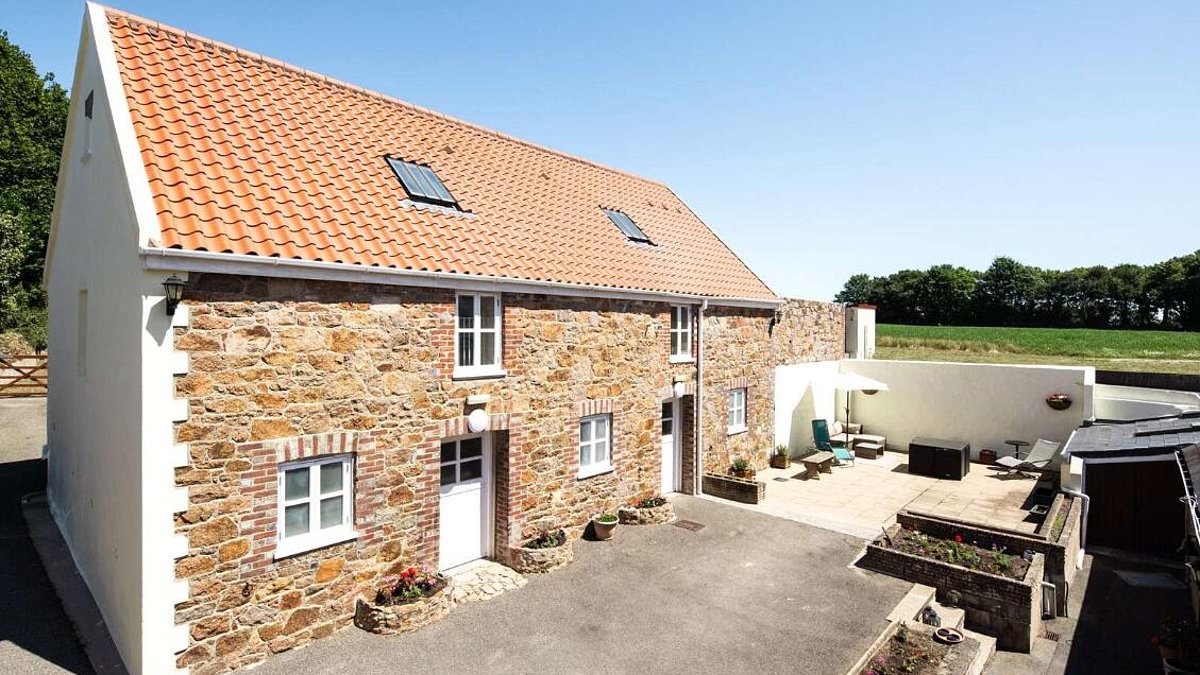
A historic farmhouse where King Charles II and his mistress are believed to have hid during the English Civil War has hit the market for £1.85million.Grade III listed La Ferme du Roi - which translates to 'The King's Farm' – stands amid the peaceful country lanes of St Brelade, Jersey and is steeped in rich history.Dating back to 1616, King Charles II and his unnamed lover were said to have sheltered at the secluded property during the English Civil War while he sought refuge in the Channel Islands.Charles, who at that time was the Prince of Wales, first fled to the island in April 1646 as Parliament's forces gained the upper hand against his father, Charles I. He stayed for around six weeks before continuing his exile in France.Following the execution of his father King Charles I in London in January 1649, Jersey became the first place to proclaim his son King in February 1649.Charles returned that September with an extraordinary entourage reportedly comprising around 300 people and more than 120 horses. The penniless king-in-exile remained on Jersey for nearly five months and officially lodged at Elizabeth Castle.The late royal was fondly known as the 'Merry Monarch' and ruled as King of Scotland from 1649 until 1651, and King of England, Scotland and Ireland from the 1660 Restoration of the monarchy until his death in 1685.Now, 380 years since he first arrived in Jersey, the historic property where the former monarch resided in secret is on sale, with a price tag of £1.85million. A historic farmhouse where King Charles II and his mistress are believed to have hid during the English Civil War has hit the market for £1.85million Grade III listed La Ferme du Roi - which translates to 'The King's Farm' – stands amid the peaceful country lanes of St Brelade, Jersey and is steeped in rich history Dating back to 1616, King Charles II (pictured) and his unnamed lover were said to have sheltered at the secluded property during the English Civil War while he sought refuge in the Channel IslandsThe property listing – which is being handled by Savills - does not identify the mistress or specify during which of Charles's two stays the couple reportedly sought shelter there.A local parish guide records that the surrounding settlement was once a fief du Roi, an estate from which the King collected the full profits.The 3,685 sq ft property contains six bedrooms, five bathrooms and three reception rooms across a main house and detached guest cottage.In the principal residence, prospective homeowners can enjoy four bedrooms and a vaulted kitchen and dining room featuring exposed granite and original wooden beams.A beamed living room includes a log-burning stove, while a home office has its own entrance.The sprawling property also features a gym and a large loft offering potential for another bedroom, studio or cinema room.In the granite guest cottage, there are two en-suite bedrooms and a bright, open-plan living space upstairs.Outside are a garage, traditional outhouse, garden store and seven Jersey vergées of land – equivalent to just over three acres.Across an estimated seven verges of land, the property also includes two large fields that are currently leased for growing Jersey Royal potatoes, with the income reportedly covering parish rates and maintenance.The land could alternatively be used for horses or livestock, while the garden offers potential for stables, additional garaging or a swimming pool, subject to planning permission.Geri O'Brien, of Savills, said: 'This is a unique property with an abundance of potential.' The sprawling property features a gym and a large loft offering potential for another bedroom, studio or cinema room. In the granite guest cottage, there are two en-suite bedrooms and a bright, open-plan living space upstairs A beamed living room includes a log-burning stove, while a home office has its own entrance. Geri O'Brien, of Savills, said: 'This is a unique property with an abundance of potential' The property listing – which is being handled by Savills - does not identify the mistress or specify during which of Charles's two stays the couple reportedly sought shelter there The 3,685 sq ft property contains six bedrooms, five bathrooms and three reception rooms across a main house and detached guest cottageBorn at St James's Palace on May 29, 1630 with his father on the throne, Charles II started his life quietly compared to what was to come.Charles was brought up by strong women — his French mother Henrietta Maria and his pretty nanny-cum-governess Christabella Wyndham, who was rumoured to have educated the teenage prince in more ways than one. As a result, he was always attracted to feisty females.By the time he was 19, Charles I had been executed at the hands of Parliament and Oliver Cromwell was ruling with an iron fist after abolishing the monarchy.The Execution of Charles I took place in January 1649, with England becoming a republic.On 5 February, the Covenanter Parliament of Scotland proclaimed Charles II "King of Great Britain, France and Ireland" at the Mercat Cross, Edinburgh.However he was refused entrance to the country unless he agreed to establish Presbyterianism as the state religion in all three of his kingdoms.After trying and failing to continue his father's royalist battle in the English Civil War, Charles was forced to flee England.Upon his arrival in Scotland on 23 June 1650, he formally agreed to the Covenant; his abandonment of Episcopal church governance, although winning him support in Scotland, left him unpopular in England. In the principal residence, prospective homeowners can enjoy four bedrooms and a vaulted kitchen and dining room featuring exposed granite and original wooden beams Outside are a garage, traditional outhouse, garden store and seven Jersey vergées of land – equivalent to just over three acres Across an estimated seven verges of land, the property also includes two large fields that are currently leased for growing Jersey Royal potatoes, with the income reportedly covering parish rates and maintenanceHis coronation led to the Anglo-Scottish war (1650–1652). Charles II was invited to restore the monarchy in 1660 after 11 years of the Commonwealth.Following his triumphant return and ascension to the throne in 1660, Charles famously took blood-soaked revenge on the men who had put his father to death.When he returned from exile in 1660, 11 years after the beheading of his father, Charles I, his primary intention was simple: he wanted to restore the glamour, splendour and power of the monarchy.He would go on to reign through the Great Fire of London and the major outbreak of the bubonic plague that preceded it.And, along the way, he was known for a particularly active love life that saw him take a string of mistresses and produce 12 illegitimate children - but no legitimate heir.King Charles II's first significant mistress was Lucy Walter, a ‘beautiful strumpet’ who had joined the court in exile in The Hague in 1648 and seduced the 18-year-old Charles. She swiftly bore him an illegitimate son, James, later the Duke of Monmouth.Neither she nor Charles were faithful, and when her promiscuity became obvious and embarrassing, he paid her off. She died of syphilis in 1658.Charles continued moving through a succession of lovers until he met the alluring Barbara Palmer in 1660. Born Barbara Villiers, as a teenager she had taken the Earl of Chesterfield as her lover and once enjoyed a ménage-a-trois with him and another girl.Another of Charles’ mistresses, the French heiress Hortense Mancini, arrived at court in 1676 with a reputation for love affairs with both men and women.Charles was pleased when Hortense became firm friends with Anne, his 15-year-old daughter by Barbara Villiers. He was less happy when he learned that Hortense and Anne, who was married and pregnant with her first child, were conducting an affair. Anne was hastily sent to the country. When Charles died in 1685, almost the last words he spoke were of the women who he had loved longest and best.
Fancy living like a King? Historic farmhouse where Charles II and his mistress 'hid during the English Civil War' hits the market for £1.85million
Full Article
Original Source
Read the full article at Dailymail →KhanList aggregates and links to publicly available news content. We do not host full articles from third-party sources. Always verify important information with original sources.