
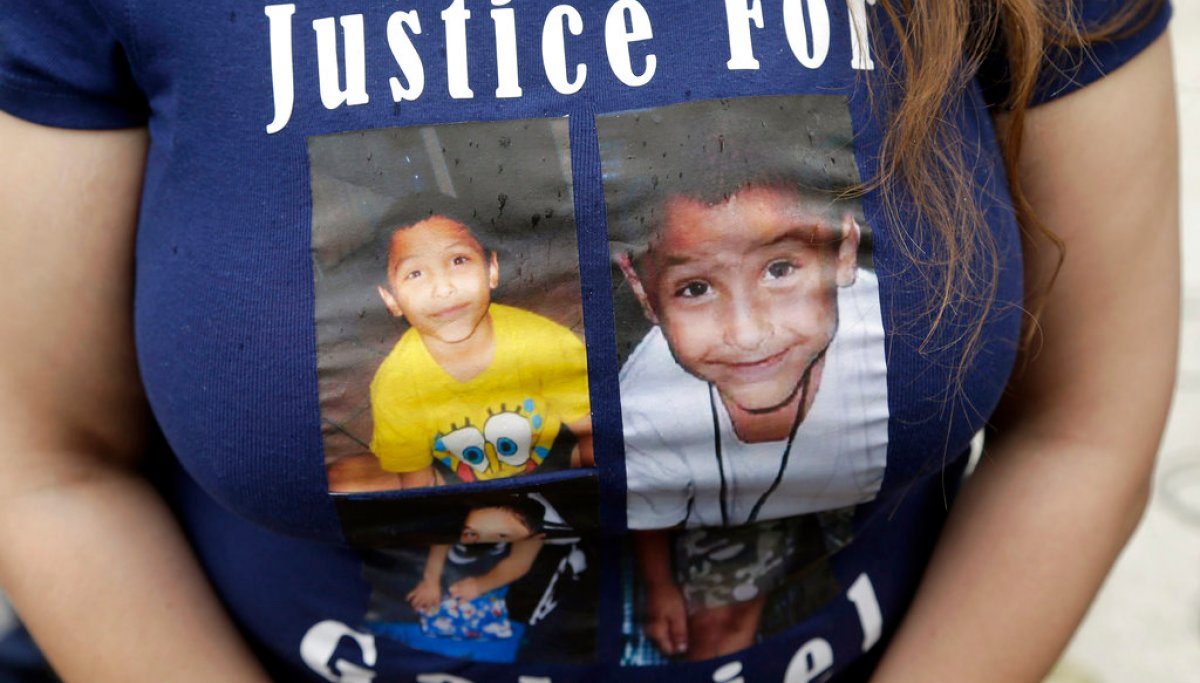
The 2013 murder of 8-year-old Gabriel Fernandez shocked California, exposing a horrifying pattern of child abuse and a succession of failures by the agencies entrusted with protecting him.Despite repeated warnings and visits from social workers, Gabriel endured months of abuse before his death on May 22, 2013, becoming the victim of one of the state’s most notorious child abuse cases.Prosecutors said Gabriel was repeatedly beaten by Isauro Aguirre, his mother’s boyfriend, because Aguirre believed the boy was gay. Gabriel suffered numerous injuries, including a fractured skull, 12 broken ribs, and burns. He was also forced to eat cat feces and his own vomit and made to sleep bound and gagged inside a small cabinet, prosecutors said. FILE – In this April 7, 2016, file photo, a friend of the family of Gabriel Fernandez, an 8-year-old boy who died in 2013, wears a shirt with his likeness in Los Angeles. (AP Photo/Nick Ut, File) Aguirre was sentenced to death in 2018, after a jury convicted him of first-degree murder and found that he had intentionally tortured Gabriel before killing him.Now, more than eight years after Aguirre’s sentence was handed down, Gabriel’s family is joining a growing campaign to challenge Gov. Gavin Newsom’s (D-CA) decision to commute the death sentences of every prisoner on California’s death row.The Criminal Justice Legal Foundation is representing members of Gabriel’s family, along with relatives of other murder victims, in a petition challenging Newsom’s sweeping clemency decision. The petition could become the first step toward a lawsuit seeking to overturn the governor’s action.The dispute is expected to take center stage Thursday afternoon, when victims’ families, law enforcement officials, and criminal justice advocates gather at the state Capitol in Sacramento to publicly challenge Newsom’s decision and outline their efforts to fight it.For Gabriel’s relatives, the issue extends beyond a debate over capital punishment. It is whether a governor can effectively rewrite a sentence imposed after a jury heard evidence of a child’s prolonged torture and determined that the crime warranted the ultimate punishment without giving the family a meaningful voice in the decision.Gabriel endured months of beatings and torture before his death in May 2013. In November 2017, a jury convicted Aguirre of first-degree murder. Jurors recommended the death penalty, and a judge formally sentenced Aguirre to death in June 2018.Gabriel’s mother, Pearl Fernandez, pleaded guilty to first-degree murder and was sentenced to life in prison without the possibility of parole. She has since twice sought resentencing, arguing that changes in state law should affect her murder conviction. Courts have rejected her efforts.Newsom’s Nov. 5 announcement threatens to fundamentally change the punishment imposed on Aguirre and hundreds of other convicted murderers, although the proposed commutations have not yet taken effect.The Democratic governor announced plans to use his constitutional clemency powers to convert all 548 death sentences in California to life imprisonment without the possibility of parole, in what would be the largest mass commutation of death sentences in modern American history.Newsom has long opposed capital punishment, instituting a moratorium on executions shortly after taking office in 2019. California has not executed a prisoner since 2006.In an open letter explaining his decision, Newsom argued that capital punishment is incompatible with California’s values and that the government cannot execute people while remaining faithful to principles of justice and human decency.He acknowledged that the decision would reopen painful memories for victims’ families.Critics say the governor’s action disregards those left behind by some of California’s most brutal crimes, as well as the juries and judges who examined the evidence and determined the appropriate punishment.The CJLF and a coalition of victims’ advocates, prosecutors, and law enforcement organizations are expected to press that argument at Thursday’s press conference.Among the organizations joining the effort are Crime Victims United, the Peace Officers Research Association of California, the California District Attorneys Association, the Chief Probation Officers of California, and the California State Sheriffs Association.The coalition argues that Newsom’s action overrides the will of California voters, who have repeatedly rejected efforts to abolish the death penalty.In 2012, voters rejected Proposition 34, which sought to eliminate capital punishment. Four years later, they rejected Proposition 62, another abolition measure, while approving Proposition 66, which sought to speed up the death penalty process.Critics say Newsom’s decision effectively nullifies those votes and the judgments reached in individual criminal cases.The legal process ahead is also complicated.Of the 548 prisoners covered by Newsom’s announcement, 382 have multiple felony convictions. Under the California Constitution, their commutations require a recommendation from at least four state Supreme Court justices. Newsom has asked the court to make its recommendations before the end of the year so he can complete the process before leaving office.The governor’s office maintains that the proposed sentence changes would not release anyone from prison, make anyone eligible for parole, or alter the underlying convictions. The prisoners would remain incarcerated for life without the possibility of parole.The administration has also said the prisoners would be excluded from new parole board commutation and resentencing regulations.For families who spent years navigating trials, sentencing hearings, and appeals, the prospect of another sweeping change has reopened wounds they say never healed.Newsom has argued that he could not justify making distinctions among condemned prisoners based on the nature of their crimes, saying doing so would create different classes of victims.GAVIN NEWSOM TURNS HIS EYE TOWARD TURKEY CLIMATE SUMMIT, SLAMMING TRUMP FOR NOT ATTENDINGHis opponents see that reasoning as precisely the problem. A decision affecting hundreds of cases, they argue, should not erase the individual circumstances of the crimes or the voices of those whose loved ones were killed.For Gabriel’s family, the question is whether the punishment imposed for a child’s torture and murder can be swept aside by a governor’s decision and whether the people who endured that loss have any meaningful say in what happens next.
Family of slain 8-year-old challenges Newsom’s decision to commute California death row sentences
Full Article
Original Source
Read the full article at Washingtonexaminer →KhanList aggregates and links to publicly available news content. We do not host full articles from third-party sources. Always verify important information with original sources.