
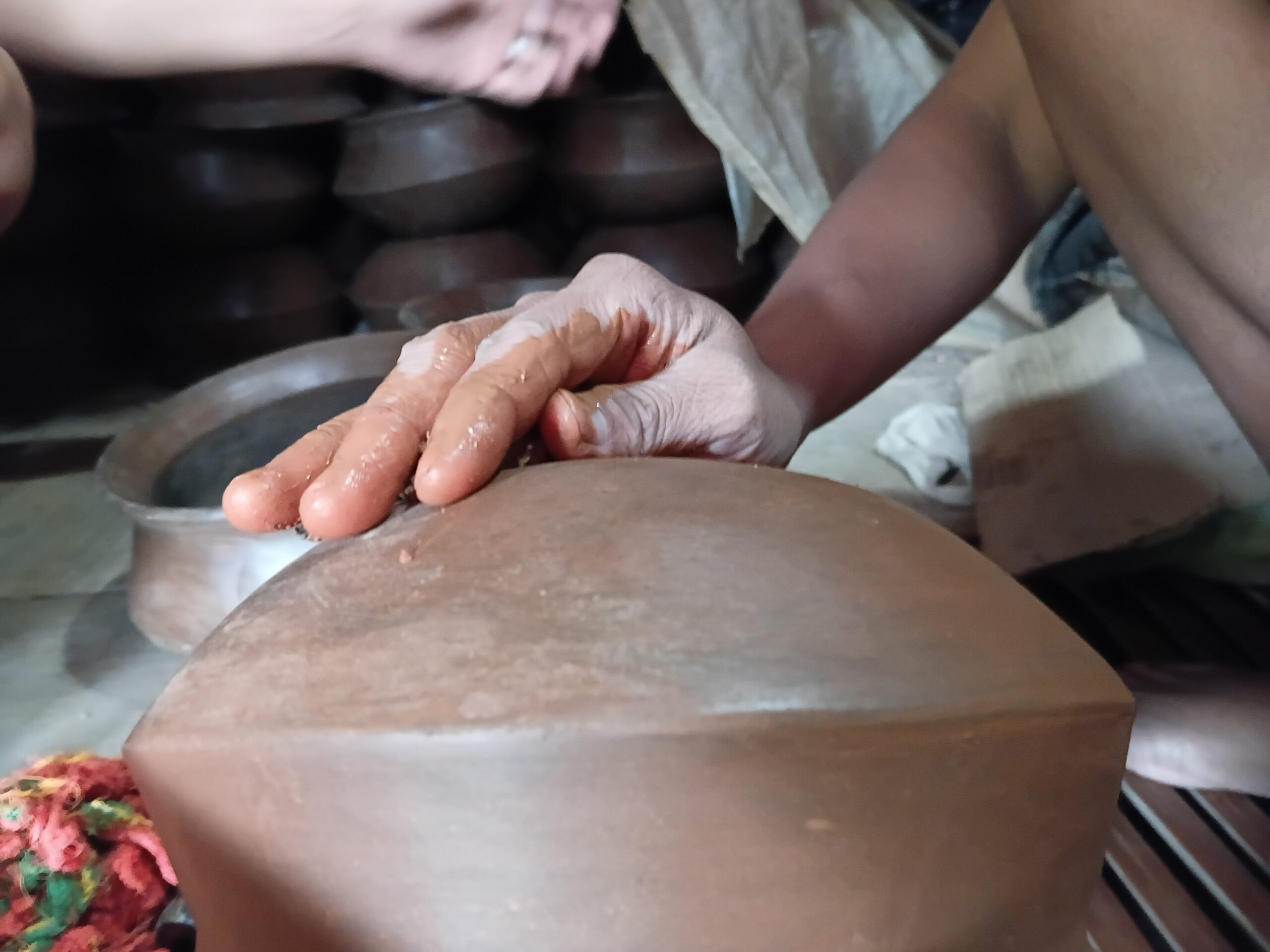
The pottery tradition in San Juan, Batangas, is at risk due to financial challenges, changing consumer preferences, and the impact of the pandemic. Cresencia Panaligan-Ilao, the oldest potter, and her family continue to practice traditional pottery techniques, but struggle with low prices and competition from mass-produced ceramics. To adapt, the family is using social media for marketing and diversifying their products, aiming to preserve their heritage while ensuring financial viability. This is AI-generated. Read the article for full context. Report any errors. BATANGAS, Philippines – A century-old pottery tradition in San Juan, Batangas, faces the risk of fading into memory. In Barangay Palahanan, however, one family remains steadfast, determined to keep this heritage alive despite the challenges of changing times. While they continue to shape earthenware by hand in makeshift workshops on sunny days, their production is frequently disrupted by the monsoon season. Lacking kilns, the potters rely entirely on sunlight to dry their clay, making prolonged rainfall a significant threat to their livelihood. This struggle is further compounded by the rise of mass-produced ceramics, which offer cheaper and faster alternatives to their traditional craft. Maintaining the custom The culture already existed even before Cresencia Panaligan-Ilao, 96, the oldest potter in Barangay Palahanan, was born. OLDEST POTTER. The oldest earthenware potter in Palahanan continues to preserve the community’s traditional pottery-making practices through decades of skill, experience, and dedication, serving as a living testament to the area’s rich cultural heritage. All photos by Christian F. Patulot/Rappler “I started making pottery back when I was 12 years old. Before that, my mother taught me to do this,” Ilao said. Palayukan, the pottery culture in San Juan, Batangas, took root as a communal livelihood during the Japanese Occupation but bloomed as commercial work in the late 1950s. Before making the earthenware, potters harvest luad (clay) from nearby riverbanks, grinding it down by foot or with electric grinders before kneading it with water into a smooth, workable dough. Artisans use the traditional paikot method where they spin the clay on a labbi-an, a potter’s wheel made of rock, using delicate hand pressure without relying on electricity. They shape the vessel with the aid of a traditional wooden beater called pamalo. After forming the base of the pots, the potters form the mouth of the earthenware. AN ARTISAN’S WORKSHOP. The humble workspace of a potter in Barangay Palahanan, San Juan, Batangas, tells the story of a living tradition. The newly shaped wet pots are air-dried under the sun to remove the initial moisture and harden the structure since the artisans do not own a pugon (kiln). The craft was passed down from mother to daughter, and sometimes the skills were inherited by a daughter-in-law if there was no one else to receive them. The passing of tradition was not the biggest problem, Ilao emphasized. “It was the fact that the money we earn in doing this is not enough.” In a study by the University of the Philippines Los Baños, pottery sales in San Juan declined significantly when the pandemic struck in 2020. Since then, the financial challenges have become more severe as customer demand continues to decrease. Despite these dwindling returns, it is Cresencia’s daughter-in-law, Lutgarda Cueto-Ilao, 76, who continues to shoulder the family’s pottery tradition. A DAUGHTER’S PROMISE. Lutgarda Cueto-Ilao handcrafted a clay pot using traditional pottery techniques as a vow to keep the legacy that her late mother gifted. Since Cresencia stopped making pots as a livelihood two years ago due to old age, Lutgarda is now the only elder who creates handmade pots in Barangay Palahanan. “I wake up at 8 am to start making pots,” Lutgarda said. Due to the extensive process, it takes four to five hours to create a fully finished handmade earthenware. “Our craftsmanship is our pride,” she added, “but we sell our raw pots for a very cheap price to retailers.” “Carrying this tradition also means carrying the burden that comes along with it,” Lutgarda said. “Because this craft is something special to us, but also because this is the only way we survive.” “The small ones are sold for P30, the medium ones are sold for P50, and the larger ones are sold for P80 to P100,” she added. With an initial capital of P1,500, a significant amount goes toward paying three workers who collect the clay, each earning P300. Another P300 was spent on 50 sacks at P6 each, while the remaining P300 goes to renting a jeep to transport the clay. By the time the clay reaches the workshop, the entire capital has already been spent. “We tried asking for a raise when we sell the pots, but the retailers won’t buy our products because they said it is too expensive,” Lutgarda said. In the market, however, retailers who bake the raw pots in kilns sell the finished earthenware for a much higher price. Finding a market beyond Palahanan For the next generation, keeping the tradition alive may require more than simply continuing the old ways. Monique Ilao-Alvarez, 26, Cresencia’s great-granddaughter, has begun using social media to promote the family’s pottery. “I started using social media as a marketing tool to promote our traditional craft,” Alvarez said. For generations, the family’s products were promoted largely through word of mouth and local retailers. Alvarez believes that approach is no longer enough as customers increasingly discover and purchase products through digital platforms. By promoting their earthenware online, the family hopes to reach customers outside their local community and introduce younger consumers to San Juan’s pottery tradition. “The market keeps changing, so we have to adapt to stay competitive,” Alvarez added That adaptation also includes making products based on changing demand. Aside from their traditional pottery items, Alvarez said her mother now produces takip ng paso, or pot lids, as demand for them grows. The changes do not mean abandoning the family’s traditional methods. Instead, the family is looking for ways to make the craft more viable while retaining the knowledge handed down through generations. The question is whether those efforts will be enough. For the Ilao family, pottery is more than a product. It is a skill learned from parents, a livelihood sustained through decades, and a link to the community’s history. But heritage alone cannot pay for clay, transportation, labor, or food. As the family searches for new customers and new ways to earn from the craft, Alvarez remains determined to keep the tradition alive. People can support the San Juan pottery industry by purchasing authentic earthenware directly from local potters and promoting their products through social media. “We can’t let this craft die,” Alvarez said.– Rappler.com Quotes have been translated into English for brevity. Christian F. Patulot is a poet-journalist, essayist, researcher, and a Mover based in Batangas. He writes about culture, language, and the everyday experiences of Filipinos.
Family in Batangas persists to keep generations-old pottery tradition alive
Full Article
Original Source
Read the full article at Rappler →KhanList aggregates and links to publicly available news content. We do not host full articles from third-party sources. Always verify important information with original sources.