
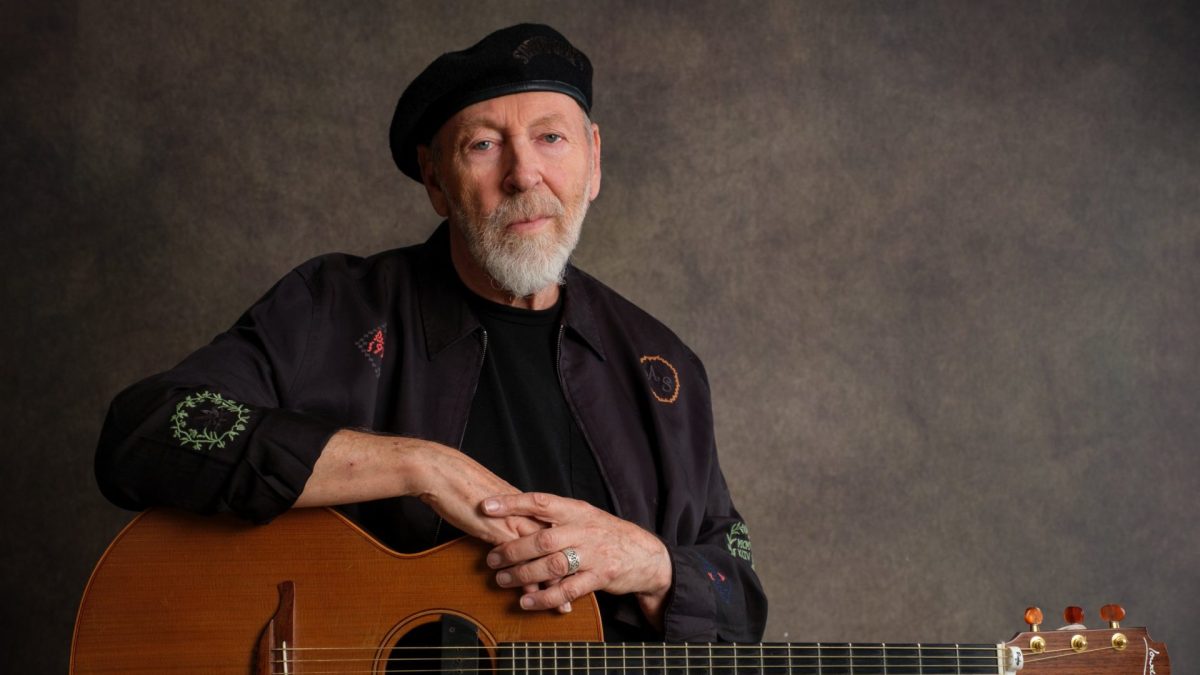
The British folk legend Richard Thompson has just released Hippies, Thugs and Heroes, the 20th solo album of his six-decade career. “I’m not counting,” he says, before stopping to think. “Only 20? That’s not very good.” But then he remembers. “Well, five albums with Fairport Convention,” he says of the pioneering folk-rock band he formed in 1967, where he forged his reputation as one the country’s most innovative guitar players. “Five albums with my ex-wife,” he says of the emotionally charged folk-orientated records he made in the 1970s with Linda Thompson. “So it’s bit more than that, actually. But I would hope that people will be able to see progress, an evolution from my first solo record,” he says of 1972’s Henry the Human Fly. “I’d go back and do things differently on that one. It’s eccentric. I realise either I was or I still am an eccentric person,” he says with a laugh. “I certainly was then. But I’m pleased with the new one. I think it turned out really well. So I don’t need to redo it just yet.” Thompson is now 77, and seems less eccentric these days. He is polite and considered on video call from north London, not far from where he grew up in Highgate, a child of the suburban post-war years who used musical expression to navigate his mid-’60s coming-of-age. He was just 17 when he formed Fairport Convention with a simple if weighty aim of changing the trajectory of folk by contemporising traditional music, rejecting the prevailing Americanisms of popular music and imbuing an archetypical Britishness. Briefly fronted by the singer Sandy Denny, Fairport Convention set the template for folk-rock as we know it.Dave Pegg (left) and Richard Thompson performing with British folk-rock group Fairport Convention at the Bath Festival, 1970 (Photo: Michael Putland/Getty Images) “We said that this is going to be our thing. We’re inventing a genre of popular music. Nobody’s done this before. And why not? There’s people who say the tradition is the tradition; you should be singing it with your finger in your ear sitting backwards on a chair. [Folk musician and left-wing activist] Ewan MacColl was a bit of a curmudgeon in that way. Well, screw that.” Thompson’s subsequent catalogue has become one of the most cherished in folk, with darkened songs of ne’er-do-wells, the desperate and the lovelorn matched to transcendent guitar solos and occasional eclectic ventures into everything from rockabilly to flamenco – in 2003, he even covered Britney Spears’s “Oops!… I Did It Again”. Though he’s never been a bestseller, he has awards (an Ivor Novello for contribution to British songwriting; a BBC Radio Lifetime Achievement Award), accolades – his 1991 track “1952 Vincent Black Lightning” was named one of Time magazine’s top 100 songs in 2011 – and an OBE awarded in 2011, with devotees who have covered his songs including Robert Plant, Elvis Costello, REM, David Byrne and Mark Ronson. And he remains driven by his initial ideals. “I’m still on a mission to make it sound not overly American. I like the idea that you express your own culture where you come from.” Yet, ironically, he’s lived in America for much of the last 35 years; he currently lives in New Jersey with his third wife, the singer Zara Phillips, who adds backing vocals to Hippies, Thugs and Heroes. Has he made a deliberate effort not to absorb any American influence? “Conscious,” he says straight away. “I’ve always had a place in London, too. So culturally, I’m still immersed in Britain, and I can shut out all the American stuff. It doesn’t interest me particularly. I’m not going to start making Beach Boys records.” Richard Thompson in London, January 1974 (Photo: Michael Putland/Getty Images) Thompson remains a contemporaneous figure – the gritty, dark Hippies, Thugs and Heroes continues an excellent run of form that began with 2018’s 13 Rivers to 2024’s Ship to Shore – yet talking to him feels like talking to a piece of folk history. While mainly an observer – “that is the place of the artist: you’re not in society – you’re always out on the edge, looking inwards” – Thompson and Fairport Convention’s origin story took place in the psychedelic London underground scene of the mid-to-late ’60s, “where Pink Floyd play you songs that last half an hour” and Thompson saw plenty of ’60s lore: he befriended Pink Floyd, Nick Drake and John Martyn, jammed with Jimi Hendrix, watched The Rolling Stones record “Sympathy for the Devil” and saw Yoko Ono’s performance art (with John Lennon also in attendance) at 1967’s legendary 14-Hour Technicolour Dream event at Alexandra Palace. “It felt like something different,” he says of London at that time. “It did feel a new generation emerging. There was a lot of drugs around, and acid was clearly a cultural changer. Not always in a good way, but it certainly changed people’s perspective.” But even with his spiritual awakening and 1974 conversion to Sufism, a mystical dimension of Islam that he still practices today, tragedy and personal conflict blighted those early years. His relationship with wife Linda, whom he met in 1969, married in 1972 and divorced in 1968, disintegrated as they moved to an electricity-less rural Sufi community in East Anglia with their young children, with adultery on Thompson’s part and a final disastrous tour together in 1978 known by fans as The Tour from Hell. They have been on good terms for some time now, singing onstage together at the concert for Thompson’s 70th birthday at the Royal Albert Hall in 2019, though Thompson politely stonewalls questions about Linda with answers that go off on only vaguely relatable tangents. Richard Thompson at The Barns at Wolf Trap in Vienna, Virginia on March 10, 1992. (Photo: Ebet Roberts/Redferns) Thompson is much more expressive about the tragic event of his life: the road accident in May 1969 that killed Fairport drummer Martin Lamble, who was just 19, and Thompson’s then-girlfriend of two weeks, fashion designer Jeannie Franklyn. Thompson was in the van, the band driving home to London late at night after a gig in Birmingham. Thompson survived (with broken ribs), as did guitarist Simon Nichol and roadie Harvey Brahman, who fell asleep at the wheel. Thompson, who tried to take the wheel to avoid hitting a post as the van careered off-road, recalls in his 2021 memoir Beeswing crawling bloodied to Franklyn laying roadside, and testing for a pulse he couldn’t find. “We did not deal with it,” he says now. “There wasn’t a mechanism. If it happened now, they put you in therapy. But it was close enough to World War Two that everyone said, ‘Come on, pick yourself up, let’s get on with life.’” Their attempt to do so was to immediately throw themselves into making 1969’s classic fourth album Liege and Lief. “We were in shock and we were grieving for about the next two years. Why did people leave the band?” he asks rhetorically: bassist Ashley Hutchings quit and Denny, who died in 1978 aged 31, was sacked before the album was released; Thompson quit the band in 1971, ostensibly to write his own material (Fairground are still going today). (L to R) Fairport Convention’s Richard Thompson, Sandy Denny, Simon Nicol, Martin Lamble and Ashley Hutchings (Photo: Gems/Redferns) “It wasn’t necessarily smart decisions. It was because there was stuff we couldn’t deal with. When Ashley left the band, he had a nervous breakdown. When I left the band, I should have really thought very hard about that because it didn’t land me in a comfortable place. When Sandy left the band, she was so traumitised.” Does he feel like he has dealt with it now? “Collectively, we’ve talked about this now, myself, Ashley and Simon. We still think about Martin. A few days go by when we don’t think about it, but we still think about it.” Beeswing was a reflective memoir that dealt with the years from 1967-1975; the songs on Hippies, Thugs and Heroes have a certain nostalgic bent to them, containing what Thompson describes as a “motley cast of characters” drawn from his past. I wonder if the process of writing the book influenced the album? “Maybe yeah,” he says hesitantly. “I think writing the memoir was interesting because it did force me to look at the things that I shut away. You know, uncomfortable things. And having done that, then you don’t want to shut them away again. You want to keep them current and keep them living with you. Plus, I think that your brain does it to you anyway. When you get to 70 something, you can’t remember what you had for breakfast, but suddenly you remember being seven years old, in a sunlit garden or something. That becomes a louder memory.” Some tracks are more detached, fictionalised take on events, such as outlaw ballad “Stringer”, based on the Brighton post-war gangsters as depicted in Brighton Rocks by Graham Greene. But others are more personal. “The Big Smoke” is “about my granny,” Thompson “putting myself in her shoes” and imagining what her life was like when she first moved from the Isle of Skye to Glasgow. “The Sorcerer’s Apprentice” is about a shady cult leader. “That’s a real character that I knew in the 70s who was an actor, who became a kind of religious leader and went a bit rogue. I was part of the same group for a while, and he clearly overstepped the line and lost a lot of his followers.” “Cocaine Walking, Booze Talking” again looks back to the ’60s. “It’s really those people who might have been a bit aggressive or edgy or violent, then they drop acid, and then this other person emerges, this peace and love person. And then after a few years, that wears off a bit, and they’re like two people. They can’t decide who they are. I think John Lennon was a bit like that. There’s this internal battle inside that kind of person.” Thompson remains creatively impatient. “You never stop learning as a musician. If you stop learning, you’re dead.” Despite previously hinting this could be his last album, it’s nothing of the sort: he’s already thinking how the next one will look, and has ambitions to put on a musical. “It’s true,” he smiles, “I don’t know when to stop.” ‘Hippies, Thugs and Heroes’ is out now. Richard Thompson tours the UK from 27th April
Fairport Convention’s Richard Thompson on the crash that killed his bandmate
Full Article
Original Source
Read the full article at Inews →KhanList aggregates and links to publicly available news content. We do not host full articles from third-party sources. Always verify important information with original sources.