
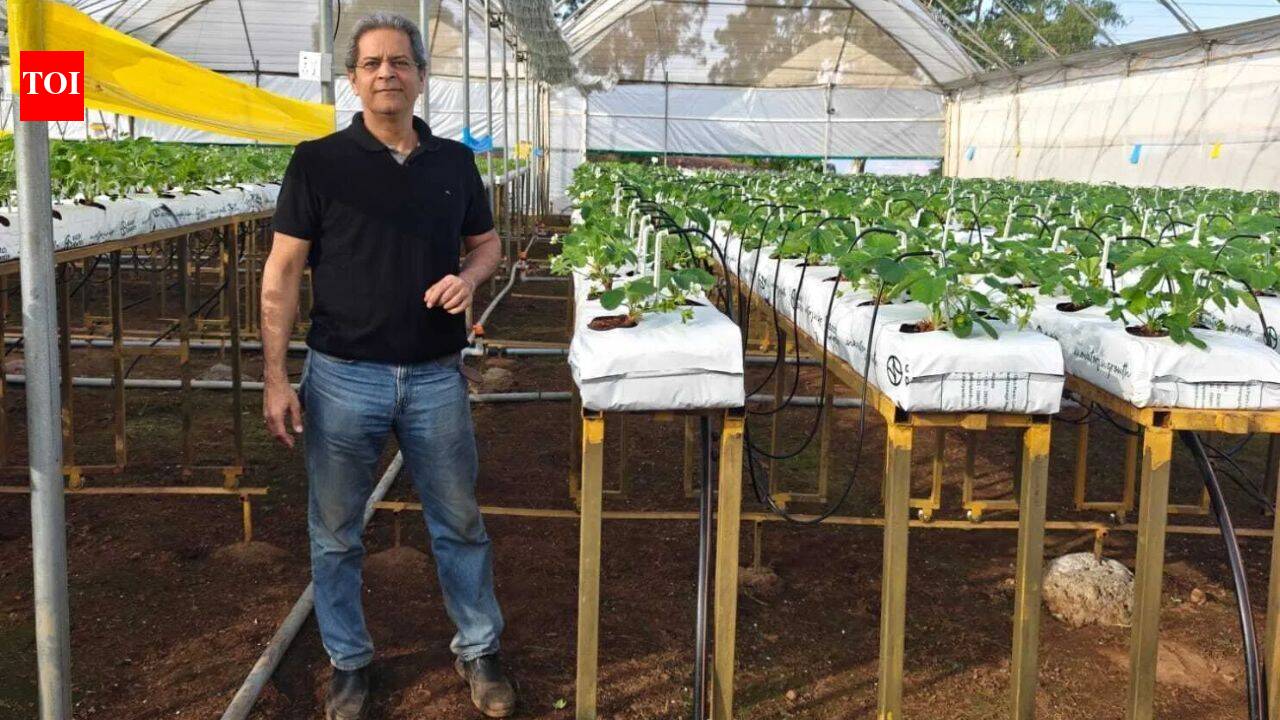
A failed harvest can make a first-time farmer question whether he has chosen the right path. For 57-year-old Ketan Sodha, however, his first unsuccessful attempt at growing strawberries in Mahabaleshwar became the beginning of a much bigger experiment.A fourth-generation Mumbaikar from a business family, Sodha had no farming background when he decided to explore strawberry cultivation in 2016. His initial attempt with 5,000 plants ended in disappointment. But instead of abandoning the idea, he studied the crop, learnt from experienced growers and gradually changed his approach.Nearly a decade later, his venture, Berry Fresh Agrotech LLP, has a soilless strawberry farm in Mahabaleshwar, Maharashtra. Using a protected growing structure, cocopeat and an automated system to supply water and nutrients, he has been able to grow strawberries beyond the traditional season. According to a report by The Better India, the farm produced approximately 8,000 kg of strawberries and generated around Rs 44 lakh in sales between January 2024 and December 2025. His journey is an example of how a failed beginning, combined with experimentation and patience, can lead to a different way of farming.From a Mumbai business to a failed strawberry experimentSodha did not grow up around farms. He completed his BCom from KC College, Mumbai University, and spent years working in the agricultural land business, connecting landowners with potential buyers across Maharashtra. His interest in Mahabaleshwar developed during his frequent travels through the region. The cooler climate and surroundings appealed to him, and he began considering strawberry cultivation around 2012-13.In 2016, when demonetisation affected his existing business, he decided to try something new. He purchased 5,000 strawberry plants from a local farmer and began cultivating them. However, his first year was a disaster. Rather than giving up, he increased the number of plants to 10,000 in 2017. The results improved, and his name gradually became known among local growers. He later entered partnerships and expanded his cultivation operations across several locations. By the 2020-21 season, he was managing nearly 40 acres across three sites. But expanding the farm also made him realise that the biggest challenge was something he could not control easily: the weather.How unpredictable weather pushed him towards soilless farmingMahabaleshwar is one of India's best-known strawberry-growing regions. However, conventional strawberry cultivation depends heavily on seasonal weather. Unseasonal rainfall during November and December can damage plants, increase the risk of fungal diseases and delay harvesting by 15 to 20 days. The other limitation is that open-field strawberry cultivation generally stops during the summer and monsoon months because of rising temperatures and heavy rainfall.Sodha wanted to find a way to overcome these limitations. In 2021-22, he travelled to Italy, Spain, Egypt and Turkey to understand how farmers in other countries were growing strawberries. He also interacted with hydroponic growers, nursery owners and agricultural consultants from countries such as Israel, the UK, New Zealand, Australia and the US. However, he realised that farming techniques successful abroad could not simply be replicated in India. Local weather conditions, water availability and other agricultural challenges required a different approach.He eventually decided to establish a protected, soilless cultivation facility suited to Mahabaleshwar's climate. His company, Berry Fresh Agrotech LLP, was incorporated on October 14, 2022. The new cultivation facility began operations in November 2024.Inside his 19,500-plant strawberry farmAfter searching for suitable land, Sodha leased two acres and developed a 1,500-square-metre polyhouse with the capacity to accommodate 19,500 strawberry plants. Unlike conventional farming, where plants grow directly in the ground, his strawberries are cultivated in cocopeat, a growing medium made from coconut husk. This method helps reduce the risk of soil-borne diseases and allows better control over the growing environment.The farm uses a retractable-roof polyhouse, a misting system and automated fertigation. Fertigation is a process through which water and essential nutrients are delivered to plants together. According to Sodha, each plant receives approximately 75 ml of nutrient solution over 24 hours. The farm also collects rainwater, stores it and treats it with ozone before using it for cultivation. However, setting up the facility was not easy. The polyhouse took more than six months to complete, while the irrigation and automation systems required several repairs and adjustments.Sourcing specialised fertilisers suitable for soilless cultivation was another challenge. Sodha and his team eventually learnt to inspect, repair and manage much of the equipment themselves instead of depending entirely on outside technicians. He also began experimenting with different international strawberry varieties to identify those that could perform well in Indian conditions. The farm is currently conducting trials involving 19 varieties from countries including the US, Spain, Italy, Uruguay and Japan.From 8,000 kg of strawberries to plans for expansionThe experimentation has started reflecting in the farm's production and sales figures. According to The Better India, Berry Fresh Agrotech produced approximately 8,000 kg of strawberries and generated around Rs 44 lakh in sales between January 2024 and December 2025. The farm reportedly recorded an average yield of 408 grams per plant, with production of approximately 3.2 kg per square metre.Its strawberries are sold at around Rs 400 to Rs 600 per kg, depending on the customer and order. The business follows both business-to-business (B2B) and direct-to-consumer (D2C) models, with customers across Mumbai, Delhi, Bhopal, Ahmedabad, Indore, Udupi and Goa. Much of its customer base has developed through word of mouth rather than extensive social media marketing.Buyers have appreciated the fruit's colour, sweetness, aroma, uniform shape and shelf life. Some have also highlighted the consistency of the produce during months when conventionally grown strawberries are not readily available. Sodha is now looking beyond his existing facility. He is in discussions with investors for a proposed five-acre farm with a capacity of approximately 2 lakh strawberry plants. His larger ambition is to develop a model that can eventually be replicated in other parts of India with suitable climatic conditions.For someone whose first strawberry crop failed and who had no previous farming experience, the journey has involved years of learning, experimentation and rebuilding. Interestingly, Sodha also finds something beyond business in his new profession. Having spent most of his life in Mumbai, he says the peaceful surroundings, fresh air and natural beauty of Mahabaleshwar have become an important part of his life. His story is not simply about growing strawberries without soil. It is about questioning conventional methods, learning from failure and finding new possibilities in an agricultural practice that has remained largely seasonal.
Failed strawberry crop turns into Rs 44 lakh soilless farming success
Full Article
Original Source
Read the full article at Timesofindia →KhanList aggregates and links to publicly available news content. We do not host full articles from third-party sources. Always verify important information with original sources.