
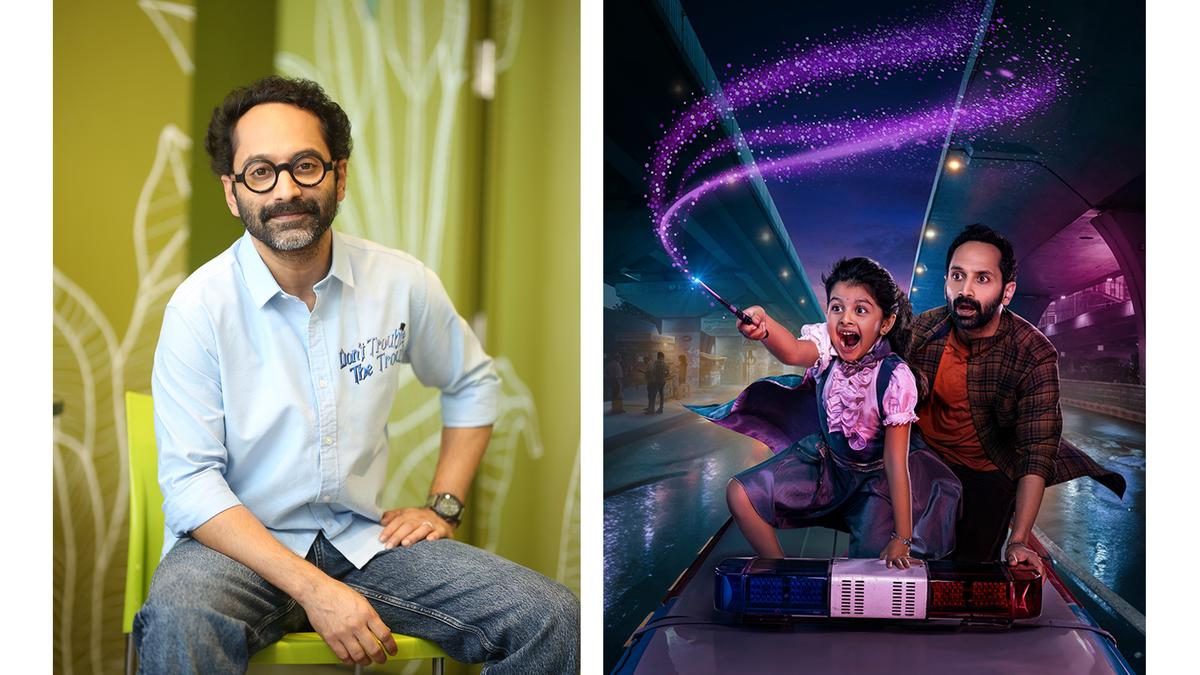
It is rare to see actor-producer Fahadh Faasil partake in media interactions. “I have been hearing this a lot,” he says with a laugh, when he walks in to meet a small group of journalists at the production house, Arka Media Works’ office in Hyderabad. His new Telugu film, Don’t Trouble The Trouble, is poised to release on October 2. “It feels as though this is my first (Telugu) film. So I wanted to come and introduce myself,” Fahadh says.But Fahadh is no stranger to Telugu cinema. He became a household name portraying the antagonist, Bhanwar Singh Shekawat, in the Pushpa films. There is also a loyal tribe of cinephiles who turn up in theatres to watch his Malayalam films in Hyderabad. A case in point is the cheer with which Aaveshamwas received in the city. He nods in acknowledgement and says, “I hope people similarly receive Don’t Trouble The Trouble (DTTT).”DTTT, written and directed by Shashank Yeleti and co-produced by SS Karthikeya and Shobu Yarlagadda from the Baahubali team, gets its title from a famous dialogue by actor Balakrishna. “There’s something in the story that spells trouble, hence the title,” says Fahadh. The Telugu trailer has a voiceover by Balakrishna.Two scripts a yearFahadh reveals that on average, he listens to only two script narrations a year. “Karth (SS Karthikeya) called and said they had something interesting. The story was fresh. Back home in Malayalam cinema, the drama is subtle. In this, there are elements of magic and fantasy woven around the core idea of concern and love. I did not want to miss this opportunity.” SS Karthikeya, Fahadh Faasil and Shashank Yeleti | Photo Credit: Special Arrangement The film was shot across 79 locations, including crowded pockets of Cyberabad and Hyderabad’s industrial exhibition, the Numaish. Fahadh is aware of the fun reels put up by a few movie buffs who watched the shooting. “Almost all my Malayalam films have been shot on location. Pushpa is a rare film I shot on a set. I enjoy filming on location and the production took care of crowd control.”DTTT revolves around Fahadh’s character named Suri, child actor Ssara Palekar and a beagle. A mention of magical powers and invisibility may evoke memories of Mr India. Fahadh describes it as “a kids’ film for grown-ups. I hope the film can make people realise a few things they had neglected at some point in their lives.”Filmed in Telugu, DTTT will also be released in Malayalam and Tamil. Learning his Telugu lines, he admits, required effort. “I think in Malayalam, translate it into English and then perform in Telugu. So this process isn’t smooth. On screen, I wanted to come across as someone who thinks and speaks the language. I turned to Shashank and Karthikeya for help and enjoyed the process.”Fahadh also credits child actor Ssara for being “in the moment and improvising her lines”, and music composer Kaalabhairava. “His music works like another important character in the film.” In the wake of a recent interview by actor-director Prithviraj Sukumaran, there has been considerable discussion about Malayalam cinema giving due importance to writers, unlike other film industries. Fahadh responds, “I have always believed that writers are more important than actors. I rely equally on the writer and director; both have to work in tandem. In DTTT, I had several discussions with Shashank since he is both the writer and director.”Of writers and thinking bigAsk him if there is something Malayalam cinema can pick up from Telugu and Tamil cinema, and he says, “Malayalam cinema can learn from these industries, especially Telugu, on how to take a film to a bigger audience. A lot of planning is involved. I learnt a few things from Arka and hope to explore this for some of my films.” Fahadh Faasil and child actor Ssara Palekar in the film | Photo Credit: Special Arrangement As a producer, he is pleased with the reception to Bethlehem Kudumba Unit. He knew intuitively that the film would be received well, but was surprised by the overwhelming response. His trust in director Girish A.D. is evident when he speaks about the film and their earlier collaboration on Premalu. “I do not always go by the script, since I think there must be some room for change. I am particular about the structure: the beginning, middle and the end. During Premalu, as the film progressed Girish would show us the footage and we would all discuss.” Fahadh equates producing a film to playing a cricket match. “We don’t know if we will win but it’s fun to play the game.”The intuitionHe states that many a time, actors and directors can gauge if things are on track. He says he could sense Patriot was not shaping up as expected. “There are times when we are all aware but helpless. As artists, we can only be honest to what we are doing.”Collaborations: Kamal Haasan and VadiveluNavigating between Malayalam, Tamil and Telugu cinema and collaborating with established actors in these film industries, Fahadh says he is constantly looking to learn from others and up his game. “During Vikram, I observed how Kamal sir performs and interacts with his co-stars. There’s always something to learn.” In the initial stages of Mamannan, when he learnt that director Maari Selvaraj was keen to cast Vadivelu, he was insistent that the actor be on board. “I studied in Ooty and thanks to my school friends, had some exposure to Vadivelu sir’s comedy. One of the most exciting aspects of Mamannan was to work with him.”In the case of DTTT, he was invested in the journey of his character from grey to white. Having spent more than a year in Hyderabad, he speaks warmly about forging friendships and gaining confidence to dub in Telugu. “I am used to sync sound (live) recording in Malayalam films. Here, though we dubbed, I insisted there be no prompting on sets. The silence on sets helps us focus better.”Post DTTT, Fahadh will be working on another film produced by Arka Media.Having completed 24 years in cinema since his debut in September 2002, Fahadh reminisces about how he did not aspire to be an actor or director, despite his father Fazil being a reputed director in Malayalam and Tamil cinema. “My first film flopped, after which I went to the US on a scholarship to study engineering. I dropped out and pursued philosophy. The pain of losing and going away bothered me. I returned after six years, during which I met so many people who introduced me to great books and world cinema. I wanted to do one successful film. I’ve continued for more than 60 films.”
Fahadh Faasil interview: ‘Don’t Trouble The Trouble’ is a kids’ film for grown-ups
Full Article
Original Source
Read the full article at Thehindu →KhanList aggregates and links to publicly available news content. We do not host full articles from third-party sources. Always verify important information with original sources.