
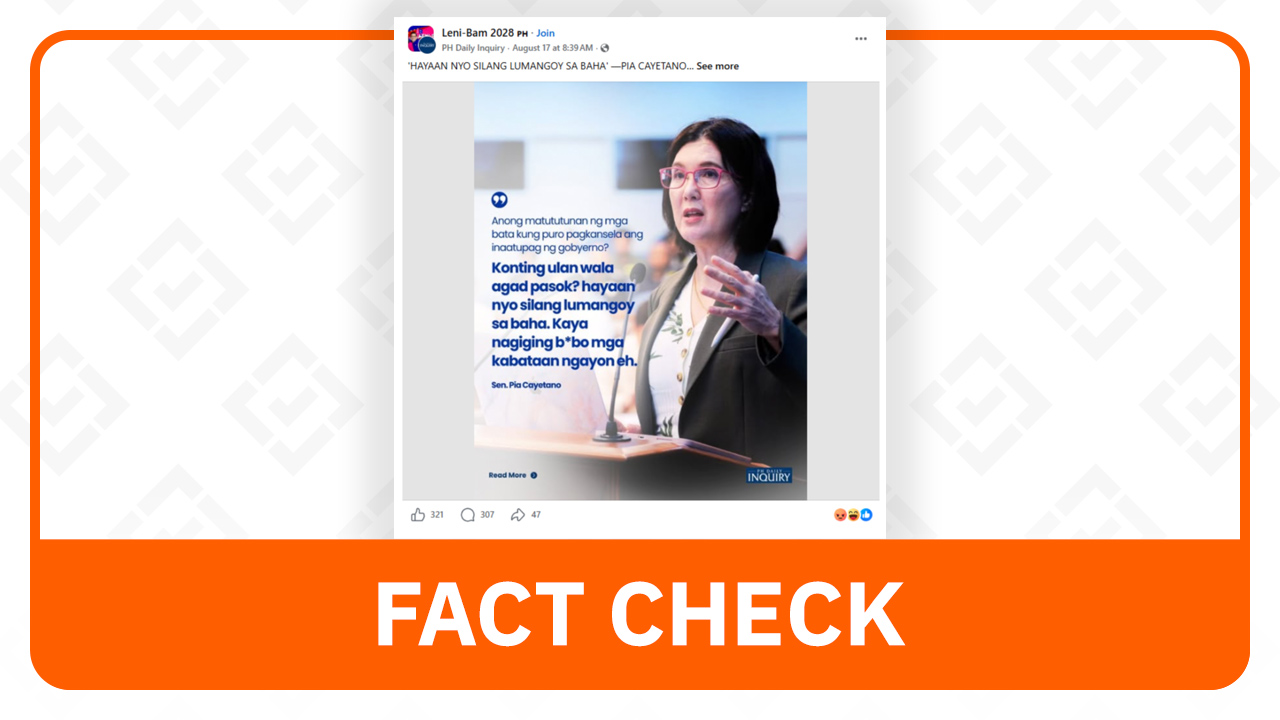
The fake quote attributed to the senator stemmed from recent class suspensions caused by the southwest monsoon, or habagat, which brought intense rain and flooding to multiple areas across the Philippines Senator Pia Cayetano did not make the statement suggesting students swim through floodwaters to attend classes; this claim is false. The fabricated quote originated from a TikTok post by PH Daily Inquiry, which has a history of sharing misleading information. Cayetano was actually sharing safety precautions related to the southwest monsoon and class suspensions, not making derogatory comments about students. This is AI-generated. Read the article for full context. Report any errors. Claim: Senator Pia Cayetano said that frequent class suspensions are affecting students’ education, and suggested that they should swim through floodwaters to attend classes. Rating: FALSE Why we fact-checked this: The quote stemmed from the TikTok account of PH Daily Inquiry uploaded on August 17. The account has around 1,000 followers, with the post garnering 240,100 views, 9,291 reactions, 519 comments, and 6,287 shares, as of August 26. It is their most popular post on TikTok. The post attributes the following statement to Cayetano: “Anong matututunan ng mga bata kung puro pagkansela ang inaatupag ng gobyerno? Konting ulan wala agad pasok? Hayaan nyo silang lumangoy sa baha. Kaya nagiging b*bo mga kabataan ngayon eh.“ (What will children learn if the government keeps canceling classes? A little rain, and classes are immediately cancelled? Let them swim in the floodwaters. That’s why today’s youth are becoming stupid.) The account is also present on Facebook, where it shared the same post on various political Facebook groups. The group post with the highest engagements had 321 reactions, 307 comments, and 47 shares as of writing. The facts: The statement is completely fabricated. There are no records of Cayetano making these statements or using provocative language towards students in any reputable news reports, official statements, or verified social media accounts. The fabricated post surfaced online on August 17, amid frequent class suspensions in public and private schools across Metro Manila and other nearby provinces brought about by the effects of the southwest monsoon or habagat. On the same day, Cayetano shared a post from ABS-CBN’s weather report, urging the public to take extra precautions for their safety. Frequent class suspensions: The fake post surfaced at a time when in-person classes were disrupted for several days due to the inclement weather. Class suspensions were declared between August 17 and 20 due to the effects of the southwest monsoon, mainly enhanced by Tropical Depression Neneng, which brought moderate to intense rain in various provinces in Luzon and parts of Visayas. Two other tropical depressions contributed to the enhancement of the southwest monsoon. These combined atmospheric conditions triggered the persistent rains, thunderstorms, and, in some areas, heavy floods that led to successive class cancellations in several provinces. The Department of Education said over 6.5 million students were affected by the inclement weather. Debunked: PH Daily Inquiry has also previously been flagged for posting another fabricated quote attributed to television host Bianca Gonzales. – Lance Ariel Bustos/Rappler.com Lance Ariel Bustos is a campus journalist from Santa Rosa City, Laguna, studying Political Science and Philippine Media Studies at De La Salle University Manila. An Aries Rufo Journalism Fellow for 2026, he is also the intermedia editor of The LaSallian. Keep us aware of suspicious Facebook pages, groups, accounts, websites, articles, or photos in your network by contacting us at factcheck@rappler.com. Let us battle disinformation one Fact Check at a time. How does this make you feel? Loading
FACT CHECK: Pia Cayetano quote on recent class suspensions is fake
Full Article
Original Source
Read the full article at Rappler →KhanList aggregates and links to publicly available news content. We do not host full articles from third-party sources. Always verify important information with original sources.