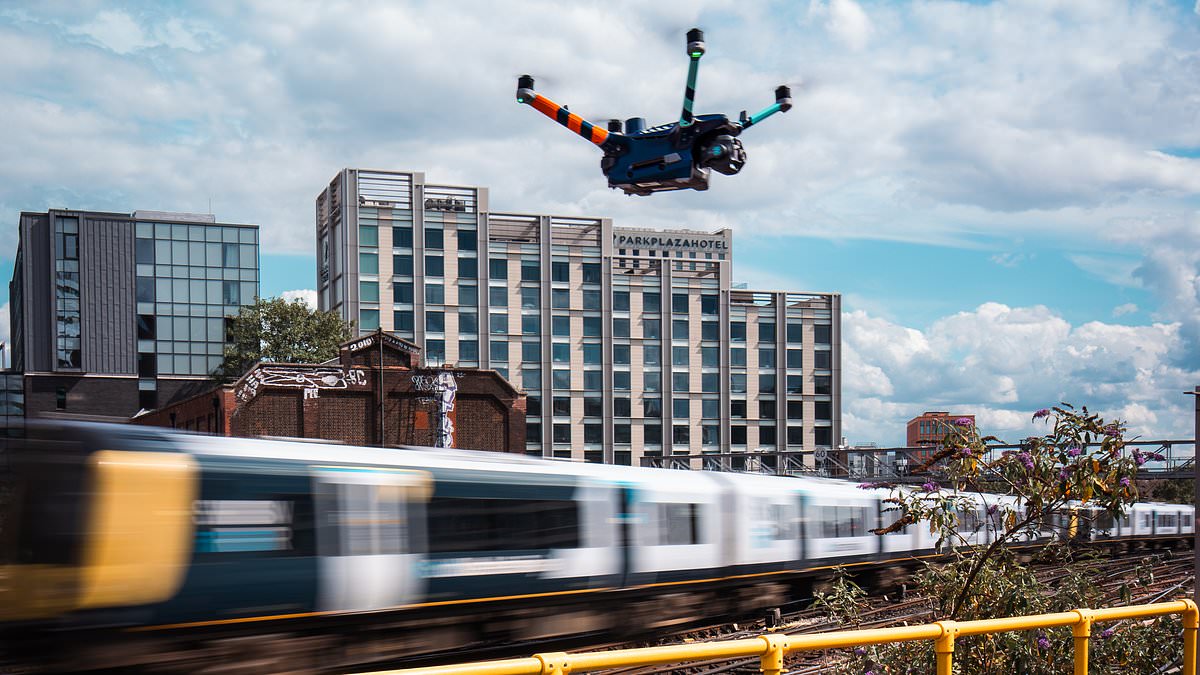
They're four words all commuters dread hearing – 'trespasser on the tracks'.But the days of lengthy delays could finally be a thing of the past, thanks to a new system being tested at London Waterloo. A drone is being used to patrol the skies over the busy train station, in search of any trespassers. Thermal imaging cameras on the drones provide operators with enhanced visibility of any potential incidents. This not only allows railway and emergency services to respond more quickly, but also limits the need to switch off the power.Tom Desmond, Operations Director for South Western Railway and Network Rail Wessex, said: 'Trespass is one of the leading causes of disruption on our network, delaying our customers' journeys and costing taxpayers.'Every minute of delay at London Waterloo also has a significant impact on our wider network.'By providing rapid, live intelligence from the air, this drone helps us respond more quickly to incidents, enhance safety and keep trains moving along one of the country's more important railway lines.' The days of lengthy delays could finally be a thing of the past, thanks to a new system being tested at London Waterloo. A drone is being used to patrol the skies over the busy train station, in search of any trespassers Thermal imaging cameras on the drones provide operaters with enhanced visibility of any potential incidents. This not only allows railway and emergency services to respond more quickly, but also limits the need to switch off the powerTrespassing on the railway is illegal in the UK, not to mention extremely dangerous. South Western Railway and Network Rail Wessex trains are powered by an electric third rail that is always on, carrying 750 volts of direct current which can cause severe injuries, or even death. For this reason, the power must be turned off as soon as a trespasser is reported – preventing any trains from running. Between April 2025 and June 2026, trespass and fatalities caused 200,000 minutes of delays to South Western Railway and Network Rail Wessex. Notably, one trespasser near Clapham Junction caused more than 57 hours of delays last September, while one in New Malden in August 2024 caused the equivalent of nine days of delays. To crack down on trespassers once and for all, UK firm SkyBound has launched a drone that's specially designed to monitor the rail line for potential intruders. The drone features high–resolution and thermal imaging cameras, which feed live footage to an operations centre in Basingstoke. If a potential incident is detected, railway and emergency services can be deployed, reducing the need for ground teams to access the track – and limiting the need to switch off the power on the line. To crack down on trespassers once and for all, UK firm SkyBound has launched a drone that's specially designed to monitor the rail line for potential intrudersWhile Waterloo is the first station to test the system, further drones are set to be rolled out at Clapham Junction, New Malden, and Walton–on–Thames in the near–future. Gemma Alcock, Founder and CEO of SkyBound, said: 'London Waterloo is exactly the kind of complex environment where automated drone operations can make a practical difference. 'From our control centre in Woolston, SkyBound is helping turn drone capability into a reliable operational service for critical infrastructure, giving railway teams faster access to visual and thermal information when it matters. 'This is about more than a single drone at a single station. 'It is about building the model for rapid response and more persistent awareness across key rail corridors, so teams can better understand incidents, inspect assets, gather evidence and make informed decisions in high pressure environments. 'The aim is simple: to help keep people safe, reduce disruption and give railway teams better information when it matters most.'
Eye in the sky: Drones are being used to help catch rail line trespassers at London Waterloo
Full Article
Original Source
Read the full article at Dailymail →KhanList aggregates and links to publicly available news content. We do not host full articles from third-party sources. Always verify important information with original sources.