
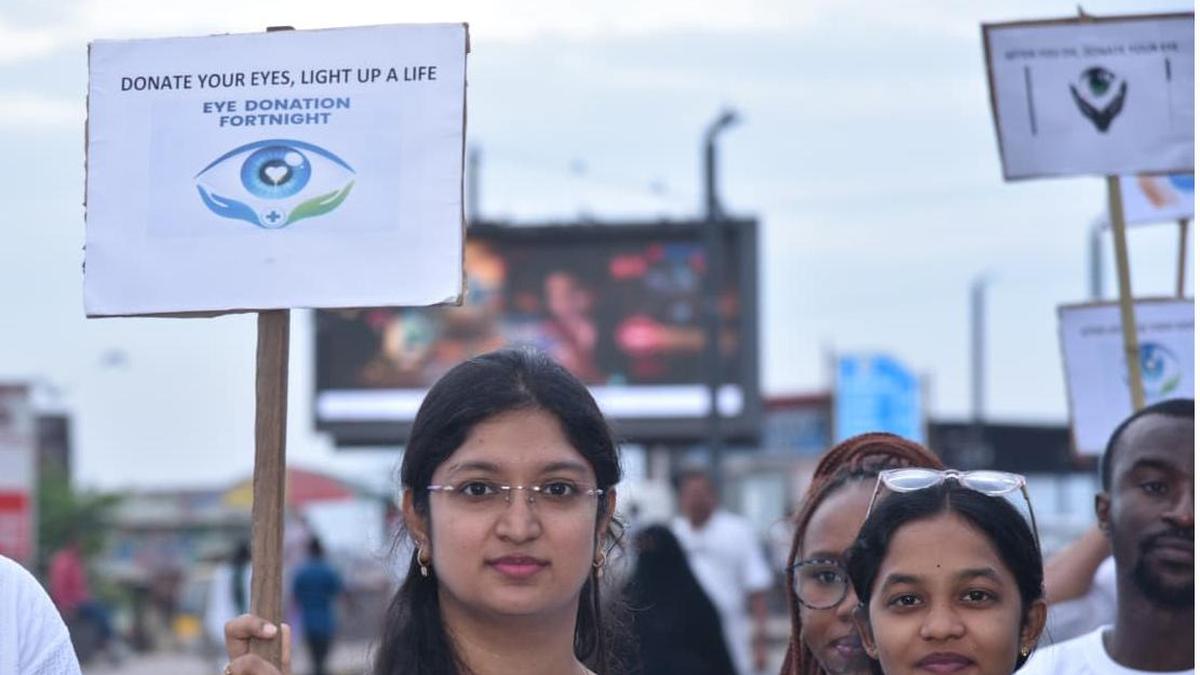
The government has a crucial role in strengthening the eye donation ecosystem through the National Programme for Control of Blindness and Visual Impairment | Photo Credit: Special Arrangement Eye donation is said to be one of the most meaningful forms of donation, as a single donor can potentially restore sight to two individuals through corneal transplantation. India has made considerable progress in eye banking; the country currently has 396 functional eye banks, and corneal collections increased from 62,370 in 2022–23 to 69,848 in 2024–25. However, the need for donor tissue substantially exceeds its availability. There are approximately 2 million corneally blind people in our country, but only 40,000 corneal transplants performed per year. Role of stakeholdersThe government has a crucial role in strengthening the eye donation ecosystem through the National Programme for Control of Blindness and Visual Impairment (NPCBVI). Government support includes funding for eye bank infrastructure and equipment, training of ophthalmologists and eye bank technicians, promotion of eye donation, and provision of corneal storage media. Government hospitals can further improve donation rates by establishing Hospital Cornea Retrieval Programmes (HCRP) and integrating eye donation into routine end-of-life counselling.Non-governmental organisations and service organisations have an equally important role in creating awareness, dispelling myths, encouraging pledges and, most importantly, counselling families at the time of death. Organisations such as eye bank networks, Lions Clubs and other community-based groups can take the message of eye donation to schools, colleges, workplaces and rural communities.Private eye hospitals and institutions can complement these efforts by establishing or strengthening eye banks, developing efficient corneal retrieval networks, maintaining high standards of tissue evaluation and preservation, and providing advanced corneal transplantation. Recent initiatives such as the expansion of the National Eye Bank at AIIMS, Delhi through partnerships with additional hospitals demonstrate the value of collaborative retrieval networks.Building strong PPPsUltimately, the future of eye donation in India lies in a strong public–private–NGO partnership. Awareness must translate into timely family consent, consent into retrieval, and retrieved tissue into high-quality transplantation. Strengthening this entire chain will be essential to bring down the burden of corneal blindness and make the gift of sight a reality for many more Indians. The goal is clear: to transform the gift of eye donation into the gift of sight. Every donated cornea carries a legacy of compassion—allowing one person’s life to bring light into another’s.(Dr. Mohan Rajan is chairman and medical director and Dr. Sujatha Mohan is executive medical director, of Rajan Eye Care Hospital. drmohanrajan@gmail.com) Published - September 05, 2026 02:15 pm IST
Eye donation in India: current scenario and way forward
Full Article
Original Source
Read the full article at Thehindu →KhanList aggregates and links to publicly available news content. We do not host full articles from third-party sources. Always verify important information with original sources.