
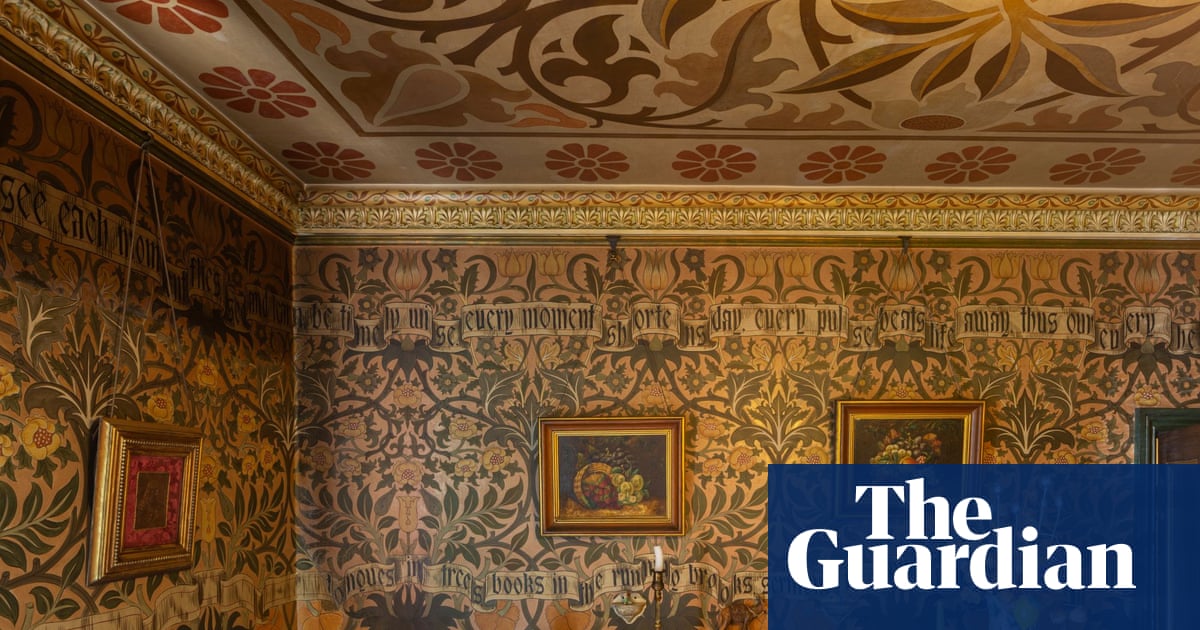
As a Victorian working-class labourer, David Parr was paid to spend his days decorating the interiors of private mansions and Cambridge colleges with William Morris’s magnificent designs.David Parr. Photograph: David Parr HouseBut as an artist, Parr chose to spend his nights filling his modest two-bed terrace house with the most resplendent decor and exquisite craftsmanship he could create.Often working by candlelight, he spent 40 years covering his walls and ceilings with his own designs, inspired by the Morris patterns his elite clients coveted for their far grander homes and dining halls.Yet while Morris and his wallpaper became legendary, Parr’s contributions to the Arts and Crafts movement – like those of the other skilled “art-workmen” who painted Morris’s designs – went unnoticed and overlooked.A bedroom at David Parr House. Photograph: Jake Husband/David Parr HouseHis extraordinary home on Gwydir Street in Cambridge, which was preserved by his granddaughter Elsie throughout her lifetime, lay hidden behind an ordinary front door for more than 80 years after his death in 1927.Now, Parr is to be honoured with a blue plaque, thought to be the first ever dedicated to a working-class Victorian art-workman.Drawing room at David Parr House. Photograph: Lucinda Douglas Menzies/David Parr House“The Victorians used the term ‘art-workman’ for the skilled painters, carvers and craftsmen who turned designers’ ideas into finished work, usually as employees of a decorating firm. Their work demanded great accuracy and artistry, yet they sat at the bottom of a hierarchy of client, designer and firm, and were rarely named,” said Annabelle Campbell, the director of the David Parr House & Gallery charity.The plaque will be unveiled on 8 February 2027, the anniversary of the day in 1886 that Parr signed the mortgage on his home, which was acquired by the charity after Elsie’s death and opened to the public in 2019.The David Parr House, as it is now known, was discovered by accident in 2009. A social historian, Tamsin Wimhurst, knocked on 93-year-old Elsie’s door and found herself standing inside the astonishing living room of the small Victorian worker’s cottage, staring at the century-old hand-painted walls in disbelief.“David Parr’s life was transformed by his apprenticeship and the varied and significant opportunities it opened up,” said Campbell. “As a highly skilled art-workman employed by F R Leach & Sons [a Cambridge-based decorative arts company], he was one of a class of unnamed workers who brought to reality the designs and schemes of the great figures of the Arts and Crafts movement, most notably William Morris and George Bodley.”The exterior of the house in Gwydir Street, Cambridge. Photograph: Matthew SmithYet in the records of his working life, his name appeared only as initials in a wage list, if at all, she said.“The plaque recognises the importance of the art-workman within the successful Victorian decorative arts economy. It also recognises the vision and aspiration of a working-class family man.”Parr spent all his free time decorating his home with designs he came up with himself, while engrossed in the work of Morris and Bodley. “He was inspired to create a house for his own family that was just as beautiful, on a smaller scale, as those he was painting.”David Stonehouse has been comisssioned to make a ceramic plaque for David Parr House. Photograph: David Parr HouseMany of Cambridge’s existing blue plaques honour elite academics such as Bertrand Russell and John Maynard Keynes. Campbell is proud the new plaque will highlight the working-class heritage of the Mill Road area of the city and its important contribution to the nation’s cultural history. “Lots of these houses were occupied by highly skilled working-class Victorian artisans,” she said. “Who is commemorated with a blue plaque is changing.”The charity is in the process of crowdfunding £6,000 to pay for a ceramic plaque to be made by a local artist, David Stonehouse, along with a short film that documents its making and an exhibition. “We don’t want to just badge the house, but to add a new layer to its history,” Campbell said. “At David Parr House, the maker, the making and the made are of equal importance and value.”
Exquisitely decorated home of Victorian workman David Parr wins blue plaque
Full Article
Original Source
Read the full article at Theguardian →KhanList aggregates and links to publicly available news content. We do not host full articles from third-party sources. Always verify important information with original sources.