
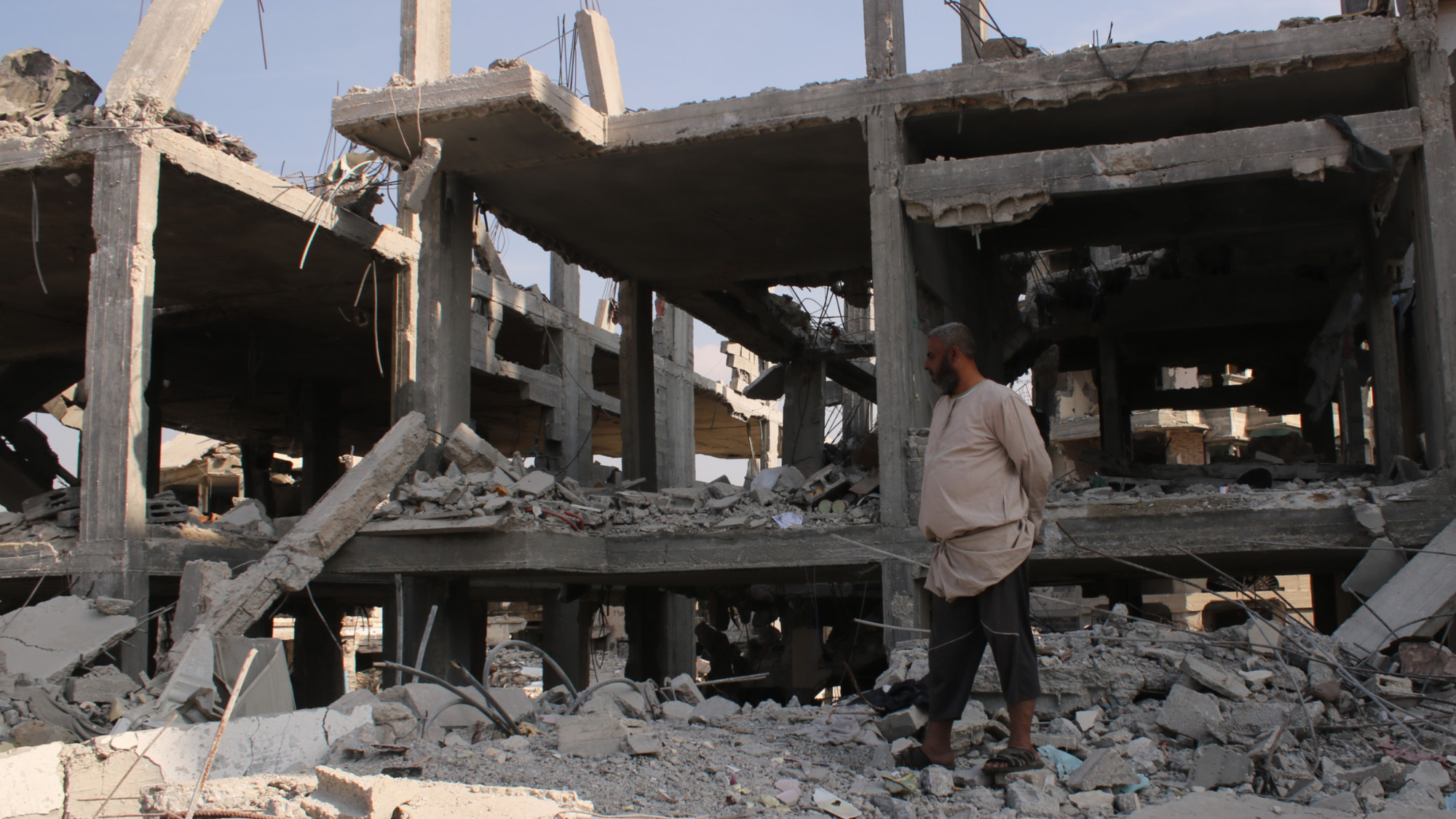
Jaber Yaseen's family was preparing the traditional maftoul dish for their Friday family lunch when they heard a loud engine approaching. The Palestinian family of 13 were startled by the noise, which grew louder as it approached their home in al-Zaytoon neighbourhood, east of Gaza City. “I thought it was an Israeli tank at first. I looked out of the window and was shocked to see a huge quadcopter drone carrying two boxes of explosives, flying low over our neighbourhood,” Yaseen told Middle East Eye. “I watched the drone move towards us. Without any warning, it dropped the two boxes of explosives on to our roof. I was terrified for my children's lives. I grabbed them and rushed out of the house, knowing the explosives could detonate at any moment. We couldn't take anything with us.” Panic spread as families watched more Israeli drones dropping explosives on to rooftops across the neighbourhood. Dozens were forced to flee their homes, with nowhere to go. New MEE newsletter: Jerusalem Dispatch Sign up to get the latest insights and analysis on Israel-Palestine, alongside Turkey Unpacked and other MEE newsletters A group of residents gathered at a distance, watching as the quadcopter drones continued to drop explosives. Minutes later, the devices on the rooftops began detonating. For 33-year-old Ismail Madi, watching the drones was heartbreaking. “We had been displaced several times before, and each time I held on to some hope that we would return home. But when I saw the quadcopter drones carrying explosives above our home, I felt as though I had left my soul behind as I walked away,” Madi told MEE. Abdaljawad Badwan, another resident of the neighbourhood, described the terror of watching the attack unfold. “Everyone was shocked and terrified. Every time an explosion went off, we hoped it would be the last. But the drones kept coming back with more boxes.” Three multi-storey houses were destroyed in the attack on 13 November 2026 (Abdallah al-Naami/MEE) Families told MEE that the initial explosions were intended to create openings in the roofs. Large quadcopter drones, measuring approximately 4m across, then continued to drop nearly 60 boxes of explosives inside each house. The explosives were subsequently detonated, destroying the houses and damaging many surrounding buildings. By 10pm (8pm GMT), the Israeli attack on 13 November had completely demolished three multi-storey houses and severely damaged dozens of others. Nearly 33 families lost their homes that night. Forced into the streets With their homes destroyed, Palestinian families were left without shelter in the cold night. “We had nowhere to go for shelter. All 13 of us spent the night on the pavement. We are still living on the pavement in a makeshift tent that I built the following day,” Yaseen said. The sudden displacement has compounded the suffering these families were already enduring. “We spent the night on the street, surrounded by piles of rubbish, rodents and insects. My two-year-old son, Abdalsamad, was very sick, and I had to go around asking neighbours for painkillers late at night,” said Badwan, a father of four. 'I built this home brick by brick. I don't know how to describe what I feel' - Jaber Yaseen, Gaza resident In the early hours of the morning, families returned to inspect their homes. They were confronted with scenes of devastation. “I have lived here my entire life, yet I could barely recognise my neighbourhood because of the sheer scale of destruction,” Madi said. For him, the aftermath was particularly devastating. He had married just two months earlier. “I put a lifetime of hard work into preparing my home and saving for my wedding. I had hoped to begin a new chapter of my life there, with a sense of stability and safety. I was overwhelmed with grief when I saw my home and everything I had worked for destroyed before my eyes,” Madi told MEE. Standing amid the rubble of his home, Yaseen struggled to put his feelings into words. “I built this home brick by brick. I don't know how to describe what I feel. It's heartbreaking. I find myself crying every night just thinking about my home,” he told MEE. ‘We face death every day’ Since returning to their neighbourhood following the October 2025 ceasefire agreement, families in al-Zaytoon have faced a daily struggle for survival. Being located near the so-called "Yellow Line" - a military boundary imposed by Israeli forces inside the Gaza Strip - has meant a consistent threat from Israeli soldiers nearby. “We face death every day,” Madi told MEE. “The Yellow Line is just 50m away. Israeli quadcopter drones and tanks come every day and open fire towards our homes. These attacks have become part of our daily routine. We have no choice but to adapt. We have even taught the children how to hide when the shooting starts.” Israel’s expanding ‘Yellow Line’ swallows Gaza districts and uproots families Read More » Israeli forces have steadily pushed the "Yellow Line" westwards over the past year, encroaching on residential areas, often without warning. “We have lived in constant danger for the past year. We could wake up any day to find that the [Israeli] army has moved the yellow blocks westwards, past our homes, and that we have to evacuate,” Yaseen said. The daily attacks are not the only hardship these families face. Living in an area classified as dangerous by humanitarian aid organisations, they receive little to no assistance. Families say that the nearest source of water, medical centre or school is 2km away. Adults and children must make the dangerous journey every day, despite the recurring Israeli attacks. “We have adapted to the daily Israeli attacks and the lack of aid because we wanted to stay in our homes. The quadcopter attack was shocking. I never imagined something like this could happen, especially without any warning,” Yaseen said. A new tactic to displace families? Despite the so-called ceasefire in Gaza, Israel has continued its attacks in Gaza, killing at least 1,600 Palestinians, destroying homes and expanding its control through military force. Last week's attack on al-Zaytoon neighbourhood marked a new development, with Israeli forces using quadcopter drones to plant boxes of explosives inside homes in a populated area outside the "Yellow Line". Families had barely enough time to escape before watching their homes being destroyed. The attack was not an isolated incident. 'I was born and raised in this home. I cannot live away from it' - Ismail Madi, Gaza resident Over the past week, Israel has escalated its use of quadcopter drones carrying boxes of explosives, destroying Palestinian homes and property outside the "Yellow Line" in al-Maghazi, al-Musadder, Khan Younis and al-Nuseirat. As these attacks grow in intensity and frequency, families across Gaza fear that explosive-laden quadcopter drones are becoming a central part of Israel's tactics to destroy what remains of Palestinian homes in Gaza and forcibly displace residents. “We are worried that Friday's attack was a message or a threat from the [Israeli] army telling us to leave the area, and that perhaps we won't be allowed to return to it in the near future,” Yaseen told MEE. On Thursday, for the first time since the so-called ceasefire, Israel announced the launch of a ground attack outside the "Yellow Line" in al-Nuseirat, in central Gaza. During the preceding night, Israeli forces destroyed several buildings in northern al-Nuseirat using boxes of explosives planted by quadcopter drones. Despite the destruction, Ismail Madi returns to his home, which he sees as the community’s first line of defence (Abdallah al-Naami/MEE) But despite the destruction of their homes and the catastrophic conditions they face, families were quick to return to al-Zaytoon neighbourhood after the attack. “I spend the day here in the neighbourhood. My soul is attached to my home, even though it is now just a pile of rubble,” Yaseen told MEE. “I'll build my tent here, next to the remains of my home. I'd rather die than live away from home.” For Madi, returning to the neighbourhood is about more than his attachment to his home. “I was born and raised in this home. I cannot live away from it,” he told MEE. “By staying here in the neighbourhood, we are the first line of defence for the community. Our steadfastness gives other families living near the Yellow Line a sense of hope and safety.”
Explosive-laden boxes dropped from the sky: Israel’s latest weapon in Gaza
Full Article
Original Source
Read the full article at Middleeasteye →KhanList aggregates and links to publicly available news content. We do not host full articles from third-party sources. Always verify important information with original sources.