
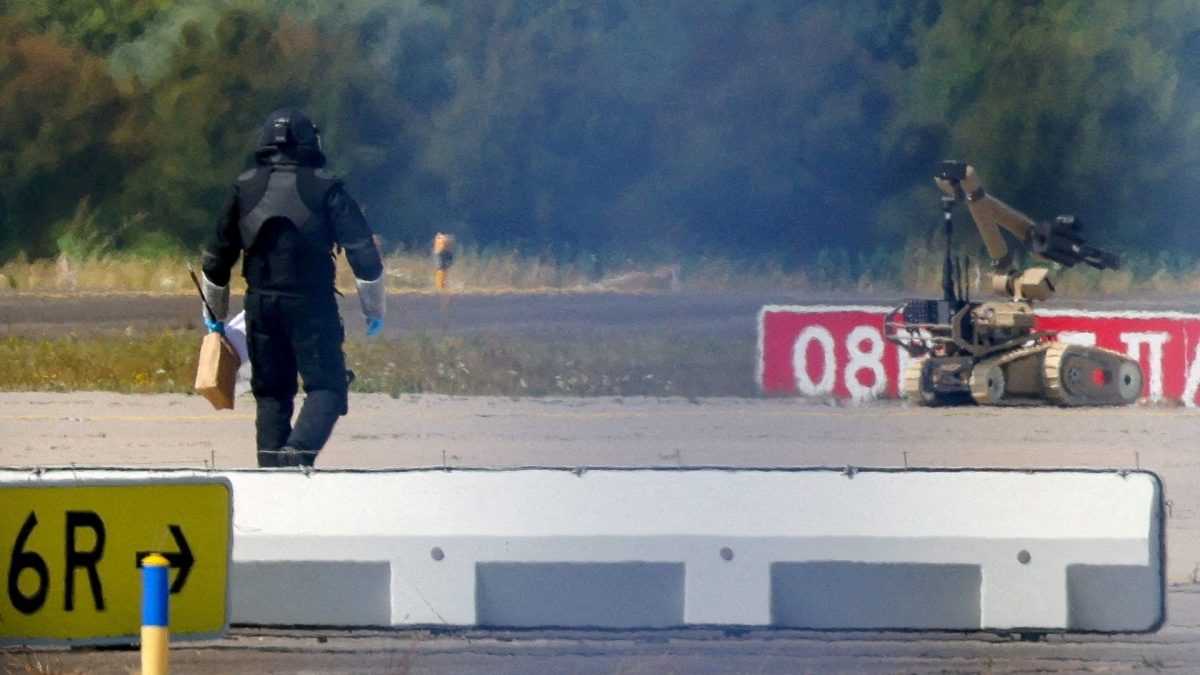
The threat of a Russian hybrid attack on the UK is rising, officials and experts fear, after the use of an explosive drone to target a German airport marked a further escalation in tactics deployed against countries supporting Ukraine. The German government took the unusual step of attributing the attack at Leipzig/Halle Airport directly to Russia on Tuesday, saying the explosives and equipment used had been seen in “other hybrid operations of Russia and its war against Ukraine”. Britain sees the Russian escalation of grey zone activity, including the attempted attack on Leipzig airport last month, as “serious”, but not out of character from Putin, government sources have said.The UK is understood to be working closely with the German government on countering Moscow’s hybrid warfare. While there is not expected to be any specific response from the British government to the Leipzig incident, including joining the EU in imposing fresh sanctions on Russia, Downing Street said the UK “stands in full solidarity with Germany following Russia’s reckless attack in Leipzig, and as the Prime Minister made clear, Russian attempts to undermine our support for Ukraine are futile and doomed to fail”. Shorts German Interior minister Alexander Dobrindt said the construction of the drone, which was discovered near a hub for Ukrainian Antonov cargo planes on 4 August, “indicated a high degree of technical expertise and considerable organisational effort”. The drone failed to detonate, but Die Zeit reported that local investigators believe the failure was “sheer chance” and a second drone was discovered in a field outside the airport. Both drones were carrying the military grade explosive Semtex and featured detonators similar to those found on Russian drones used in the Ukraine war, the newspaper reported. German investigators are said to be assessing whether the attack may have failed because disposable agents were hired as “proxies” to carry it out, rather than deploying the Russian intelligence officers believed to have orchestrated the plot, in a trend seen in hybrid attacks across Europe. The UK has already experienced several Russian hybrid attacks, including an arson attack that damaged a warehouse full of satellite equipment due to be sent to Ukraine for its war effort in March 2024. Whitehall sources believe the threat of further physical attacks is the highest it has ever been, due to Russia’s desire to punish nations who are giving Ukraine military support by increasing the associated security risks and financial costs, and trying to increase public fear and political opposition. A warehouse containing supplies for Ukraine was set alight in March 2024 (Photo: London Fire Brigade/PA) Following reports that British-made drones had been used for Ukrainian strikes inside Russia last month, its London embassy said the actions would “inevitably carry consequences”. “The deeper [Britain’s] involvement in the conflict and the greater its support for Kiev’s terrorist machinery, the higher the price it will pay,” a statement added. After last week’s announcement that the UK would hand Ukraine blueprints to help it make long-range missiles, Russia’s foreign ministry spokesperson Maria Zakharova said “any British military facilities and hardware, located both inside the Ukraine and beyond its borders, may become legitimate targets”. Andy Pryce, the former head of countering disinformation at the Foreign Office, told The i Paper that such overt threats were unusual. “It’s more bellicose than I’ve seen in the last decade – more visceral, more language of war type activity,” he added. “Multiple figures, spokespeople, state media have threatened consequences for supporting Ukraine in the way we’re supporting Ukraine. So I’d be very surprised if there were not some form of hybrid attack.” Russian airport plot previously hit UK Leipzig/Halle Airport was previously among the targets of a Russian plot that also hit the UK in July 2024. A series of packages containing self-igniting neck massage pillows were sent across Europe by air and road. One exploded into flames inside a postal warehouse on the outskirts of Birmingham, another burst into flames in a lorry driving through Poland and a third caught fire shortly before being loaded onto a plane at Leipzig/Halle Airport. Leipzig/Halle airport is a base for Ukrainian Antonov cargo planes (Photo: Axel Schmidt/Reuters) Several men accused of involvement in that plot are currently on trial in Lithuania, where the national prosecutor said “socially vulnerable people” had been offered payment on Telegram or through criminal networks by people linked to Russia’s GRU military intelligence service. Dr Peter Neumann, professor of security studies at King’s College London, said that both the exploding parcel plot and the latest airport drone could have caused “very significant escalations of the conflict” if explosions had caused significant damage or the loss of life. “These hybrid actions can pursue different objectives,” he told The i Paper. “One may be a more concrete one in terms of disrupting military supply lines, but also at the same time, intimidating and polarising societies is always one of the objectives of hybrid warfare.” Dr Neumann said the attack in Germany was consistent with statements by Vladimir Putin threatening that in revenge for Ukrainian strikes in Russian territory, Russia will “increasingly attack the Ukrainian hinterland, which he considers to be the Western Nato states that are supporting Ukraine”. “I do think that there is an increased threat of these kinds of attacks, not only for Germany but also for Britain and other countries that are supporting Ukraine,” Dr Neumann added. “This is a time where Russia is increasingly looking to strike at Nato countries.” Speaking at a press conference on Wednesday, Nato secretary general Mark Rutte said Russia was growing “increasingly reckless”. “We have also seen an increase in malign activity targeting our territory directly,” he added. “The examples are many, the danger Russia poses is clear.” Andy Burnham’s official spokesman said: “We will continue to defend against any threat to our collective security, alongside our allies, including through Nato. “We’ve been in constant contact with our German counterparts since the attack, including to offer our support and assistance to their investigation… And the Kremlin should make no mistake: alongside our partners, we’ll continue to expose Russian hostile activity at every level.” Political leaders across Europe also issued statements saying that they would not be intimidated into reducing support of Ukraine. “Leipzig marks a new escalation on European Union soil directly attributed to Russia, but it is part of a pattern of increasingly dangerous incidents,” European Commission president Ursula von der Leyen said. “Europeans are faced with the hard truth that this is the new normal.”
Exploding pillows and airport chaos – how a Russian attack on the UK could unfold
Full Article
Original Source
Read the full article at Inews →KhanList aggregates and links to publicly available news content. We do not host full articles from third-party sources. Always verify important information with original sources.