
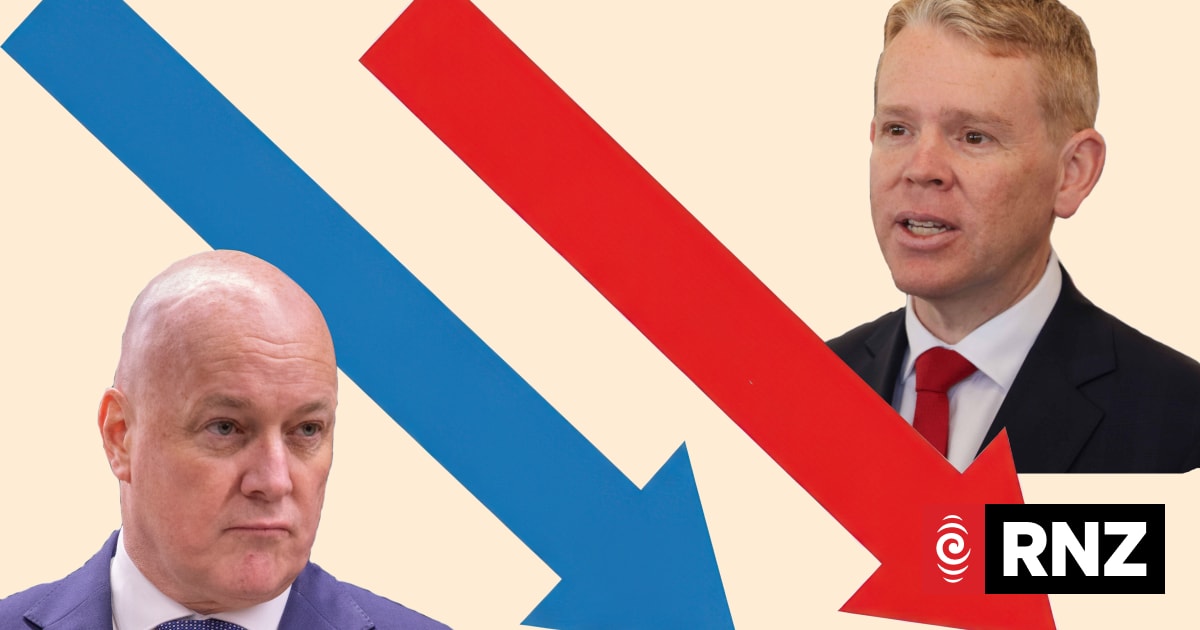
Explainer - You'll see a lot of red and blue, pink and green signs leading up to Election Day - but purple might be the colour to keep a close eye on.One month out from the election, one thing is becoming clear - voters are turning away from Labour and National as minor parties reap the rewards.The "purple vote" has been dropping in recent elections and polling shows it might reach a new low this year.What is the 'purple vote' anyway?It's just a way of describing the combined vote for National (who favour blue) and Labour (who favour red).Election results over the past 10 years and polling for this year's election are showing a steady decline in their overall share of the pie as smaller parties like the Greens and New Zealand First take bigger slices."People are switching off from the so-called major parties," RNZ's political editor Jo Moir said after the latest poll numbers came in Tuesday."There's a broader trend away from major political parties around the world," said analyst Lara Greaves, an associate professor in politics at Victoria University of Wellington and a senior research fellow in statistics.What do the last few elections tell us?The purple vote has been steadily declining since the 2005 election, with a bit of a shift upwards in the 2017 election.In 2005, Labour and National combined took 80.2 percent of the party vote, but by 2014 that had fallen to 72.17 percent.In the 2017 general election, the purple vote rose back up to 81.3 percent, in an election which saw NZ First and the Greens fall under 8 percent and ACT getting only 0.5 percent of the party votes.But after 2017, it started to fall again, and by the 2023 election the purple vote only managed 64.97 percent.That was the lowest purple vote since the 1996 election, the first under MMP, when only 62 percent of the party vote went to National and Labour, and NZ First, the Alliance Party and ACT all finished strongly.Greaves said that first MMP election saw a shift away from Labour and National, "and then people kind of went back to them, which was kind of interesting".MMP "kind of rewards us as voters from moving away from the major parties," Greaves said."We don't have to worry as much about a wasted vote, although some people still do."After 30 years, many voters have never known the old first-past-the-post system of voting, she noted, and tend to vote more strategically.What do the polls tell us about this year?The polls if anything show an even sharper drop could be possible on November 7.Reid Research polling dating back to 2021 shows a steady downward trajectory for the combined purple vote.The latest RNZ-Reid poll released this week had Labour and National getting just 56.7 percent of the party vote, which if repeated on Election Day would be by far the lowest result for the two in MMP's history.Other polls this season have generally showed similar trends. The latest 1News-Verian Poll released Tuesday night showed National at 29 percent and Labour at 28 percent.Moir called the 56.7 percent for the purple vote in the latest RNZ-Reid poll "jawdropping"."That is down from 61.3 in August in our poll then and it is down from 64.9 at the 2023 election."It might ultimately lead to a change in how "major" and "minor" parties are defined, Greaves said."You know, when you start to get minor parties solidly in the teens, and the major parties heading into the 20s, it's like at what point are they no longer a major party? And at what point do they have less of the cards?"If a major party did dip below 20 percent in the party vote, "that would be shocking to me, but stranger things have happened," she said.It's all a sign that the purple vote is "just continuing to slide away, people are switching off from the so-called major parties and it's creating all sorts of weird things," such as the talk about strategic voting to engineer potential overhangs, Moir said.Politicians worldwide have ridden a wave against business as usual.BILL PUGLIANO / GETTY IMAGES NORTH AMERICA / Getty Images via AFPAre voters just perpetually dissatisfied now with the status quo?It's hardly a New Zealand phenomenon to see minor parties romping ahead of the established players in polls and a growing anti-incumbent movement.In Britain, Nigel Farage's Reform UK has been leading many polls for months, while in Australia Pauline Hanson's One Nation has also seen a resurgence.And it's hard not to note that the steeper decline in the purple vote began in 2017, around the time Donald Trump first assumed the US presidency and a general wider shift in global politics began happening.So many normal political processes have become unsettled in the past 10 years, Greaves said."There is this argument that people are turning to the minor parties because the major parties haven't fixed anything."It is this genuine swing towards more radical change or more action or someone a bit different because the major parties have held power for so long and they haven't actually helped our lives improve so much more than where they were, say, 20, 30 years ago."In the end, voters may decide to try something new like the novelty of the Opportunity party or give established smaller parties a go.The latest RNZ-Reid poll also found 53 percent of people responding said they think the country is on the wrong track."That's not a mood that is going to be easy to capture and convince in four weeks that actually they've got this sorted and that National is the right party to turn it all around," Moir said.
Explainer: What is the 'purple vote' and why is it shrinking?
Full Article
Original Source
Read the full article at Rnz →KhanList aggregates and links to publicly available news content. We do not host full articles from third-party sources. Always verify important information with original sources.