
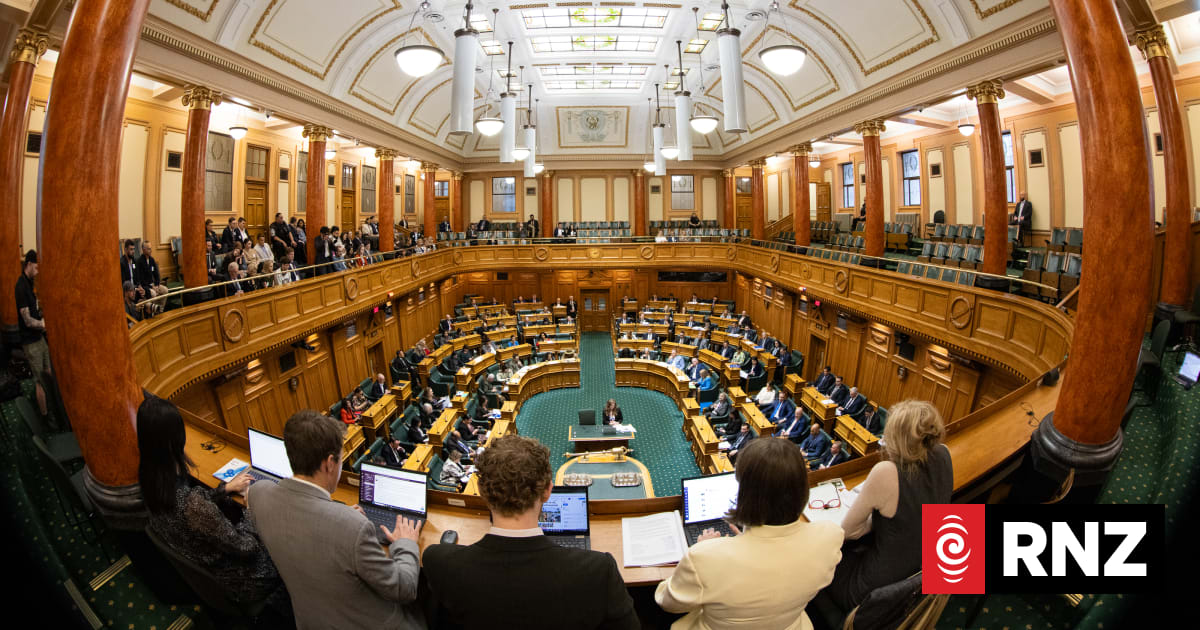
Explainer - You may hear an awful lot about "overhangs" and the upcoming election. But what does that mean?It's something that can happen under the MMP system where the size of Parliament can expand based on the difference between electorate and party vote results.Back in 2023, overhangs created what is New Zealand's largest Parliament ever with 123 seats - two created by Te Pāti Māori winning electorate seats and one that was created due to a special byelection after the death of an ACT candidate in Port Waikato.There are concerns that parties could intentionally attempt to create overhangs which could possibly shape the next Government after the 7 November election.What exactly is an overhang?It's aimed at keeping the proportionality of Parliament while also respecting the wishes of voters in local electorates - although there are disputes about how effective it is.Trigger warning: This involves maths.It all boils down to how MMP works. Remember, you're basically voting for two separate things - a party vote for the political party you prefer, and a vote for your local electorate MP. So you could easily vote for your local Labour MP and cast a party vote for NZ First, for example.Constitutional and electoral law expert Graeme Edgeler said an overhang is one possible result of that MMP system."If one party gets too many electorate votes, compared to the size of its party votes ... say it wins four electorates, but its party vote would only give it two seats, those extra two seats are overhang."The overhang then creates additional seats in Parliament to fit those extra electorate MPs in.There have been overhangs five times since the introduction of MMP in 1996, after the elections of 2005, 2008, 2011, 2014 and 2023.Parliament has a base line of 120 MPs, but overhangs can make it even bigger.VNP / Phil SmithHow is the shape of Parliament decided anyway?The two votes - party votes and electorate votes - determine who the 120 MPs (or sometimes more) will be.Candidates who win their electorate become electorate MPs, and these are filled first. There are more electorate seats than list seats - about a 60-40 ratio, which gives electorate seats a little more bargaining power in the total.Parties that win at least 5 percent of the party vote or an electorate get to fill the remaining list seats, in order of their party list, until their total number of seats is proportional to their share of the party vote.How exactly is the share of seats determined? There's a mathematical formula to determine this to make sure each party gets a share of seats that proportionally matches their vote.The Electoral Commission gives the example that a party with 30 percent of the party vote should get about 36 seats, or 30 percent of the seats in a 120-seat Parliament.... Um, that really is a lot of mathsSound confusing? It kind of is! If you want to get down in the weeds, New Zealand uses what's called the Sainte-Laguë Formula to figure it all out.It all gets pretty numerical but fortunately, the Electoral Commission also has an online seat allocation calculator you can use to play around with all the millions of possible theoretical election results configurations - have a go!A sample possible election result using the Electoral Commission's online seat allocation calculator tool.SuppliedWhy are we talking more about overhangs right now?Te Pāti Māori recently announced its election strategy is to focus on the candidate vote and get more Māori into Parliament, while ceding the party vote to the broader left bloc of the Greens and Labour."There's one plan, two votes; our plan has to be to focus on the candidate votes," co-leader Debbie Ngarewa-Packer said.There are seven Māori electorate seats which are typically fiercely contested between Labour and Te Pāti Māori.Te Pāti Māori's announcement sent heads spinning in political circles that it could unleash a whole new era of tactical voting using MMP.Dr Oliver Hartwich of the free market think tank the New Zealand Initiative published a research paper in August titled "Unravelling MMP: How The 2026 Election Could Break The Voting System From Two Sides."In it, he looked at Te Pāti Māori's strategy and called overhang "the soft spot" in MMP, and noted the system could also be used from the other side of the political spectrum.Voters picking National electorate candidates and giving their party vote to NZ First or ACT could "swell Parliament beyond 130 seats," he wrote."What happens if the taboo against exploiting the system is broken in the open?" Hartwich asked.Figures on the right supporting the notion included former National Party leader Don Brash, who told The Platform that if used in a certain way "The right would be unstoppable," and billionaire Zuru founder Nick Mowbray, who suggested splitting party and electorate votes "to maximise National's electorate seats while strengthening ACT/NZ First through the party vote.""The electorates are the meal," Hartwich wrote. "The party votes are leftovers, and leftovers can feed an ally: sent to Labour or the Greens, they buy the left bloc additional seats while costing Te Pāti Māori nothing."There's nothing illegal about voting this way, of course, or other tactics used by parties to find an advantage in the MMP system.For instance, the Epsom electorate held by David Seymour has long been quietly ceded by National to ACT party candidates, ensuring they win an electorate and get into Parliament."Epsom voters were asked to split their ballots against their own party, for the good of the bloc," Hartwich wrote. "They complied, election after election.""Parties follow incentives," Edgeler said. "If there's an incentive there to do something in a particular way that's beneficial to you, it's something that's going to happen. And so if we had a system without overhang, there'd be something else."However, nobody for National is pushing a split vote against their party, he noted."It's certainly not something National's pushing because it's very much not National's interest."Constitutional law expert Graeme Edgeler.RNZ / Samuel RillstoneAre there risks to that strategy?Te Pāti Māori has defended its plan, although other parties aren't so complimentary."This is what true leadership looks like in a political space, is making a sacrifice," co-leader Rāwiri Waititi said of the decision to forego the party vote. "Te Pāti Māori is making an ultimate sacrifice here."Waititi said he believed the party's strategy could see up to 13 Māori MPs get into power.However, Labour's Māori campaign chair Willie Jackson said the strategy threatened a backlash against the Māori seats that could lead to their abolition "when you start working the system like that".New Zealand First leader Winston Peters, who has spoken out against and pushed for a referendum on Māori seats, said the intentional strategy to create an overhang was a "disgrace"."Here they are perverting the whole democratic system," he said.National's former campaign chair Chris Bishop dismissed the idea of National doing anything to game MMP."I think voters would punish that kind of game-playing. We've got no intention of doing that."Smaller overhangs have happened in the past, such as in 2014 when United Future won only 0.22 percent of the overall vote - just 5286 votes - but leader Peter Dunne won his electorate of Ōhāriu and thus Parliament had an overhang of one that term.The plan announced by Te Pāti Māori "is different because it's not trying to engineer proportionality, it's trying to engineer disproportionality," Edgeler said."Every party could see the overhang lever," Hartwich wrote. "None pulled it, because each expected the voters to punish whoever did. Once one party pulls the lever and profits, restraint stops being a principle and becomes a handicap."Just how big could Parliament get via an overhang?The current Parliament is the biggest ever at 123 seats. But there's no hard and fast rule it can't go bigger.One scenario worked up by RNZ on the Electoral Commission's online seat allocation calculator (pictured above) came up with a Parliament with 126 seats, an overhang of six.David Wilson, clerk of the House of Representatives, told RNZ the work of Parliament generally continues as is regardless of its size.The Clerk of the House of Representatives David Wilson.VNP / Phil Smith"While there are more MPs than ever before, the time allocated to business hasn't changed, as a result of the larger House," he said."Some things are affected by the size of the House though. Committee of the Whole House debates have no time limit or set number of speeches. Every member is able to participate, in theory. It is possible that a larger number of members has led to longer Committee of the whole House stages."Parliament itself can hold its current 123 members, but more than that might require a little housekeeping, Wilson said."As things stand, we have enough seats in the debating chamber for 123 MPs. If there were more returned at the election, we'd need to re-organise the chamber to accommodate them. It's unusual for all 123 to be present at one time but they all need a seat."Wilson said that it's also possible an increase in the House could put pressure on the budget for the Parliamentary Service.In his paper, Hartwich models that Parliament could actually reach up to 159 seats with an admittedly extreme scenario where every National Party vote switches to another while they go on to win electorates."Nobody expects the limit to be reached," he wrote of his figure, but "its purpose is to show the system has no floor."Winston Peters, Christopher Luxon and David Seymour at the formal signing ceremony for the coalition Government in 2023.RNZ / Samuel RillstoneCould overhangs actually determine the next Government?It's theoretically possible."Overhang has never made a difference to which party could govern in New Zealand," Edgeler noted."It's never made a difference as to which party gets to form Government between National or Labour."But that could change with Te Pāti Māori's explicit call for just the electorate seat votes."If they won all seven, but only got 1.5 to 2 percent of the [party] vote, and the size of Parliament was to increase by four or five to make up that difference, that very much could make a difference in who could govern."If it did, and particularly if it was deliberately engineered, which is a possibility in this election, I think there will be a response to that. Maybe Te Pāti Māori thinks it's worth the risk but that's a risk they should know they're taking."There are other complications that could emerge - if Te Pāti Māori decided not to submit a party list, for instance, overhangs would not be possible.Newsroom senior political reporter Marc Daalder explained to The Detail recently a scenario where Te Pāti Māori submits a list, wins four seats and receives one percent of the party vote, which could create an overhang and a Parliament of 123 MPs. If it does not submit a list, due to a quirk in the Electoral Act, there is no overhang. That would require the shape of Parliament itself to be distorted without expanding, he said."You end up with a Parliament of 120 seats, four of them are Te Pāti Māori MPs, and everyone else's share of the pie through the party vote is distributed among the remaining 116 seats."See, we warned you there was a lot of math.There have been periodic calls to get rid of the overhang. Germany abolished them in 2023 after the size of their parliament exploded.In 2012, a review of the MMP system recommended removing the provision for overhang seats, but it has never been acted upon.In his paper, Hartwich warned that abuse of the overhang could destroy MMP."An election that unravelled from two sides, by a left party gaming the Māori seats and right voters gaming the party vote, would write the case for MMP's abolition better than any campaign could."
Explainer: What is an overhang and how could it change NZ's election result?
Full Article
Original Source
Read the full article at Rnz →KhanList aggregates and links to publicly available news content. We do not host full articles from third-party sources. Always verify important information with original sources.