
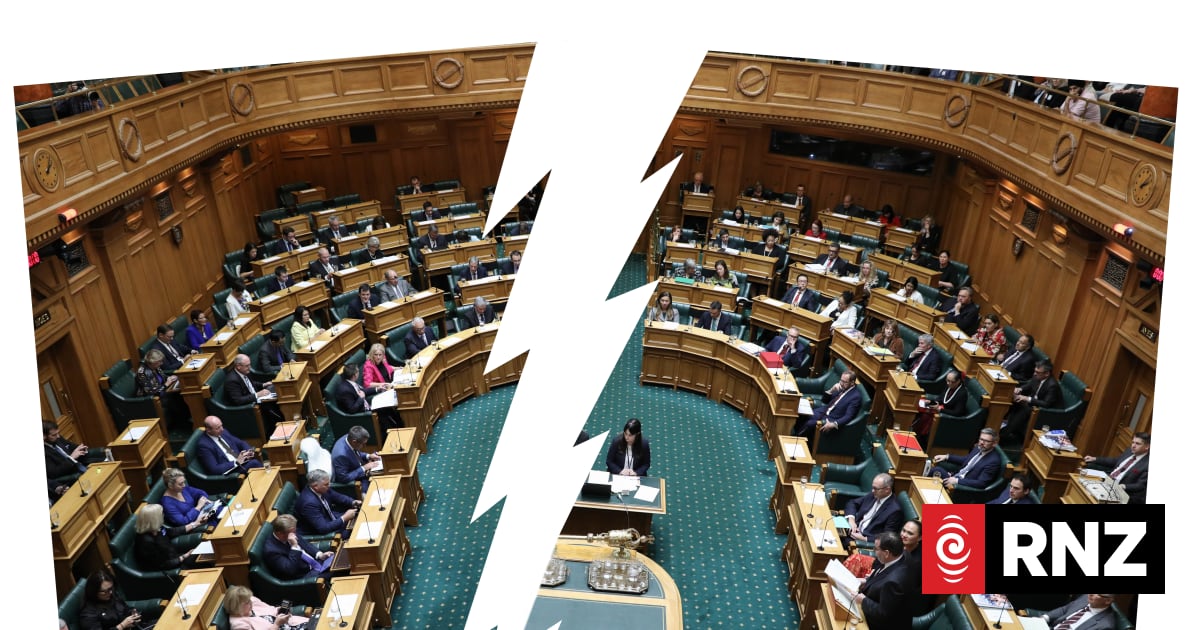
Explainer: What happens if nobody can agree who should be in charge of the country?The extremely close preliminary election results - both Labour and National are locked only a few thousand votes apart - have raised fears of a 'hung parliament', which could prolong the wait for a next government or even theoretically lead to a new election.We're all waiting around for the special votes to be counted by 27 November, but in the meantime, many wonder what happens if the election basically ends in a tie.What exactly is a hung parliament?Quite simply, it's a Parliament that's evenly divided between factions, meaning no one group can form a majority.Often, that just means a coalition must be formed to create a majority, as happened in the 2017 and 2023 elections, but what if the Parliament stays hung? That's where it gets tricky.Our Parliament has a base number of 120 MPs (before any possible overhangs), which means a 60-60 tie between blocs is quite possible.With the very likely overhang after election results, it gets a little trickier. RNZ's current tally of the preliminary vote shows a Parliament with a whopping 131 seats - 11 as the result of an overhang.Until we get the final count on 27 November, there's no way of knowing if we have an even or odd number of Parliament members. Even numbers make the possibility of a hung Parliament, with the current tight vote margins, considerably higher.Hung parliaments are not unique to our MMP system, which is marking its 30th anniversary.Under the old first-past-the-post system, the 1922 and 1928 elections both left no single party with a parliamentary majority. Governments were subsequently formed with support from other MPs or parties.We're technically under a caretaker government until National leader Christopher Luxon finds out if he has the numbers.MICHAEL BRADLEY / AFPWhat would happen next?Right now, as you may have heard, the government is under a 'caretaker convention'. In the event of a hung Parliament, that would continue to be the case.That means the current government is still in charge, until the results are resolved, but "significant decisions will be deferred or attended to with a light touch", as political scientist Grant Duncan wrote recently.Coalition talks are intended to create the next government and they've been known to last anything from just over a week to nearly two months.The waka-jumping or party-hopping law also prevents MPs from going rogue and crossing sides to break up a stalemate."Our beautiful caretaker convention gives the negotiations the time and space needed to deliver an outcome, however long that takes," said Dean Knight, an expert in constitutional law at Te Herenga Waka Victoria University of Wellington.Labour's Chris Hipkins, Opportunity's Qiulae Wong and Nationals's Christopher LuxonRNZIs there any way to break up a stalemate?The governor-general could "gently remind the parties and their leaders of their obligation to the country to try and reach some negotiated solution", Otago University law professor Andrew Geddis has written."But the governor-general can't force anyone to do anything and she shouldn't try to engineer any particular outcome (because she needs to remain politically neutral)," Geddis wrote.If a prime minister was holding up the next government's formation, they could also be rolled by their own party."PMs serve as long as they maintain the confidence of their cabinet colleagues, their party caucuses and, ultimately, the House on behalf of the electorate," Knight said."The lifeblood of confidence applies equally within the parliamentary interregnum and process of government formation."If a PM's stubbornness is not supported by their colleagues, they could roll the PM, and replace them with someone more prepared to deal or to return to the polls."A request for a new election would have to go to Governor-General Dame Cindy Kiro.Mark PapaliiWait, could there actually be a new election here?In a speech in March this year, Governor-General Dame Cindy Kiro said that "if it... became clear that no government could be formed, another election may be required".If a hung Parliament persists, there are mechanisms to have a new election, but don't place any bets on that happening.Such an act would be subject to the caretaker convention and require effective majority support in the House, Knight said. A request from the prime minister for a new election would then go to the governor-general."The caretaker prime minister would be expected to consult other parties and seek majority support for calling a new election," Dame Cindy said in her own remarks."In that situation, it would be up to members of Parliament to ensure that the governor-general is never required to consider calling an election without ministerial advice.""The governor-general won't accept a request for a fresh election during the caretaker period unless the PM demonstrates a majority of MPs in the incoming Parliament support such a course," Knight said.That would be an absolute last resort, pretty much everyone would agree."There should be no need for a fresh election," Duncan wrote."It's up to the parties now to find a majority. There are strong incentives for them to do so and no party wants to be blamed for forcing the country to return to the polls."The governor-general does also have the reserve powers to dismiss a prime minister, to force a dissolution of Parliament and call new elections, to refuse a prime minister's request for an election and to refuse assent to legislation - but really, nobody wants that to happen."It is the responsibility of the members of Parliament to resolve matters, so that the governor-general is not required to consider dissolving Parliament and calling an election without ministerial advice," the Cabinet Manual notes."These powers to act without or even against ministerial advice are reserved for the most extreme situations, and with the exception of the appointment of a prime minister following an election, no New Zealand Governor-General has ever needed to use them," the governor-general's own office notes.What's happened in other countries?Many countries have had elections where no one party has a majority.For instance, Israel is currently wrestling with its most recent election, where opposition leader Gadi Eisenkot has been tasked with forming a new government.Israel had to hold two new elections, after an April 2019 vote repeatedly failed to result in a coalition.Bulgaria, Spain and Green have also held more elections, after governments failed to form."Precedents abroad like Belgium and Northern Ireland show us [we] could be in a twilight for an extended period without the sky falling," Knight said."Importantly, while we haven't needed the caretaker convention for a long period or even after Parliament's first sitting, it is capable of managing a long period of throttled-back government and does so in a way faithful to democratic principle."The grand champion for going without a formed government is Belgium, which went more than 500 days without settling their next government in 2010/11.While nobody knows for sure what will happen as final results come in and serious talks begin, one goal is clear - nobody wants to be like Belgium.
Explainer: What is a hung Parliament and could it actually lead to a new election?
Full Article
Original Source
Read the full article at Rnz →KhanList aggregates and links to publicly available news content. We do not host full articles from third-party sources. Always verify important information with original sources.