
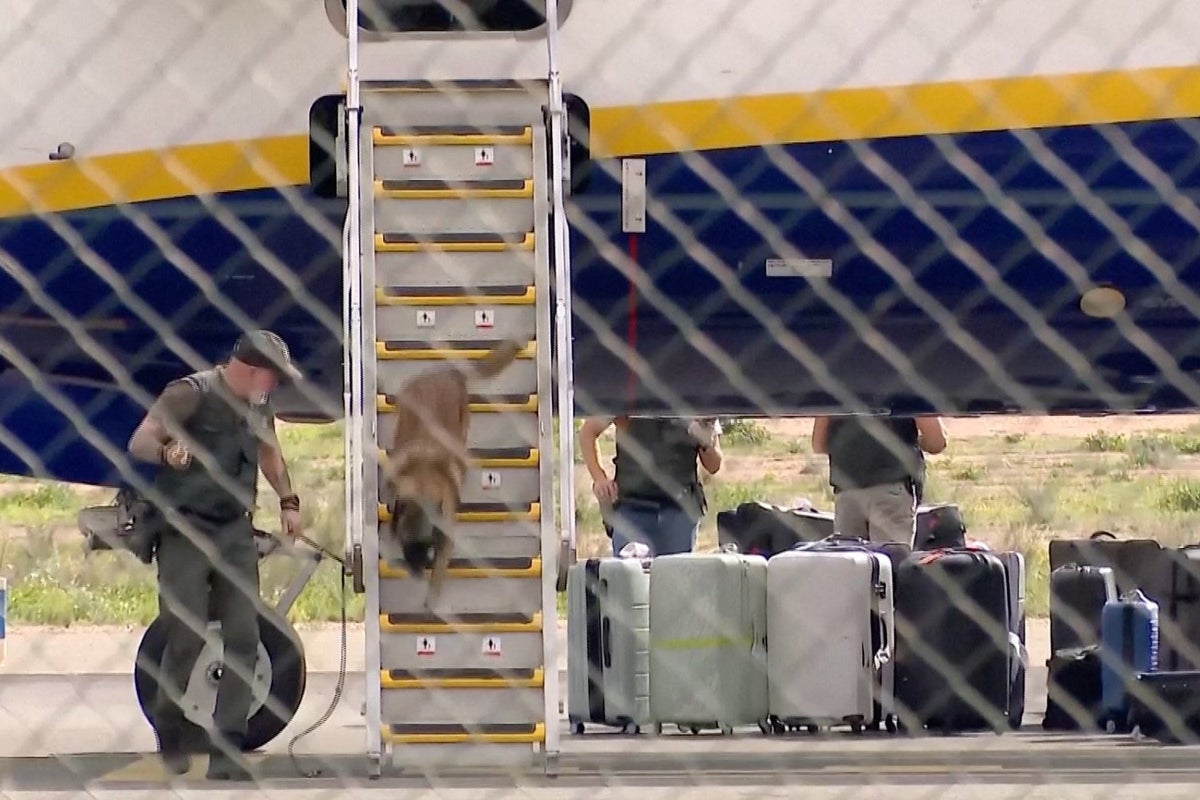
The bomb threats levelled at flights across Europe on Tuesday could lead to days of travel disruption, according to experts.Some planes made emergency landings and some were forced to divert after the bomb scares, which occurred on flights from London, Manchester, Copenhagen, Israel, Dublin, Bergamo and Lisbon.Part of Murcia airport in southern Spain was cordoned off following the incidents, while Warsaw-Modlin airport in Poland was closed while a plane was searched.No devices have been found and the airport has since been reopened. It is not yet clear who was behind the threats.Hundreds of passengers were on board the affected planes.A police officer and a sniffer dog inspecting a Ryanair plane and its baggage after a bomb threat to a flight between Manchester and Murcia (Reuters)It came after a Wizz Air flight from London to Sofia was diverted to Budapest airport after receiving a bomb threat on Monday.Justin Crabbe, a commercial pilot and the founder and CEO of Jettly, an app allowing travellers to book private jets, said that there is no “universal timeframe” for investigating a threat to a flight, as a specific threat may require a different response to a vague one.Searches can be “extremely thorough”, with baggage unloaded and subjected to additional screening, and trained dogs and bomb technicians brought in. Any threat regarding a commercial aircraft is taken seriously – regardless of how credible it first appears, he said.“The guiding principle is always to treat the threat as potentially genuine until authorities have sufficient reason to conclude otherwise.”Any aircraft that is subject to a threat is generally held out of service until authorities are satisfied that it is safe to operate, Mr Crabbe said.A Wizz Air plane on the tarmac at Budapest’s Liszt Ferenc International Airport after being diverted following a bomb threat during a flight from London Luton to Sofia (AFP/Getty)“The crew will also be affected, particularly if the delay causes them to approach their maximum permitted duty hours. Even after an aircraft has been cleared, the airline may need to arrange replacement pilots or flight attendants before the flight can depart. “This is one reason an incident that initially appears relatively straightforward can result in a much longer delay than passengers might expect.”The disruption can “extend well beyond the aircraft involved”, with arriving flights placed in holding patterns or diverted, and departing flights experiencing ground delays, Mr Crabbe said.“At busy airports, even a relatively short interruption can create a significant backlog because aircraft, gates and crews are all operating on tightly coordinated schedules. “There's also a ripple effect across the airline's network. An aircraft delayed in one city may have been scheduled to operate several additional flights that day, potentially affecting passengers hundreds or thousands of miles away.”Travellers on the affected planes might find themselves waiting a day or more for replacement flights, but the larger concern was the “operational disruption” caused to the wider network, he said.University of Illinois computer science professor Sheldon Jacobson said that the disruption to airports may be the response that those behind the threats were looking for.“Given that so many flights were impacted, this was likely a planned threat attack,” he said.“This situation highlights that airport security screening remains an important activity to keep the air system secure.”
Experts warn of ‘significant’ delays after bomb threats cause travel chaos across Europe
Full Article
Original Source
Read the full article at Independent →KhanList aggregates and links to publicly available news content. We do not host full articles from third-party sources. Always verify important information with original sources.