
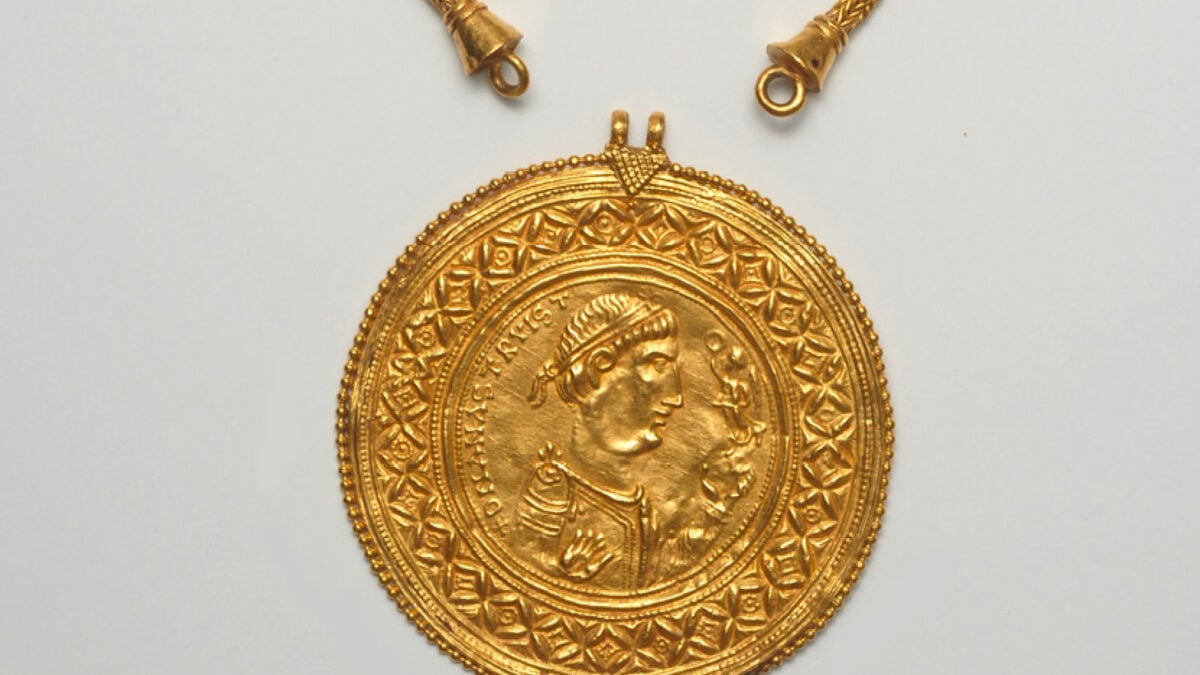
While browsing through the Dumbarton Oaks Museum in Washington D.C., medieval historian Marco Cristini stumbled upon a pendant composed of two golden medallions. Previous analysis had deemed these unofficial medallions of dubious value—but Cristini suspected something was off. A new investigation by Cristini, published in the journal Frühmittelalterliche Studien, confirms his suspicions. The items were initially classified as “pseudo-medallions,” which were different from “true medallions” minted on behalf of Roman emperors and served a ceremonial function. The former were thought to be crafted in unofficial workshops and arguably had less value. However, Cristini’s research found evidence suggesting otherwise, including a specific moment in the early sixth century where the medallions were used by East Roman emperors as tools of “glittering diplomacy” and soft power to secure alliances, he explained to Gizmodo. For the study, Cristini combined historical records with epigraphic analysis—a study of inscriptions and engravings on artifacts. Everything “clicked” when he identified a ruler of the Lazi—an ethnic group near the Black Sea—as the recipient of the medallion, and that the inscriptions were referring to this ruler, he told Gizmodo. Unequal treatment The Dionysus medallion that forms the other half of the pendant. © Dumbarton Oaks, BZ.1958.26.1 Byzantine Collection via Cristini 2026. For a “pseudo-medallion,” the workmanship seen on these artifacts is exquisite. The medallions form a pendant around 3.4 inches (8.7 centimeters) across and are suspended from two braided gold chains. The chains are fastened by a clasp set with framed gold coins of Zeno and Anastasius. On the front side is East Roman emperor Anastasius in military gear, a cloak, and a diadem. One hand is raised while the other holds a winged statue with a laurel wreath. The emperor’s profile is framed with a geometric border and the Latin inscription “DNANASTRVIST.” The other side “bursts with lively mythological detail” of a crowned Dionysus flanked by satyrs and a panther-like animal, Cristini explained. Artifacts redeemed Well, beauty was in the eye of the beholder, it seems. For scholars who previously examined the medallions, these features were unimpressive imitations. First, the Latin phrase was thought to be “garbled gibberish” as it didn’t match standard coin legends. Second, the emperor’s portrait “breaks away from classical naturalism” in that it showed unsightly features like a double chin, Cristini explained. The clasp composed of two framed solidi depicting Zeno and Anastasius. © Dumbarton Oaks, BZ.1958.26.1 Byzantine Collection via Cristini 2026. Cristini’s work presents some rebuttals. The epigraphic analysis strongly suggests that the Latin inscription was a diplomatic abbreviation that refers to the pendant’s recipient, a Lazi king. Also, other “true” medallions, like the Maurice medallion on the Kyrenia Girdle or a now-lost Justinian medallion, depicted “equally unclassical portraits,” Cristini explained. Justinian’s portrait, he added, even had a “double chin of his own.” But the real “Eureka moment” came while reviewing a text by the sixth-century chronicler John Malalas. According to Malalas, a Lazi king received a ceremonial clock featuring a portrait of the emperor. The Lazi at the time occupied a strategic location between the East Roman Empire and Persia, so this “lavish gift was designed to bind their king to Constantinople,” Cristini said. More in neglect? For Cristini, the biggest question now is how many more of these “pseudo-medallions” may be diplomatic gifts, not unimportant copies. The transition from the Roman Empire to the Early Middle Ages is seen as a “dark era,” he added, which may be an unfair assessment of an otherwise equally sophisticated era. Cristini’s forthcoming book will tackle these themes in greater detail, he shared. “Ultimately, we should stop judging late antique and early medieval works of art by the standards of classical Greek art,” he said. “Rather than an isolated backwater, the early medieval world was a web of sharp diplomatic signaling and cross-cultural fluency.”
Experts Thought This 1,500-Year-Old Gold Medallion Was a Cheap Copy. They May Be Wrong
Full Article
Original Source
Read the full article at Gizmodo →KhanList aggregates and links to publicly available news content. We do not host full articles from third-party sources. Always verify important information with original sources.