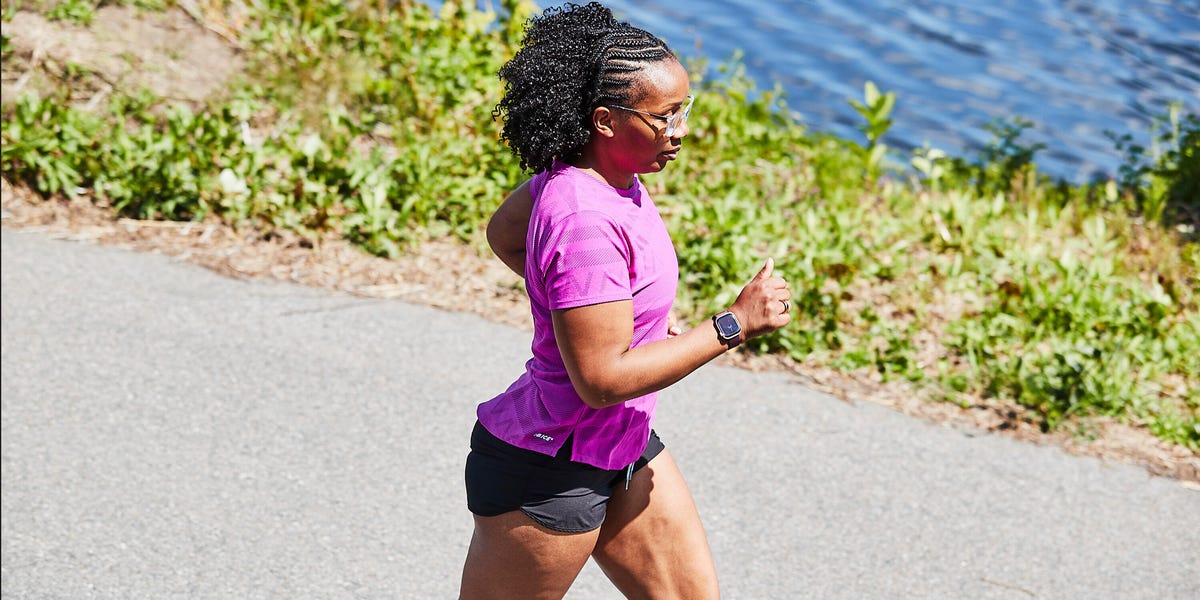
Whether you’re fairly new to running or you’re returning to the sport after a long time away, it takes time for it to feel easy again. In those first few runs back, your legs feel stiff, your muscles achy, and your breathing might feel heavier, even on easy runs. That’s normal!When you’re trotting through the difficulty of the first few runs, the last thing you want to hear is the simple notion of “just give it time,” without any real expectation of when it truly gets easier. To give you a better sense of how long it might take to feel better on your runs, we spoke with coaches and physicians and mapped out a timeline on what to expect as you make your comeback.Look for these benchmarks when the miles start rolling, your legs feel fresher, and your mood generally lifts.The amount of time it takes for running to feel easier will depend on a handful of factors, such as how much time you took off from running and whether or not you were active in other ways.“If you’ve had a significant injury where you’ve been in a cast and non-weight bearing, it can be a lot longer before you can start comparing yourself to your pre-rest self,” Kaleigh Ray, certified run coach and exercise physiologist, previously told Runner’s World.If you’ve remained active through other activities like cross-training or strength training, that can help make running easier faster, she adds.Older runners should keep in mind that easing into running may be different, even if you’ve run in the past, because certain fitness metrics naturally decline with age, like VO2 max, bone density, and muscle mass, so you might need more time to adapt to the sport.What to expect in two weeks…Adaptations vary from runner to runner, but generally speaking, your plasma volume and stroke volume, which both determine how efficiently your heart pumps blood and delivers oxygen to your system, happen within one to two weeks of consistent cardio, Tyler Slayman, MD, family and sports medicine physician with University of Iowa Health Care, previously told Runner’s World.These changes will make you feel less winded and more in control of your breathing on runs. This only happens if you consistently run, though, which can look like two to three runs a week, while maintaining good sleep, nutrition, and hydration practices.Along with cardiac adaptations, some research suggests you can see neuromuscular adaptations within two to four weeks of beginning a running plan. These adaptations can contribute to better power output and delayed fatigue, essentially making you more efficient and stronger to withstand your runs.What to expect in two months…If you’ve remained fairly sedentary, research shows that you could see great improvement in your VO2 max in eight weeks, and all it takes is three workouts a week while increasing intensity over eight weeks.If you’re on the fitter side, highly trained runners would need more time and more specific training, as they have less of a “runway” for improvement.After that consistent, focused period of training, you should feel like you can go faster without as much effort, breathe more easily in workouts, and run with better form.6-WEEK TRAINING PLAN TO BOOST VO2 MAXSoreness will vary throughout your running comeback, experts say, as fitness level, experience, and training methods (like strength training) will affect how your muscles feel. (Even seasoned runners get achy after workouts or experience delayed-onset muscle soreness a.k.a. DOMS!) Any mild-to-moderate amount of soreness you experienced after your initial easy runs should subside within a few weeks, though.Keep in mind that tendon adaptations follow a general adaptation timeline of eight to 12 weeks, research shows, so keep an eye out for soreness versus pain. Generally speaking, sharp pains could signal an injury and warrant a trip to a physical therapist and may require you to back off running a bit.Your overall running economy, or the amount of oxygen you require to hold a certain pace, will improve over roughly eight to 12 weeks, in Slayman’s experience. As your running economy improves, you’ll notice your “engine,” or cardiovascular system, can handle faster paces without as much effort, so you can continue to clock up faster paces in workouts.“The neuromuscular control, your stride mechanics, your motor patterns—all of that’s usually the last piece of the puzzle to fall into place,” says Slayman.The Bottom LineFrom two weeks to two months, your smooth adaptation to running relies on consistent miles, recovery practices, and training plans that hold you accountable to those commitments. Each week of training will make you stronger as you lay your fitness foundation, brick by brick.Don’t let those first few days or weeks (or even a month!) of running deter you from getting out there regularly—the more you stay consistent, the easier running will feel.Kristine Kearns, a writer and avid runner, joined Runner’s World and Bicycling in July 2024. She previously coached high school girls cross country and currently competes in seasonal races, with more than six years of distance training and an affinity for weightlifting. You can find her wearing purple, baking cupcakes, and visiting her local farmers market.
Experts Share How Long It Takes Running to Feel Easier—and What Has to Happen Before It Does
Full Article
Original Source
Read the full article at Runnersworld →KhanList aggregates and links to publicly available news content. We do not host full articles from third-party sources. Always verify important information with original sources.