
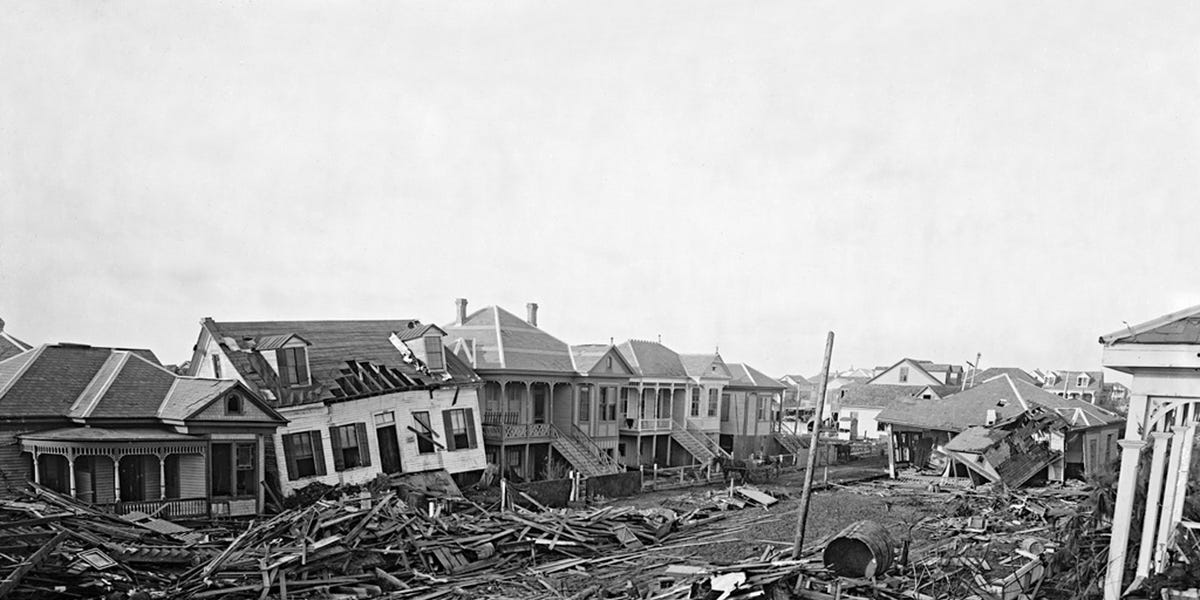
4 min readHere’s what you’ll learn when you read this story:On September 8, 1900, what was only a weak tropical storm a few days earlier intensified into a Category 4 hurricane and smashed into Galveston, Texas. The town with a population of 38,000 was taken completely by surprise, and whole sections of Galveston were completely swept away. Although deaths were never accurately reported, estimates place it around 6,000 to 12,000 people, though 8,000 is the most commonly cited figure.The U.S. is no stranger to natural disasters. The county is home to more tornadoes than any other nation on Earth, wildfires regularly burn throughout the west, and boiling heatwaves and crushing blizzards occur within its borders with equal measure. But no natural disaster is quite as deadly as a hurricane, and none come close to the devastation delivered by the worst of them all—the Great Galveston Hurricane of 1900.On Friday, September 7, 1900, local meteorologist Isaac Cline raised a red flag with a black center over the Levy building, the tallest building in the center of Galveston, Texas, to signal to the city’s residents that troublesome weather was inbound. Located on an island southwest of Houston, Galveston had always been vulnerable to tropical storms, but Cline suspected that the one approaching would be especially big. The U.S. Weather Bureau—as it was called before changing its name to the National Weather Service in 1970—issued a warning for a region east of Galveston that a storm was approaching, but Cline correctly surmised that it had changed course and was barreling towards them.As rain pelted the town on the morning of September 8, Cline raced in a buggy around Galveston’s sprawling beaches, warning residents to seek higher ground and take shelter. Some would take his advice, others would not—at their peril. The last train to leave the isolated town departed at 9 a.m., and by 5 p.m. strong wind gusts knocked out telegraph communications. Galveston was on its own.When the storm passed the Dominican Republic a few days earlier, it was reported as just a weak tropical storm, but as it passed through the Gulf of Mexico it gained a hideous strength, and it smashed into Galveston as a Category 4 hurricane. Louisa Rollfing, a resident of Galveston, later recalled hearing “the blinds and windows break . . . and it sounded as if the rooms were filled with a thousand little devils, shrieking and whistling.”With winds peaking at 120 miles per hour between 6 p.m. and 8 p.m., the kitchen of the Rollfing house tore away while the entire structure shifted on its foundation. However, after surveying the city in the morning light of September 9th, it was clear that their family—having all survived—were the lucky ones. “Nothing! Absolutely nothing!” August Rollfing later recounted. “The ground was as clear of anything as if it had been swept, not even a little stick of wood or anything for blocks and blocks.”According to local reports, bodies lay strewn about the island, face down in the water or even tangled among salt cedar trees that lined the shore. The estimated death toll of the hurricane lies somewhere between 6,000 to 12,000 people, though the most commonly cited figure is around 8,000—far more than any other hurricane before or since. Cora, Cline’s wife, was among the victims.“Sunday, September 9, 1900, revealed one of the most horrible sights that ever a civilized people looked upon,” Cline later wrote in an official report. “About three thousand homes, nearly half the residence portion of Galveston, had been completely swept out of existence, and probably more than six thousand persons had passed from life to death during that dreadful night.”The complete devastation instigated reforms both local and national. The Galveston Hurricane of 1900 showed the importance of decentralizing official weather communications from the office in Washington, D.C. Because of the fast-moving change in the storm’s strength and path, official warning came too late for residents to seek shelter, so going forward, regional offices would have the authority to issue warnings as well. The town of Galveston also built a 17-foot seawall to protect against future storms, and in 1915, when another hurricane eventually arrived, it caused only eight deaths and minimal damage.However, one of the biggest lessons, according to one meteorologist speaking with The Saturday Evening Post, could be “learning from your neighbors.” Communities near Galveston had been devastated in the decades leading up to the 1900 hurricane, but the town took no measures to protect itself. This unfortunate scenario also played out during Hurricane Helene in 2024 as Asheville, North Carolina could’ve been better prepared for the storm if they’d studied how Hurricane Camille impacted nearby Nelson County, Virginia.Today, the 1900 Storm Memorial in Galveston, first installed at the centennial of the tragedy, stands in remembrance of the thousands of lives lost on that terrible September day.Darren lives in Portland, has a cat, and writes/edits about sci-fi and how our world works. You can find his previous stuff at Gizmodo and Paste if you look hard enough.
Experts Misjudged a Tropical Storm. By the Time They Saw the Impending Doom, It Was Too Late.
Full Article
Original Source
Read the full article at Popularmechanics →KhanList aggregates and links to publicly available news content. We do not host full articles from third-party sources. Always verify important information with original sources.