
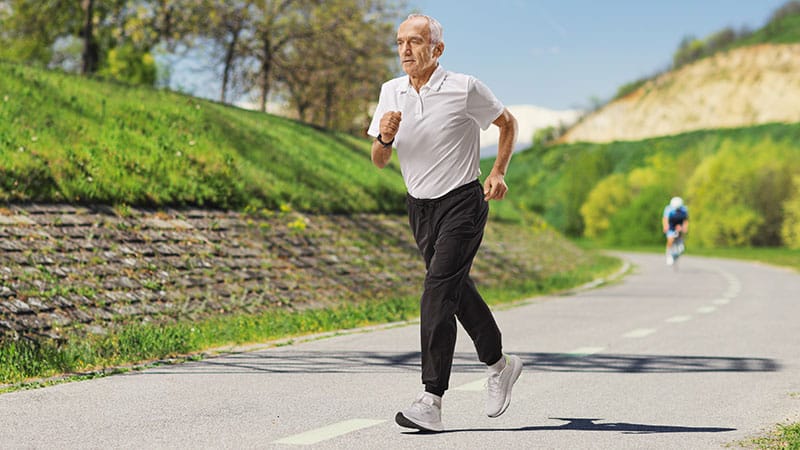
Higher levels of physical activity were associated with slower cognitive decline and motor progression in mild-to-moderate Parkinson's disease (PD) over up to 7 years of follow-up, a longitudinal cohort study showed.While the greatest cognitive benefits were observed in patients who reported more than 8 hours of moderate-to-vigorous physical activity per week, those who were active for at least 4 hours a week also showed slower decline than individuals who were less active. The same held true for motor progression, with all levels of activity showing some benefit but those getting more exercise reporting the slowest motor decline.In additional analyses, vigorous activity showed no association with either outcome beyond that of total activity time. Recent activity remained associated with both outcomes after adjustment for activity in the 10 years before enrollment.The data add to limited evidence on the relationship between physical activity and cognitive decline in PD and offer a longer-term picture of protective motor benefits that that short-duration trials were could not provide. Alberto J. Espay, MD, MSc"Our findings suggest that physical activity may influence the cognitive trajectory of Parkinson's disease, alongside its motor benefits," senior investigator Alberto J. Espay, MD, MSc, a movement disorders specialist and professor of neurology at the University of Cincinnati, told Medscape Medical News."That is encouraging, but it does not establish that exercise prevents cognitive decline or dementia," Espay said, adding that randomized evidence is still needed, along with confirmation that the differences translate into preserved everyday function.The study was published online October 7 in Neurology.Long-Term Data LackingNo drug has been proven to modify the course of PD. Exercise has been studied as one possible way to do so, and two randomized trials have shown short-term motor benefits.In Park-in-Shape, 130 patients with early PD who completed 6 months of home-based aerobic exercise had a smaller increase in off-medication motor scores than an active control group. In the phase 2 SPARX trial , 6 months of high-intensity treadmill exercise was associated with less motor worsening than usual care, whereas moderate-intensity exercise did not differ from usual care.As reported previously by Medscape Medical News, a 2022 study in Neurology linked regular moderate-to-vigorous exercise in early PD with slower decline in processing speed.But testing long-term effects in randomized trials is difficult because restricting physical activity in a control group for years is neither ethical nor practical, the investigators of the 2022 study wrote. Adherence problems and crossover between groups can also erode the difference in exposure over time.Filling in the Gap To address the lack of long-term data, the current study's investigators analyzed data from 294 patients with mild-to-moderate PD (mean age, 66.4 years; 33% women) enrolled in the Cincinnati Cohort Biomarker Program between January 2019 and February 2025. Clinical research fellows gave patients a structured interview, adapted from a questionnaire used in other large PD cohorts, that recorded weekly hours of moderate and vigorous activity at work, at home, and during recreation.Moderate activities included brisk walking, nonstrenuous bicycling, doubles tennis, light swimming, and household chores. Vigorous activity included such activities as jogging, fast bicycling, aerobics, or snow shoveling.Patients were divided into tertiles of total weekly activity: up to 4 hours, 4-8 hours, and more than 8 hours. Baseline Montreal Cognitive Assessment (MoCA) and motor scores did not differ significantly across groups, although the most active patients were younger. Patients were followed for cognitive function for up to 5 years and up to 7 years for motor function (median follow-up for both, 3 years). Motor scores were assessed while patients were in the "on" state, when their usual PD medication was taking effect.Higher Activity = Slower Progression In models adjusted for age, sex, disease duration, education, BMI, and baseline disease stage, each additional weekly hour of activity was associated with 0.035 fewer points in MoCA decline per year (P < .001) and 0.082 fewer points in motor worsening per year (P = .020).The middle tertile also declined more slowly on the MoCA than the least active group (P = .005), with no significant differences between the middle and highest tertile groups.The cognitive association held after investigators excluded four participants in the least active group who declined unusually fast, whereas the motor association weakened. On the motor examination section of the Movement Disorder Society-Unified Parkinson's Disease Rating Scale (MDS-UPDRS-III), where higher scores indicate worse function, the average score at baseline was 23. Scores rose by 0.143 points per year in the least active group but fell by 0.783 points per year in the most active group.The highest activity group reported significantly slower MDS-UPDRS-III progression than those who were physically active for fewer than 4 hours a week (P = .048)."Taken together, these results suggest that physical activity may provide dual clinical benefits by independently reducing both motor progression and cognitive decline in PD," researchers wrote. "Furthermore, the observed effects of moderate-to-vigorous physical activity were more strongly related to activity duration than intensity and were not explained by baseline activity level."Study limitations include the observational design, self-reported activity, and a single-center cohort that was 98.3% White. Patients excluded from the analysis, most often for missing activity data, were older and had higher baseline motor scores than those included.Mechanism Remains Unclear While previous studies have demonstrated the potential short-term neuroprotective benefits of exercise, researchers say the new findings fill a gap in the literature on long-term effects. But the question of how physical activity is linked to cognitive and motor function preservation remains unanswered. "I suspect several pathways work together, rather than one mechanism explaining both findings," Espay said. "Improved blood flow, reduced inflammation, and greater capacity for synaptic adaptation could support the brain networks involved in both movement and cognition."Bastiaan R. Bloem, MD, PhDThe range of biological effects is what makes exercise a compelling candidate for disease modification, said Bastiaan R. Bloem, MD, PhD, professor of neurology and director of the Center of Expertise for Parkinson and Movement Disorders at Radboud University Medical Center, Nijmegen, Netherlands. Bloem led the Park-in-Shape trial but was not involved in the new study. "It has anti-inflammatory components. It enhances blood flow. It increases neurotrophic factors. It drives neuroplasticity," he said. Bloem's group found in a follow-up imaging analysis of Park-in-Shape that patients who exercised built new functional connectivity in the brain and had less brain atrophy than a stretching control group. The new study's greatest strength is its long follow-up, since randomized trials have often been limited to months, he said.But Espay said that whether those biological pathways explain the associations seen in the Cincinnati cohort is not yet clear. "We cannot establish the direction of causation from these data, and the relationship may run both ways," he said, adding that people with slower progression may be better able to stay active. Only a clinical trial can settle the question, he added.The investigators wrote that examining the relationship between physical activity and disease-related biomarkers — including alpha-synuclein, amyloid-beta, and tau in cerebrospinal fluid — could help clarify whether the benefits are disease-specific. That analysis is planned but has not yet begun, Espay said. High Intensity Still Has a Role Daniel M. Corcos, PhD, studies exercise in PD in the Department of Physical Therapy and Human Movement Sciences at Northwestern University, Chicago. He was co-principal investigator of the phase 2 SPARX trial and leads the ongoing phase 3 SPARX3 trial, which compares high- and moderate-intensity treadmill exercise in patients with the disease. Corcos is also the lead author of 2024 guidelines on exercise prescription in PD.Commenting on the new findings, Corcos, who was not involved in the research, noted that for patients, the cognitive result is the one that counts most. Daniel M. Corcos, PhDTremor does not concern many people with young-onset PD, "cognition does," Corcos said. "That's why that finding is so important. Once you lose your cognition, you lose the sense of who you are."The results may not apply everywhere, partly because of the level of care patients receive at the University of Cincinnati, he said. "I don't think these kinds of results are universal."Corcos also cautioned against reading the intensity analysis as evidence against vigorous exercise. "The strongest data you can have is when you manipulate variables… This is not the paper which definitively shows there's no benefit to high intensity," he said. "Backpedaling on high intensity is just a really, really bad idea because there's decades of evidence that it's good," Corcos said.Self-reported activity was a particular weakness, in his view, as questionnaires are "notoriously bad," he said. The take-home message, he added, is to "be active and exercise, and find great care."The study was supported by the Gardner Family Foundation and the Precision Medicine Neurodegenerative Disease Fund. Study authors' disclosures are available with the original article. Corcos reported no relevant financial disclosures. Bloem reported advisory board and speaking fees from multiple pharmaceutical companies, paid to his institution, and research support from the Michael J. Fox Foundation, Parkinson's Foundation, and other organizations.
Exercise Tied to Long-Term Cognitive, Motor Benefits in PD
Full Article
Original Source
Read the full article at Medscape →KhanList aggregates and links to publicly available news content. We do not host full articles from third-party sources. Always verify important information with original sources.