
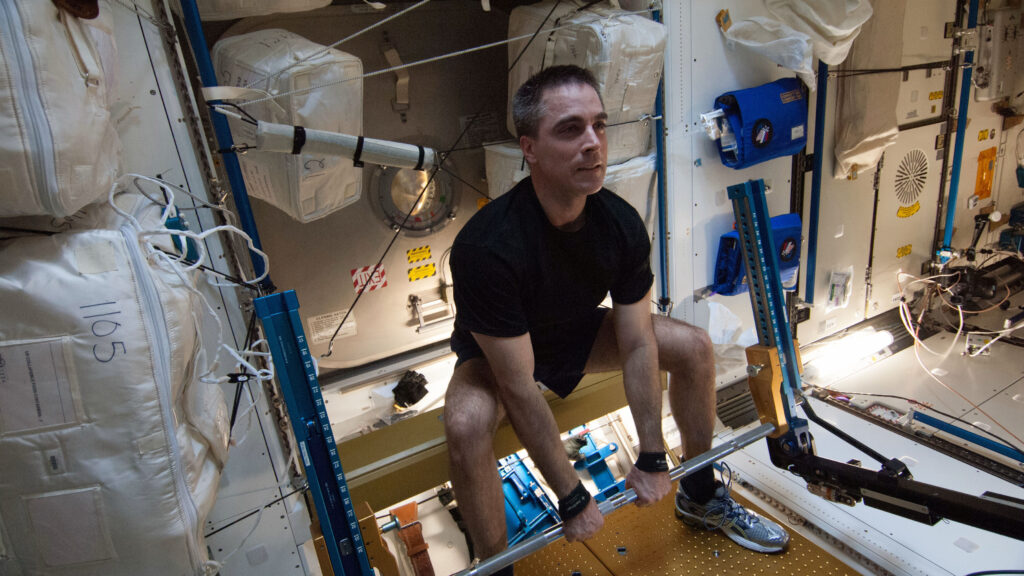
Spaceflight is a risky business. Keeping astronauts healthy, especially their hearts, has driven Benjamin Levine’s career as a top consulting cardiologist to NASA. Now that a Mars mission is on the horizon, his most recent research continues to test how well exercise maintains the heart’s structure and function during prolonged spaceflight. In their paper published Tuesday in Circulation, an international team reports results from 13 astronauts who performed onboard echocardiograms during their six months in space. That imaging showed mild but transient changes in the heart when moving from Earth gravity to microgravity, revealing how long-duration spaceflight affects cardiac size and function, and what happens when landing on Earth and in simulations of Martian gravity. Their conclusion: Initial changes in the astronauts’ heart structure and function stabilized over six months in space, and then returned to normal after they got back to Earth. The authors credit exercise regimens for protecting the astronauts’ hearts from prolonged time in space and in a simulation of Mars-like low gravity. Microgravity changes how fluids flow to and from the heart. Heart chamber walls change their shape, altering how the heart pumps blood. That’s where exercise and strength training can come in. “The single most novel thing that we showed was that after six months in space, when you come back down to Earth and then are exposed to three-eighths gravity, which is the gravitational gradient that we will experience on Mars, that nobody, not a single astronaut, had a cardiovascular response that was more stressed than the upright posture on Earth before they went,” Levine, director of the Institute for Exercise and Environmental Medicine at Texas Health Presbyterian Dallas, said. “That was really reassuring to me.” A mission to Mars, at the moment planned for 2035, requires two six-month journeys in microgravity sandwiched around 18 months on the red planet. Weightlessness is well known to weaken bones and muscles. Beyond the temporary dizziness astronauts can experience after returning to land, there were concerns about how their health and performance might be affected when they first stepped onto Mars to begin their work there. Beyond that concern, Levine reminded his audience in a 2024 Grand Rounds lecture that while deaths in the U.S. space program have come only from equipment failure, there’s always the possibility of a medical emergency. An example: the medical evacuation in January, a first for NASA. Because astronauts are typically middle-aged men and women, Levine said, the most likely cause of a catastrophic medical problem would be a cardiovascular event. Previous research in the field had used blood pressure and heart rate to infer how well hearts were functioning. For the new study in Circulation, the researchers went beyond those markers of heart health, teaching astronauts how to use echocardiograms, ultrasound tests that create moving images of the heart, during space flight to better see physical changes and the potential impacts of countermeasures, meaning exercise. Levine spoke with STAT about these latest findings. The conversation has been edited for length and clarity. Professor of internal medicine, UT Southwestern Medical Center; director of Texas Health Presbyterian’s Institute for Exercise and Environmental Medicine, Dallas, Texascopyright UT SouthwesternCourtesy UT Southwestern Tell me what’s different about your research. This study is really the first time that the full expression of the cardiovascular adaptation to spaceflight has been described across a prolonged exposure to space relative to the typical gravitational gradients that we experience every day on Earth. Are there caveats about what you learned? These are astronauts who were able to do their countermeasures. When they got down to Earth, they had a lot of medical support, and some of them got IV infusions. But what would happen, for example, if an astronaut got injured and couldn’t exercise? That might be a problem, and they might be more compromised when they land. Before we go any further, how did the astronauts perform their own echocardiograms? You can’t fly a sonographer into space, so the whole concept of remote guidance really evolved from NASA. With a little bit of training, I can have a sonographer on the ground talking to the astronauts and with some diagrams saying, OK, put your probe here on the side of the sternum. Now rotate it 10 degrees counterclockwise. Tip the tail down towards the left hip. Breath in, breath out, hold it, push the green button, capture, and boom, we can get research-quality echoes that way. Are astronauts healthier than regular folks? I love the crew and the astronauts; they’re wonderful people, but they’re not particularly remarkable physical specimens. What do you recommend for in-spaceflight fitness? In the context of the space program providing transportation to Mars, they’re going to have to have exercise devices and tools to preserve the entire spectrum of human adaptation to physical activity. So it’s not just the heart, of course. It’s the skeletal muscle, it’s the bones, it’s the brain, it’s the mental status. What kind of exercise can be done on a spacecraft? You saw how important just this flywheel device that they had in Artemis II was to the crew. I mean, they just loved getting on it and practicing with it and using it, but going to Mars, it’s not going to be as big as the space station. The space station has a treadmill and a bike and a weight system. What in the way of equipment might be on a vehicle headed to Mars? That’s what the NASA exercise scientists are working on right now — it’s not really for me to determine. For the engineers, it’s always a balance of mass and volume. How big is something? How much room does it take up? How much power does it require? And can we integrate that into a vehicle that can take astronauts all the way to Mars? How did you arrive at exercise as a possible solution? We’ve done a lot of studies using bed rest, ground-based models showing that if you just decondition, if you go to bed, if you eliminate a hydrostatic gradient from the head to the foot, the heart shrinks and atrophies and gets functionally stiffer. And if you exercise while you’re in bed, that is completely eliminated. You say in your new paper that the heart is remarkably plastic, as in nearly 75% of the left ventricular muscle mass is responsive to changes in physical activity. The amount of blood the heart pumps per beat falls by 50% between the supine and the upright posture. That’s why some people faint when they stand up. That sounds like POTS, or postural orthostatic tachycardia syndrome. POTS is a very good model. The reason I take care of patients with POTS is because they fundamentally have a gravity disease. The approach that I use for patients has been informed by the studies we do in spaceflight. What should those of us on Earth keep in mind? What captures the attention of the American public and provides the support for what is a quite extraordinary engineering and scientific expense to explore the universe is the human in the loop. We sent lots of rockets into space around the moon, but it wasn’t until the astronauts of Artemis II went on TV and went around the moon to the backside that people said, “Oh, my God, this is just incredible.” And so, as we think about all these engineering challenges, what may be the single most important limitation and important connection is the health and safety and well-being of the astronauts. STAT’s coverage of chronic health issues is supported by a grant from Bloomberg Philanthropies. Our financial supporters are not involved in any decisions about our journalism.
Exercise — and echocardiograms — in space protected astronauts’ hearts in study
Full Article
Original Source
Read the full article at Statnews →KhanList aggregates and links to publicly available news content. We do not host full articles from third-party sources. Always verify important information with original sources.