
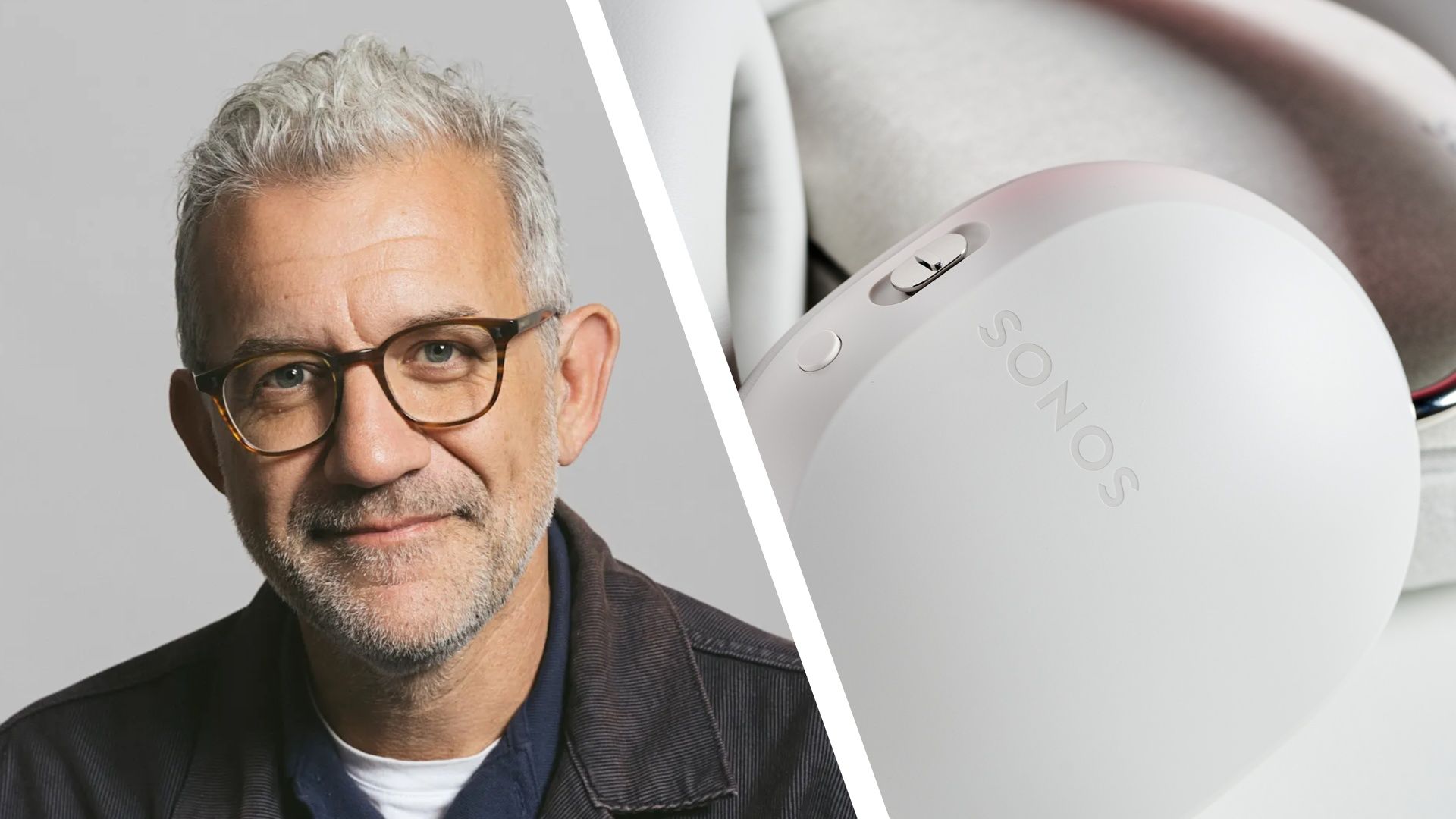
(Image credit: Sonos / Future) Sonos has just made three new announcements: it's launching a new pair of headphones called the Sonos Ace Ultra; it's launching a new soundbar called the Sonos Beam Ultra; and it's rebranding its software side as an "operating system" that it's calling Sonos 27 — and is adding a new AI-enabled voice assistant, new AI agent integration, and smarter ways for its speakers to work together.I spoke to Sonos' CEO Tom Conrad about the new launches — especially the new software, since any new software changes that Sonos makes will be met with caution from the community, as Conrad and I discussed last time we spoke.First, here's a rundown of the details of what Sonos is launching, starting with the Ace Ultra. These new headphones will launch at $449 / £399 / AU$699, and bring a new 40mm driver promising improved sound — but more interestingly they're powered by a new chip called the Headphone Engine 2 that means they'll be able to do what people expected the original Sonos Ace to do: they'll be able to work as a standard part of the Sonos ecosystem.The Beam Ultra, meanwhile, sits between the Sonos Beam (Gen 2) and the Sonos Arc Ultra — it's a compact soundbar, but it delivers 7.1.2 channels of Dolby Atmos sound, using nine drivers (including two upfiring drivers, which is a first for the Beam range). It launches at $699 / £699 / AU$1,099.Both of the new products are available to pre-order on September 1, 2026, and will launch on September 29, 2026. Image 1 of 2 (Image credit: Sonos) When it comes to software, Sonos has given its platform a name for the first time: Sonos 27. Part of the launch of Sonos 27 is the reveal of Sonos Fabric, which is the name Sonos has given to "the system capability that enables Sonos products to sense each other and adapt to the moment" — and immediately, Fabric is being used to enable smart music switching on the Ace Ultra, and the ability to have portable surround speakers in Sonos home theater setups. Conrad will explain both of those in our interview.There are two other new elements to Sonos 27, though. Sonos 27voice is a new voice assistant that's based on AI tech, and Sonos 27mcp is a new way for AI agents to connect to Sonos systems and control them.Sign up for breaking news, reviews, opinion, top tech deals, and more.In our conversation, Conrad dug into why the company is doing all of this and what the company is offering for AI skeptics — so let's get into it, starting with Conrad's explanation of why they wanted to give the software a name at last.Tom Conrad: When I got the nod to become permanent CEO about a year ago, one of my observations about the company's recent history was that while we had started as a system company, we had spent the last almost decade being really focused on getting great at shipping individual products, filling out the product line with every shape and form that our customers were interested in. Small, medium, and large soundbars; a couple sizes of subwoofer; big amplifiers, small amplifiers; portables… you get the point. And Patrick [Spence, former Sonos CEO] and the team became a really well-oiled machine with respect to hardware execution.But in doing that, I think the unintended consequence was that at times we took our eye off the ball [regarding] what it meant to bring those products together into a cohesive whole. And someone shortly after I arrived said that the thing about Sonos is it's really 100% hardware and 100% software. And I love that framing, because it's so right. We have these two really hard problems to solve, and if either one of them doesn't get complete dedicated focus from exactly the right people, we don't deliver what our customers expect. (Image credit: Sonos)And so, we've done all kinds of things to elevate the software expertise in the company over the course of the last year. And at the same time, we've really invested in the idea that the software is what makes the system. And as you look at how we've taken our products to market through the years, we've always given the hardware a name — Arc and Ace and Beam and Move — but the software has never had a name.So one of the big announcements this week is that we're giving the software a name. And what we make is really an operating system for audio experiences in the home — and ‘OS’ has always been there in our name! And so we're simply calling the software Sonos 27 because, really, it is that ‘systemness’ that the software provides that makes Sonos. And we're attaching the year moniker to it, because Sonos does get better year after year. There'll be a Sonos28 and a Sonos29 and so on.Matt Bolton: As soon as I saw the name, my first thought was whether this means we're talking about a planned update cadence, and that feels like it would probably be a different approach than Sonos would have necessarily taken in the past?Tom Conrad: Yeah, I think one of the things about the company for the last many years is that because we only talked about the hardware, anything we wanted to do in software had to kind of ‘ride along’ on the hardware itself. And so we'd add Atmos, or we'd add voice assistants, or we'd add new surround experiences, but they would always be tied to the fact that we're making a new soundbar, so we can work on home theater experiences. We're making a product with a microphone so we can work on voice products. By separating out the idea of the operating system, we're giving it its own identity, its own road map, its own cadence of release, which we think is a really exciting change for the company.And our customers can expect that the software doesn't get better only when we release new hardware. And it doesn't even get better just once a year. It gets better all the time through the year, which I think fits a new, modern way that people talk about their software platforms.Matt Bolton: What we've been seeing more recently is you guys rolling out improvements and features on a pretty regular basis. The question I have as a user is: does this mean that I'm going to be waiting for a once-a-year Sonos 27 update to get new features? Tom Conrad: I understand that feeling. But I think if you look at even what Apple does now, they once a year talk about their new operating system, and then the features roll out through the year, some of which they've sort of talked about in their big moments and some of which are a surprise and delight along the way, and our model will be exactly the same.Matt Bolton: I assume this means that you've got a road map already in mind that covers Sonos 28 and Sonos 29. How far in advance are you thinking?Tom Conrad: We do, for sure. Certainly, the list of things that I want to accomplish in software runs to many years. But one of the unique opportunities in software — unlike hardware, where you have to make these bets that go out, two or three years after you start programs — is that in software, even a big program might be six months of effort.And so, while I like to have a two- or three-year road map for software, I like to be constantly replanning so that we can react to what's happening in our customers' lives. If you think back three years ago, for example, we hadn’t even had the ChatGPT moment yet. And so, to have a locked three-year roadmap and be resolutely dedicated to that path, not understanding how the world has changed in the last three years, would be foolish. And so we have a plan, but also the wisdom to be constantly reevaluating and reprioritizing as our customers' needs evolve. (Image credit: Sonos)Matt Bolton: How far ahead do you plan to communicate to customers what is coming? Like you say, Apple will announce at WWDC things it doesn't expect to necessarily launch until quite a bit later in the year.Tom Conrad: I think it's likely that we'll do a couple of events or moments a year where we talk about what's coming and what's newly available. And so I think you can expect, in many years, there'll be kind of a fall event, like this one, where we talk about our big plans for the year, and then there'll be kind of a midyear check-in where we'll add to the story.Matt Bolton: So let’s talk about AI integration. Generally, people have gotten to the point where they're now pretty skeptical of AI features being added to everything, but it sounds like you're taking a practical approach. So how do you assess what you should build and integrate — what you can do with, as you say, the three years of the ChatGPT ‘moment’?Tom Conrad: I guess we'll start with what we do for skeptics. The things that we do with conversational AI are completely opt-in experiences, to the point that our speakers all have a hard microphone button on them, so you press it, and it literally breaks the electrical connection between the microphone and the rest of the device. So for those who are uninterested in this moment, we provide a platform that I think has incredible utility, even absent modern AI-powered capabilities.But I think in some ways, the more exciting dimension of what we're doing is that we're really not starting from, ‘Oh, there is this incredible new technology in large language model, generative conversational AI infrastructure, what can we build with that?’ Instead, we're starting from really spending time with our customers and understanding what they might want to do with voice in the context of Sonos in their home. And we have the room to do that because we've been shipping voice assistants on Sonos for nearly a decade, including our own.And when I talk to customers, they say, ‘I love the idea that I can engage with the Sonos system in my home without taking my phone out of my pocket. It takes a long time for me to get to the app, my partner looks at me sideways. Like, why are you on your phone when we're having a conversation?’ I mean, I think broadly you'd be hard-pressed to find somebody who's like, ‘I wish that the people I share my home with were on their phone more.’ Instead, they're looking for ways to put the phones in a drawer and enjoy being together. (Image credit: Sonos)I think voice is intuitively a great way to solve that, and that's why Sonos One, our first product that had a voice assistant, was such a smash hit 10 years ago. I think people understood that this is a great way to engage. But, unfortunately, the [voice] agents themselves really didn't meet the expectations of the customer.When I go out and talk to people, the first thing they say is not crazily complex scenarios about how to control my smart home in nine different ways — all this stuff that you hear about from other players in the industry. They say, ‘I just want to be able to talk to the assistant about what I want the same way I would talk to a human being.’ I wanna be able to say, ‘Play that album that I loved in college, with the one with the singer from the Cocteau Twins. I think the band did the theme song to that Fox show. What's it called? It's about a doctor who's really grumpy all the time. Oh, yeah. It's called House.’And, certainly, with first-generation voice assistants, even if they knew the name of the song, they would have to remember that you have to say ‘Play this song by this artist’ and not say the album and not say the artist first — and [we had to] guess what the agent is thinking. So job one, two, three, four, five, and six is: speak to this thing naturally.The second thing that they say is they don't really care about all of these seemingly made-up examples of things that tech companies seem to think that we want to do. ‘I looked at your calendar and noticed that you have people coming for brunch tomorrow, and the refrigerator says you're out of eggs. So I'm gonna text your wife to tell her that you've gone to the store to get-’… I mean, no one wants the system in your walls to do that stuff in the real world, I don't think.But they do want to be able to quickly control ‘atmosphere’, I would call it — which means music, means a soundtrack, and often means lighting. And yeah, they wanna be able to set timers. They wanna be able to ask about the weather. Everything else is really far down the list from there.So we built [Sonos 27voice] to do exactly those things. It's really fast. It's really reliable. It's really resilient to anything you throw at it linguistically. And I think people are gonna be really delighted with just the fact that it just works. One benefit to narrowing the problem domain to exactly what customers are asking for is that we're also able to deliver this with modern infrastructure that is affordable to run, which means that we can make it a standard part of the Sonos system without having a secondary subscription on top — which is another dimension that people, I think, really want. They don't want another line item on their credit card just to be able to control the ambiance in their home.Matt Bolton: What is the technology in the background? Are you using a particular language model? Are you running on your own servers or tying into someone else's systems?Tom Conrad: Let me give you the one last piece of the puzzle that we hear from customers, because it will help me explain the architecture. They do also say that they want access to comprehensive world knowledge. I'm in the kitchen. I'm cooking a pork tenderloin. I wanna know what the temperature should be for it to be safe to eat. My wife and I are having a debate about the name of the actor from Ted Lasso. And people want the voice assistants to be able to talk to them about the world.So you need something that is everything that I described, but also has the wisdom to reach out to a more sophisticated general-purpose model when the query is outside of the domain of ambiance and timers and weather and the stuff that makes up 95% of what people ask. So we've built our own core model that is a purpose-built, fine-tuned, kind of mid-scale large language model, if you like, that we run on our own infrastructure and answers that 95%, and then reliably routes to an external frontier model for the general knowledge or complex questions. (Image credit: Sonos)And we'll even do fun things, like if the frontier model can help in the task of figuring out the music, it will do that too. So you can say things like, ‘Find some music that's breaking through on TikTok and filter it through that shoegaze music that I liked when I was in college in the nineties and make a playlist for me.’ And it will use the frontier model to understand what's being talked about on TikTok. It'll use our infrastructure to understand my musical taste, and then it'll build a playlist and go. So that's what we're doing with Sonos 27voice.Matt Bolton: I assume the frontier model will change over time, but which one are you using for launch?Tom Conrad: We're not talking about the infrastructure at launch, but you're right to assume that part of the flexibility here is to be able to trade in and out frontier models to optimize costs, et cetera.Matt Bolton: The other side of the AI features you announced that I'm really interested in is the MCP integration. Sonos has this long history of being relatively developer-friendly and open, which you guys emphasized a lot in the announcement of this OS. So the MCP integration feels like you’re re-embracing the element of wanting people to be making stuff that works with your system.Tom Conrad: I think one of the exciting things that's happened in the last, not even two years, but in the last six months, is that suddenly we see ordinary people are able to make software, right? And I know we see it all over the company, and we see it all around the world with our customers. Already, unofficial hacked API access to Sonos is a very common, vibe-coded use case, and you hear people, lots of very high-profile people, talking about controlling their system. And then I meet customers all the time who are experimenting with these things.And so, we're launching Sonos 27mcp, which makes a supported, full surface-area set of actions in the Sonos system available to our customers, to interact with music through any agent that they choose. Sonos will show up in the Claude connector directory — and the ChatGPT connector directory, and the Grok connector directory, and the Gemini connector directory — alongside Slack and Calendar and Figma, all the other things that you might interact with in Claude on any given day.And you can do pedestrian things like turn the music down in Claude or whatever you’re using on your phone, in their app, in their desktop app, in a web browser. It will have enough context to understand that the music is on your Sonos system, and it will find the music that's playing and turn it down. (Image credit: Sonos)And it will also chain tools together, so you could say things like, ‘Look at my calendar and see the party that's coming up, look at who's coming, help me figure out what would be a great set of music to play based on what we know about these people from my email history with them.’ It's a terrible made-up example. But it's really good at chaining together a bunch of tools and its own native inference and doing these things.And then as you point out, in the sort of hobbyist community, there's this tremendous opportunity to make bespoke control experiences, both software and hardware, using this infrastructure to integrate Sonos into the emerging agentic frameworks like OpenClaw and Hermes. There's going to be dozens of these things that take over, over the course of the next year, and we'll be able to participate in that.I think it's just gonna be really fun to see what our customers do with this. And I think it's a really unique capability, because to do it well, you have to have both the technical infrastructure — which is to say access to the nouns and verbs of your system through the internet — which very few people have.And then you also have to have the, like, philosophical perspective that says openness is good, and allowing integration and access from these third-party systems doesn't disintermediate us. It elevates us, and not every company — maybe no other company — has that perspective.Matt Bolton: It feels like it must be part of building a future-proof system as well, because MCP seems like quite an agnostic approach, and it means that if, say, Apple adds good MCP support to Siri, you don't have to do anything to support it. But at the same time, does it make it any harder for you to develop on your end knowing that you're going to have this really open-ended way for agents to come in and interact with the system? Does that complicate building and planning features in any way?Tom Conrad: First, just as a footnote, I should say that it may turn out that Apple's answer to all of this integration is not MCP, but what they call App Intents. And we're also, in this moment, shipping App Intent support on Apple's platform, so we have that piece as well. It's kind of a semantically one-to-one mapping — where the connector lives is different, but what you can do with it is very similar.How do I say this… Maybe the worst of all worlds is to have all of the third-party engagement with your product be done through hacks and unsupported APIs… I have a friend who has a newborn, and he gets up early to work. He wants to be notified when his wife wakes up, so that he could put the coffee on. And so he basically just set [Claude] Fable about the task of, like, ‘Figure out when my wife wakes up’. And so the agent hacked his smart bed. And then he's like, ‘And start the coffee maker [at that point]’. And it hacked the API for his coffee maker.I don't know that I wanna be on the receiving end of that universe, because now when I change an implementation detail, it breaks these experiences. And I think the customer blames the coffee maker company and the smart bed brand. They don't blame the fact that they essentially had hacked themselves on top of some infrastructure that was never meant to be built upon.And so I think the new world sort of demands a certain amount of willingness to participate in this, and I'm really excited at the idea that the MCP infrastructure gives us a really nice structured way to not just do it once and have it applied to multiple platforms, but to do it in a way that allows for a layer of compatibility as we evolve the back-end services.Matt Bolton: The other thing I wanted to ask regarding so much talk of this being an open platform is just how open are we talking? Would we see Sonos 27 on other devices, on non-Sonos hardware?Tom Conrad: I think, for now, the magic of Sonos really is the marrying up of what we do in hardware and then what we do with software. And so you'd never say never, but at least as it relates to the core audio business that we're in, I think we're focused on making our own exceptional experiences for the home.I will put a tiny asterisk on that. We have a great partnership with Peloton that started with us tuning the audio experience in their newest equipment, but is extending over time to allow the Sonos system in their customers' homes to become the audio destination for [their products’ audio output]. It's not quite us bringing the operating system into other people's audio hardware, but it’s a good example of continuing the work that we've all already done to integrate everywhere where our customers wanna be.Matt Bolton: In the Sonos Ace Ultra, obviously the big headline hook for the hardcore Sonos fans is going to be the Sonos system connectivity that people had hoped the first Ace would have. Why is the new Headphone Engine 2 hardware necessary to make that happen?Tom Conrad: There were two pieces to unlocking the headphone connectivity for the system. The first is that we needed Wi-Fi performance and secure storage transport of [security] credentials, which is deeply embedded into the actual silicon that goes into the headphone. Unfortunately, Ace doesn't have that platform, so we couldn't responsibly bring the feature to Ace without putting your Wi-Fi password, for example, at risk on an open network during configuration. And without the improved Wi-Fi capability of the headset itself, we couldn't get the kind of ‘walk around your home’ networking performance that we wanted for the product.But to your point, I'm really proud of the original Ace. They're super comfortable. They've got great battery life. They've got best-in-class noise cancellation performance. They're great headphones.But it is the best example of how, in that chapter, the company had forgotten how important it is to make sure that the products we make are really part of the system, and not just an exceptional pair of headphones. Because let's be honest, there are lots of exceptional headphones in the world.And so from the jump on Ace Ultra, we knew that we had to do the thing that our customers most wanted, which was to make the headphones an intuitive part of the [Sonos] system.There are two mechanisms for engaging with this feature. The first is really kind of magical: you can walk up to any speaker that's playing in your home, press a button on the headset, and the music just jumps from the speaker into the headphone. You can then walk to some other part of your house, press the button again as you stand in front of [another speaker], and the music or content jumps from the headphone to the speaker. No app, no delay, no Bluetooth; it's really just the Sonos ‘Fabric’ tech facilitating this effortless, seamless experience around the home. (Image credit: Sonos)I said there were two things that unlock this capability. The first is the hardware that lives in the new headphones. The second is something that happens in the operating system itself, which is that — with the launch of Amp Multi — we built a virtualization technology that allows a single instance of the Sonos OS to host multiple instances of the runtime. And what that's for in Amp Multi is that you’ve got one box running four rooms.We've taken that capability and extended it to the whole modern speaker family, so that this Sonos Play that's sitting on my desk with me can run more than one instance of the runtime. And so the headphones, which don’t have the CPU horsepower to run the full Sonos stack, doesn't have to — because it can nominate a speaker on your network to be its proxy.And so when you when the music jumps from the speaker [to the headphones], we spin up a virtual instance of Sonos [software] in one of the speakers — it might be the one you're standing in front of, it might be another one that's less utilized — and send audio over the network as a stream to the headphones, rather than running the full stack in the headset.And what's cool about this is whatever speaker is doing that work still has the performance overhead to run as a speaker to play music for someone else in the home. So it's a deceptively simple feature that has a lot...underneath it.Sonos Fabric is the moniker that we've given to the fundamental technology of Sonos that bonds, and groups, and links headphones. And the other exciting thing that we're doing with Fabric in this release is that we're enabling what we call portable surrounds, which is the ability to take a Sonos Play or a Move and to use them as surrounds in a home theater setup. (Image credit: Sonos)So the idea is you've got Sonos Play or a couple of Moves in the kitchen, the backyard, whatever — for movie night, you can bring them in, set them down [behind you], and use them for the surround Atmos experience in your family room. And then when you're done, put them back to work in other places in your house.What's so cool about this technologically is that the way a speaker becomes part of your home theater is fundamentally technically different than the way that a speaker joins the grouping architecture of Sonos [for multi-room], because the latency requirements between the soundbar and the surround speakers are much higher.So when a speaker joins a home theater configuration, it actually, from a networking standpoint, connects directly to the soundbar. It doesn't go through your home network. And so when you take a speaker that was in the kitchen as part of the grouping architecture, and move it into a [home theater] satellite position, a whole bunch of magic stuff has to happen.First of all, the soundbar and the speaker have to recognize one another. And so we use the accelerometer in the portable speaker to understand that it's been picked up and set down. And when it's set down, we send an ultrasonic signal. If there's a soundbar in the room that can hear it, it sends a signal back, and they do a handshake to figure out left-to-right distance, to automatically tune, and spin up to the home theater networking connection — all without you doing anything. No app involved at all.It’s another one you kinda have to experience to really appreciate, but I’m super excited to begin to ship these much more flexible home theater configurations. It's unlike anything that the rest of the industry is delivering today.Matt Bolton: Can you tell me about the new driver design in the Ace Ultra? What did you want to change compared to the previous one?Tom Conrad: We have just some of the most sophisticated audio engineers in the world working on these products, and they wanted to deliver deeper bass, clearer details, and a clearer soundstage with less distortion. We had the opportunity to go in and build a custom driver for Ace Ultra to tune it in the studio with some of the best, and award-winning audio engineers in the world.You have to hear it and compare it side by side with Ace, but I think you'll find that it has a deeper bass response, clearer detail, [better] balance across the audio spectrum.Matt Bolton: I thought it was really interesting that the Beam Ultra comes in kind of as a replacement for where the original Arc ended up in the product range following the launch of the Amp Ultra. Why did you go down the route of squeezing more channels into the smaller Beam body, instead of sticking with the bigger and more flexible Arc shape to fill that role? Tom Conrad: Our goal was to deliver truly the best midsize soundbar in the world. There are still plenty of people around the world that want a smaller form factor. They want something that can tuck underneath the television when it's sitting on a credenza, or for a smaller television. Or, frankly, they just want an object that doesn't call as much attention to itself as a larger soundbar.And yet they want full true 7.1.2 Dolby Atmos. They want a height experience that puts them really inside the action. And so with Beam Ultra, we built a system that has nine drivers, including two upfiring drivers, that bounce audio off the ceiling and the walls to create that immersion. (Image credit: Sonos)If you spend time with any home theater customer, you understand that they really want a pristine dialogue experience where the dialogue always cuts through the busy scenes. And so the center soundstage of Beam Ultra is dramatically improved.They also want bass that lands with a tremendous weight without having to put a subwoofer into the room. They want music that's expansive and has a clear soundstage. And the creators want products that recreate their intention in the family room with great accuracy.It's so hard to talk about these products that deliver these sound experiences before people have the chance to experience them in person. But everyone we're sharing Beam Ultra with just can't believe the amount of sound experience and presence you get out of such a small soundbar.Matt Bolton: So was it the case that when you were speaking to customers, you figured out that if people are buying at this kind of midrange price, they more often want the smaller size rather than the bigger size — even if that adds complication on your end?Tom Conrad: That's right. I mean, we already have the best-in-the-world large soundbar in Arc Ultra. And so the question really was for the rest of the market: what can we do to make a huge generational leap in capability here? And that's the place that Beam Ultra comes from.Matt Bolton: It feels like you could have gone with 5.1.2 channels on the Beam Ultra, and that probably would have made people happy if delivered with higher quality. What was there in the development that meant that you settled on 7.1.2 as necessary, or the right option?Tom Conrad: Well, I think part of it is that we deliver in Beam itself such an exceptional experience around the 5.1.2 experience. We really wanted to find a way to expand the product portfolio rather than just refreshing Beam. And so, in this moment, Beam will stay in the market as our solution for the customer that is more price-conscious and who wants that 5.1.2 experience, and Beam Ultra sits above it to deliver a more immersive Atmos surround experience. Matt is TechRadar's Managing Editor for Home Tech, covering everything from TVs and home theater upgrades, to turntables and headphones, to air fryers and plug-in solar. Matt has over a decade of experience in tech publishing, and previously ran the TV & audio coverage for our colleagues at T3.com, and before that he edited T3 magazine. During his career, he's also contributed to places as varied as Creative Bloq, PC Gamer, PetsRadar, MacLife, and Edge. TV and movie nerdism is his speciality, and he goes to the cinema three times a week. He's always happy to explain the virtues of Dolby Vision over a drink, but he might need to use props, like he's explaining the offside rule.
Exclusive: Sonos CEO Tom Conrad explains why the new Sonos Ace Ultra headphones can achieve what fans wanted the first Ace to do, why its new Ultra soundbar is small, and the AI features of the company's new 'operating system'
Full Article
Original Source
Read the full article at Techradar →KhanList aggregates and links to publicly available news content. We do not host full articles from third-party sources. Always verify important information with original sources.