
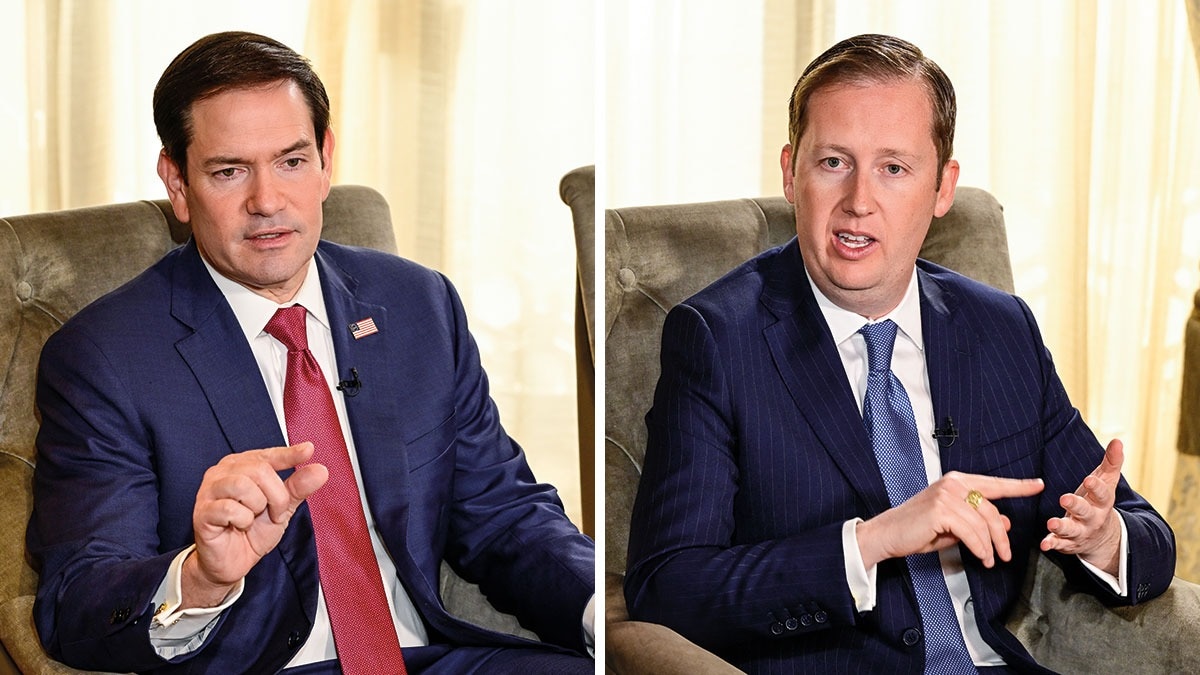
At a time when India-US relations were hampered by a trust deficit, two of Washington’s most influential interlocutors, US Secretary of State and National Security Advisor Marco Rubio, who was in Mumbai on his second visit to India in less than five months, and US Ambassador to India Sergio Gor, sat down with India Today Group Editorial Director Raj Chengappa for a candid discussion on the challenges and imperatives shaping the relationship. From the elusive bilateral trade deal and India’s energy security needs to Russian oil purchases, defence and technology cooperation, the H-1B visa crackdown and concerns over Washington’s growing proximity to Pakistan, the two shared their insights into America’s strategic priorities and the leadership style of their boss, US president Donald Trump. Excerpts:Q. If you were to rate the India-US relationship on a scale of one to 10, with 10 being a perfect partnership, what score would you give it, and why?Marco Rubio: I wouldn’t put a number, I would say it’s a very important relationship. Obviously, it’s two big, important countries. We’ve worked together for a very long time. We have a lot of common interests, and we have a history of working together. And I think India’s progressing so fast on so many areas that are important to the national security and national interest of the United States. It’s a logical partnership. So, I don’t know about one to 10. I would say it is as strong as it’s ever been, and I think in five years, we’ll look back and say it’s one of the strongest relationships in the world.Q. What are the two or three things you plan to focus on right now? Rubio: Well, we’d like to get this trade agreement done because I think that provides stability and certainty for everyone. And then beyond that, I think there are so many areas we can work on, on energy and certainly on technology, artificial intelligence and things of this nature, telecommunications. There’s so much we can work on—biomedical, pharmaceuticals—you name it. I could go on for an hour.Sergio Gor: I will add that pick any sector, and today, the United States and India are working on it closer, at a higher level, and are more engaged, whether that’s pharma, or military exercises. You know, India has more military exercises with the United States than anyone else. So, any sector—IT, of course, sales, our bilateral trade—we’re working at it at a much higher level than ever before. Q. On trade, President Donald Trump has said that India and the US are close to signing an agreement that would be different from others. Is Washington willing to offer India the competitive tariff advantage it is seeking under this interim trade deal?Rubio: Well, I’m not going to get into the specifics of any agreement until they’re done, because there are still a number of items being negotiated, although very few. So, we’re very close, and I can’t foresee anything that will keep us from reaching an agreement, but there’s still some items being discussed. So, I’d prefer not to go into the details of it until it’s all fully worked out. Suffice to say that once this deal is done, it has to be one that’s beneficial to both countries, and that’s what I anticipate it will be.Q. India expects continuity rather than unpredictability in trade relations. Yet there is a Super 301 provision hanging over our heads. Can we expect continuity and not a continuous revision of tariffs?Rubio: Well, the point of an agreement is to be able to have certainty so that people know they can invest, people know what the rules governing trade and commerce between the two countries are going to be. That’s the very purpose of having a deal. And that’s what we’re working towards, and I feel very optimistic that we’re going to get to a very good place very soon.Q. Where do you see the next big wave of American investment in India coming from, and in which sectors?Gor: Look, our bilateral trade is at an all-time high. Fifteen years ago, it used to be 20 billion dollars. Today, it’s 240 billion dollars. And it goes both ways. You have incredible investment coming into the United States. The President recently hosted Essar in the Oval Office. They’re opening incredible facilities, multi-billion-dollar facilities in the United States, that are creating jobs in local communities for Americans. On the other hand, this is a win-win situation. We have American companies that have moved here, especially relating to IT. Now, when they move here, that also complements a job back home. This is not a one-way street. And so, our goal is to keep increasing that bilateral trade and identify those win-win situations.Q. Moving to energy, Secretary Rubio, could you elaborate on the national interest that President Trump has cited to justify US purchases of Russian diesel, as well as the waiver of sanctions allowing India to buy Russian crude, when the country was previously penalised for doing the same?Rubio: Well, a couple points. The first is, right now, you’re looking at the global economy, and all foreign policy has to be balanced holistically. You can’t look at everything through the lens of just one country or one conflict. And while we remain very concerned and are doing all we can to bring an end to the war between Russia and Ukraine, we also recognise the impact that war is having on the global economy, in addition to what we’ve seen in the Strait of Hormuz and now, increasingly, the Red Sea. And so I think the President made a very wise decision, which is to, for a short period of time, allow additional energy flows into the global marketplace, and not just to benefit us. Obviously, it helps the United States, but also diesel prices are high all over the world. In the case of India, it has made real progress in diversifying its portfolio of energy. And it’s done so not because of threats or anything of that nature. It’s in India’s interest to diversify its portfolio...where it gets energy from. You never want to be overly dependent on one country versus another. So, it was already on that trajectory to begin with. It’s not so much about buying less Russian oil than it is about buying more US crude or Venezuelan or others from the western hemisphere. I think that’s in India’s interests, and obviously we want to help facilitate it. And, more importantly, where India has real capability is in ramping it up for refining. India has the capacity and the capability not just to refine more, but to, in very short order, have the kinds of investments that would allow it to expand its refining capability even further.Q. Is that why you went to Jamnagar, to enhance energy cooperation between India and the US?Rubio: Well, we already have energy cooperation. It’s more important to go see the facility, see how they’re operating and understand a little bit more about how it works. It’s a very impressive facility. But it (Reliance) also happens to be a company that has an investment in the United States in Brownsville that is hopefully going to be online by 2029. So, it was a good opportunity to interact with a company that’s investing in expanding refining capability in the United States and at the same time (Jamnagar) is a facility that could play a role in helping refine more crude from the western hemisphere, thereby allowing the world to diversify away from the Middle East.Q. India recently opened its civil nuclear sector, particularly small modular reactors, for private investment. Do you now finally see a breakthrough moment for American investment?Gor: We’ve had incredible momentum on that. Things take time, there have been some regulation challenges, nothing gets done overnight. But to Prime Minister Modi’s credit, the Shanti Bill passed, which enables SMRs and private technology to come to India. These are very complex issues, and they’ll set up the relationship for decades to come. But India is one of the first places that the United States is looking at possibly to have its first SMRs internationally. And so we’re on an incredible path there. We have had meetings in Washington. We have had meetings on this in Delhi and in Mumbai, because the regulatory agency for India is based here. So, it is moving in the right direction. I do think we’ll get there on that soon also.Q. We are sitting inside the Taj Mahal Palace Hotel, which was, if you recall, at the heart of the horrific 26/11 terrorist attacks in Mumbai in 2008. What is America doing to assure India that its current close ties with Pakistan will not come at the expense of India’s fight against terrorism?Rubio: Well, first of all, the United States has to have a relationship with as many countries in the world as possible because we have a global presence and a global interest in anything that’s going on. So, our relationship with Pakistan is not new. Now, it has just developed in a way that allows us to hopefully have more influence over the decisions they make on a variety of topics. In no way does the relationship with Pakistan come at the expense of our relationship with India. We share the same concerns India does about terrorism. We have been victims of terrorism, as India has been, and continue to be. In fact, no country in the world does more to go after terrorism than the United States. It was the United States under President Trump that destroyed ISIS or Daesh in the Middle East. It’s the United States that eroded Al-Qaeda. It’s the United States that went in and eliminated bin Laden. It’s the United States that’s gone in now into parts of Africa to take on these elements as well. So, I don’t think any country in the world has shown a greater commitment to go after global terrorism than the United States, and that includes many of the same ideologies that threaten India.Q: Secretary Rubio, last year, you played an important diplomatic role during Operation Sindoor, following the terror attack in Pahalgam. On May 10, 2025, just before the ceasefire was announced, you spoke directly to the leadership on both sides. Could you take us behind the scenes of those conversations?Rubio: Well, I won’t take you behind the scenes because then no one will ever talk to me again in the future. But anytime we see a flashpoint between countries that could lead to a broader conflict and a war, we try to play a constructive role. And this was a good example of our ability to speak to multiple parties and use, in the case of both India and Pakistan, long pre-existing relationships, that I think have improved over the last few years, to ensure that there aren’t flashpoints that could lead to something broader and more difficult for both. Look, the tensions that exist between the two countries are well-understood. But I can say to you with confidence that I think the United States is prepared to play a constructive role because we’d prefer not to see war. We’d prefer to see the opportunity to partner in business and commerce and do things that provide prosperity and security for the people of India, and also the people of the United States.Q: Let’s turn to defence partnerships. How far is Washington willing to go for joint production, technology transfer and developing advanced weapon systems?Gor: Look, I mean, that has already existed in India, and continues to exist. Lockheed is here, Boeing is here, co-production is happening. Jobs in the United States and jobs in India are progressing hand-in-hand on these production systems. Our defence cooperation is at an all-time high. If you go just by the numbers, it is unmatched. In the last month alone, we had 500 US Army soldiers training here for Yudh Abhyas. We had Tarang Shakti, the first time ever F-35s have been in India to participate in a joint exercise with the Indians. Our F-35s don’t go to any nation, they go to nations we trust, partners we trust. India’s a very valuable partner to us in the Quad. The secretary has had multiple meetings at his level, including, by the way, another one next week at the G20 in Atlanta. Dr Jaishankar will be there, the Australians will be there, the Japanese will be there. We’re also working towards a meeting between leaders, including President Trump, Prime Minister Modi, in the next month. So, there’s a lot happening in the Quad. Defence goes hand-in-hand with the United States, and India is a valued partner in that. So, there’s a lot happening on that front also.Q: Secretary Rubio, how do you see the Quad evolving in response to China’s growing assertiveness? And what more can India and the United States do together to secure critical supply chains and reduce their dependence on China?Rubio: The first meeting I ever did as Secretary of State was a Quad meeting. We’ve had more Quad meetings in the last year and a half than probably the previous four years combined at the foreign ministry level. And we are going to have a leaders’ level meeting now very shortly, probably in December, and we will try to arrange even more before the end of President Trump’s term. He’s got two and a half years left. So, this is a very important relationship, but it’s important not just because we have four countries that are coordinating with one another. We’re beginning to see outcomes. We’re beginning to see results. As an example, maritime awareness, the ability to know what’s happening underwater, threatening cables and so forth. This is something the Quad is working together on, and real things are happening. We can have the same when it comes to supply chains at large. The one thing I think is a consistent theme across the world, but certainly in the US-India relationship, is we do not want to be overly dependent on any country in the world. I am not singling out China. I’m saying any country in the world. We don’t want to depend on any single country in the world for 90 per cent of anything that’s critical to our economies, and we have to have the domestic capacity to do certain things for ourselves. That’s an interest India has. That’s certainly an interest the United States has under President Trump, and that’s something we can work together on. And that is, where we can create domestic capabilities in a mutually beneficial way for both countries on various key sectors, be it artificial intelligence or technology, biomedicine or pharmaceuticals, or critical mineralsthe list goes on.Q: India recently joined Pax Silica. Can we expect significant American investments and technology partnerships that would help India emerge as a key hub in strategic supply chains?Gor: It’s a great partnership. India was one of the first 10 countries that the United States invited to join Pax Silica because we trust India. They’re a valued partner in this supply chain. It is the reason that the Secretary is here twice in one year. I am determined to bring the highest levels of our government here so they can talk to the highest levels of your government here and identify those opportunities. In three weeks, we have the attorney general coming here to work with the folks in Delhi. We’re going to have a counter-narcotics conference in the capital. We’re bringing our DEA administrator. To me, it is important to have the highest levels of our government engaged with individuals here in India.Q: Secretary Rubio, you have spoken about America’s efforts to reindustrialise. In that context, shouldn’t the US be welcoming highly skilled Indian professionals, as it has in the past, rather than raising the cost of work visas and making it more expensive for Indian students to study in America?Rubio: There is a change in our immigration laws, and it’s not one that’s built or focused on India. It happens to impact Indians that want to come to the United States and work and that our businesses are trying to bring in, but it’s not geared towards India. It is global. In fact, there’s no meeting in the world I do that doesn’t raise some visa issue. The United States has had a broken immigration system. We’ve had a system, maybe not in this programme but in others, we had 20 million people unlawfully enter the country across our border. We’ve had business-related immigration programmes where fraud and abuse have been rampant in several cases and have been misused in ways that have not made sense. We have tensions in our own society. What country in the world would not have its people react if they see some of their best jobs going to people coming from abroad? So, these things have to be addressed, and we’re trying to address them, but they’re not aimed at India. They apply to every country in the world. That’s true on trade. That’s true on immigration. I know that a country disproportionately impacted by a policy change in the United States may feel like it’s being targeted, but it’s not. We are going to get it right, and we’re going to have a system that works for our economy and for the American people. In the end, I will say this. I expect the government of India will always put the people of India first and that you will always put the national interest of India first. But I also hope everyone understands that the United States under President Trump is going to put our people first, our workers first, and our country first. And where friends can work together is when there are differences on this, our existing, our common interests, our longstanding relationship, and our shared values will allow us to work through some of those differences to reach outcomes that are positive for both countries.Gor: The Secretary is 100 per cent right. When we talk about America First, it doesn’t mean America alone. And to the Secretary’s point, all these items that have changed that have impacted India, it’s not just India. It’s the whole world, that the United States needed to take a look at. For too long, we had open borders. For too long, people were coming into the United States and taking advantage of us. We had leaders on both sides of the political aisle that did not look out for the American people. That changed under President Trump. That doesn’t mean it’s targeting any individual country. We need a reset. The Prime Minister’s been very clear here, India First. There’s nothing wrong with that. He should be looking out for his own country. But people shouldn’t be surprised that our leadership’s looking out for ours. LEADER TO LEADER: PM Narendra Modi with President Donald Trump on the sidelines of the G7 Summit in France, Jun. 17 Q: Secretary Rubio, turning to geopolitics, President Putin has indicated that Russia is open to a trilateral meeting involving the US and Ukraine to discuss ending the war. What do you see as a realistic path towards ending the Russia-Ukraine conflict?Rubio: Well, it’s a very difficult conflict to end. I know the President has dedicated a tremendous amount of time to it. We have people that do nothing all day but work on trying to find a way to make a difference and bridge those differences. I would just say to you that that war, while people keep talking about it (as) a war in Ukraine, that war is about Donbas. It’s about one region of the country. It is, at its core, about 11 per cent...one part of the country that Russia wants and cannot take militarily, and that Ukraine is unwilling to give up. And they have reasons why they don’t want to do it—for their sovereignty and their own long-term security. And so, the question is whether both sides will make some concessions to bring an end to the war. This war is not going to be solved militarily. This war is only going to end diplomatically. And the question is, can you arrive at an outcome in which both sides receive something, a benefit, but also give concessions and bring this to an end? So, it’s been difficult, but I can tell you this. As hard as it is, it is impossible to do unless both sides are at the table talking, and we’re happy to play the mediating role in that regard. So, that’s really what we’re trying to do. Not claiming that just getting them in the room is going to solve this problem, but we have no chance to solve it if we can’t get them in the room.Q: Ambassador Gor, you have worked very closely with President Trump. What’s the secret of working successfully with the President?Gor: Look, the President is an incredible individual. I have known him for many years. He’s very direct. He expects results. He is results-driven in a similar way that your Prime Minister is. He wants to move fast, and he wants to get things done. That’s something frankly I have admired about our President. Not every global leader is results-driven. A lot of people love having these press conferences and meetings after meetings after meetings. Our President wants results, and he wants them done now.Q: And his equation with Indian prime minister Narendra Modi?Gor: They’re dear friends and it works well because of that, because they see eye to eye on moving the ball forward, on getting things done, on delivering. And so, he holds the Prime Minister in the highest regard. They’ve known each other for many years. They’ll continue to engage. They’ve had multiple phone calls in this month alone. And so, a lot happens behind the scenes that people are not aware of, but the two leaders are constantly in contact.Q: Secretary Rubio, what’s your experience of working with your boss, President Trump?Rubio: Well, he’s a historic figure. There’s no doubt about it. He is not an orthodox political figure. He is not a politician at all. He is a man of business whose intent in life is to make decisions based on what makes sense. But here’s something else he doesn’t get credit for. He’s a visionary. He imagines what people will say is impossible. He thinks things that people say, “Well, we can’t do it because that’s never been done before.” And then he achieves them. When you look at issue after issue, what the President has pushed towards and has been ableTo achieve that people didn’t think was possible because a traditional political figure would have never done it. So, I think for those of us who work for him and with him, it gives us energy to know that we have the ability to do things that you would not be able to do under someone who came from a traditional political background.And in the case of foreign policy and in the world, and in the realm of global affairs, it’s a very exciting time to be doing it.Gor: I will add that, in the future, people will look back on these years, and our President will be one of the greatest, and also a historical figure who achieved a lot. We see it happening in real time now.Q: Secretary Rubio, can we expect to see your name on the presidential ballot in 2028?Rubio: I am plenty focused. I have two jobs right now and they both take up all my time and energy, and I’m very happy doing those jobs.- Ends
Exclusive interview with Marco Rubio: 'Five years from now, India and America will have one of the strongest ties in the world'
Full Article
Original Source
Read the full article at Indiatoday →KhanList aggregates and links to publicly available news content. We do not host full articles from third-party sources. Always verify important information with original sources.