
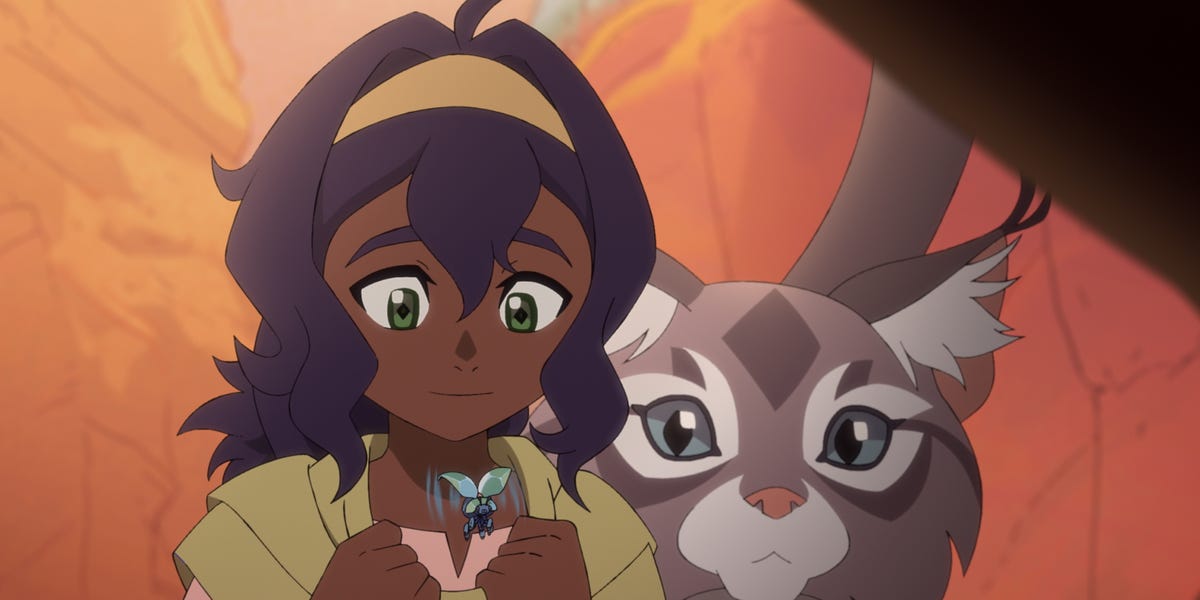
7 min readIn 2020, the winds of change for Avatar—the animated franchise, not the James Cameron movies about blue aliens—began to blow. During the pandemic, animators and creators Michael Dante DiMartino and Bryan Konietzko, who met as students at the Rhode Island School of Design, began mapping out the future for their beloved universe. It included not one, but two new shows.They first made waves in 2005 with their hit Nickelodeon series Avatar: The Last Airbender, a martial arts fantasy about a boy who can harness the four elements of earth, wind, fire, and water. They followed it with the equally acclaimed The Legend of Korra, about a brash young woman who could do the same, that aired between 2012-2014. When die-hard fans assumed Avatar had no more stories to tell, DiMartino and Konietzko secretly hammered away on what was next. The future is here, in the new series Avatar: Seven Havens on Paramount+. And that’s not the only show on the way.“We wanted to do a post-apocalyptic thing,” says Konietzko, in an exclusive with Esquire.As the creators sketched out the character to be the next “Avatar” (that’s the chosen-by-fate, once-a-generation hero who can harness the elements), they resurrected ideas they’ve had for decades but couldn’t execute until now. Setting a story in a society built atop the ruins of another stoked their imaginations for years, but the time for it wasn’t right. “And then at the beginning of 2021, we were like, ‘This is that time.’ You don’t know how many opportunities you get. That’s when we really started digging in.”Paramount+Avatar: Seven Havens is the newest series in the Avatar universe, following twin sisters who discover they are both the next Avatar.Avatar: Seven Havens is the third and newest series in the Avatar universe, with executive producer Ethan Spaulding and co-executive producer Sehaj Sethi. Set more than two hundred years after The Last Airbender and Legend of Korra, the show follows an adventurous girl named Pavi (voiced by Saheli Khan) who hides in obscurity because of her power to manipulate, or “bend,” the elements. But Pavi’s destiny changes when she meets her twin sister Nisha (Aishu Devan), a skilled student who can bend the elements just like her. For the first time, an Avatar story will reckon with two living Avatars at once. How and why this happens are the questions driving the new series forward.Unlike the previous shows where the “Avatar” was a mythic hero, Seven Havens casts them as persona non grata—they are a condemned figure deemed responsible for ruining the world. So it’s truly a matter of life and death that two young sisters must keep their powers secret as they walk among the ruins of a fallen civilization. “A big theme we’re playing with here is that the world is destroyed,” says co-executive producer Sehaj Sethi. But just because the world is broken doesn’t mean it’s too late to fix it.“I do feel I’ve put a burden on my kids’ shoulders. We’ve given them a screwed-up world,” she says. “The only way I could make sense of that is, if I’m like, I need to make you brave, strong, and kind enough that you find a way to fix this. That’s my guiding light with Pavi and Nisha. ‘I cannot save you from danger, I cannot save you from pain. But we can help you face it.’”While the team is obviously resistant to spill more details about the Avatars, plural, they believe it is their first step into a bold future for Avatar at large. “The twin aspect was the key to the whole thing,” says Ethan Spaulding, “It’s like How can that even happen? And the sibling rivalry of two sisters. That’s the main thing.”Why follow two sisters in the first place? The creators joke that it has to do with DiMartino becoming a father of twins in 2016. “That was lingering around,” he says with a laugh. “We did start with Pavi, and we’re like, ‘How are they different?’” Refusing to repeat what they’ve done already with past protagonists Aang and Korra, they made their new heroes younger than either of them, about nine years old (another scrapped idea from Last Airbender) and gave them a sibling to bounce off their restless energy.“What’s interesting is they don’t know each other at first. There’s a lot in the series about memories and digging into the past, finding how this all came to be,” says DiMartino. He adds that the first season of Seven Havens, titled “Book One,” is all about learning the circumstances behind their separation. “That’s what Sehaj and the writers fleshed out throughout Book One and the whole series. Their relationship and how it’s very sibling-like, where one second they’re best friends and the next second they’re fighting.”Gone are the Earth Kingdoms and Fire Nations. The titular Seven Havens are seven pockets of society separated by violent wildlife and massive storms. One of them, Ellora, is the primary setting for Seven Havens. It’s a desert city that resembles a mixture of New Delhi and Southwestern America, with healthy doses of 1970s-’90s Japanese anime and the alien landscapes of French artist Moebius. The whole place is governed by an involuntary paramilitary force of benders called the Bending Brigade. (This is still a cartoon, remember.) Ellora’s half-medieval, half-futuristic identity marks the first time Avatar flirts with science fiction, but the creators aren’t doing a full-throated genre shift. Yet. “Mike and I are always in favor of allowing Avatar to change,” Konietzko says. “It’s not this perpetual fantasy that’s locked in the same state of progress or equilibrium. It’s a dynamic world. We liked the idea of, ‘What if the world was not looking for the Avatar to come back?’ That was something we hadn’t done yet, and was one of the big sparks.”Seven Havens is the first time in twenty years an Avatar series centers on children. But the creators feel that it isn’t dulling their edge. It is an all-ages program—emphasis on “all.” “We did not want [to be] light, fluffy, protective,” says Sethi. “This was a series where yes, the main characters are children, but that did not mean this was just for children.”Spaulding adds Avatar has “always had stakes” that, when seen through the eyes of a child, “is even more dramatic.” “The fun part of the first Avatar was that you’re seeing these heavy themes through the lens of a young person.”“We don’t think in age demos,” says Konietzko. No kidding. Though Avatar: The Last Airbender was intended for an audience between the ages six to eleven, it amassed a devoted fan base of teenagers and adults. In September 2026, The New York Times ranked the best shows of the 21st century. Avatar: The Last Airbender was left off the list, which drew the ire of the Internet. The Times then spotlighted it with actress Devery Jacobs, who raved about its legacy. “I can’t tell you how many times we’ve met people who say, ‘My grandma watches the show.’ If you have a good story, good characters, and a good world, it doesn’t matter.”Speaking of their omission by the Times, I ask Konietzko and DiMartino about it. They’re untroubled. “We’ve been lucky to be on a lot of other lists,” Konietzko says. “We call animation ‘the kids table.’ Live-action people look down on it, but they’re always trying to adapt animation into live-action, and animation tends to still make money.”“The realm of what is possible in animation has exploded,” adds DiMartino. “When you look at the Top Ten on any of the streamers, half of them are usually animated. Some of which are more than ten years old. Animation has staying power in a way that some live-action just doesn’t.”Avatar is proof positive that animation can have staying power. People still talk about Avatar, and Avatar is not slowing down. At New York Comic Con, the creators not only confirmed Books Three and Four for Seven Havens, but they have a fourth series already in the works.It’s called Avatar: Kuruk, and it’s going to be a way different experience than what we have come to expect. How different? Think Freaks and Geeks in the world of Avatar. “This is our first true comedy,” Konietzko reveals to Esquire.Set four hundred years before The Last Airbender, the new series will follow Kuruk, another Avatar who lives in a peaceful and flourishing era—no wars or genocides to worry about. Though Kuruk has made appearances in past Avatar shows and several comics, he’s long been painted in a tragic light. Konietzko, who is fond of the guy, felt he had enough. “I was like, This guy’s getting a bad rap. I want to flip that on its head and show how awesome he was. It’s a really fun show.”He describes the show as spiritually “high school,” but that doesn’t mean Avatar fans will see storylines about football games and prom nights. “It’s kind of a Freaks and Geeks. It’s not a high school setting. It focuses on these Water Tribe kids traveling around the world. They’re just total screw-ups, and it’s super fun.”In the past, Avatar has been about boy monks and headstrong girls. Now it’s about lost twins, and soon, lunkheaded teenagers from eons ago. “That’s what’s exciting to me,” says DiMartino about the present and future of Avatar. “It can go in a bunch of different genres, tones, and styles. We have a hundred-plus Avatars, half or more of which we haven’t even created yet. There’s a lot of opportunities down the road.”
Exclusive: Inside the Bold New Future of Avatar
Full Article
Original Source
Read the full article at Esquire →KhanList aggregates and links to publicly available news content. We do not host full articles from third-party sources. Always verify important information with original sources.