
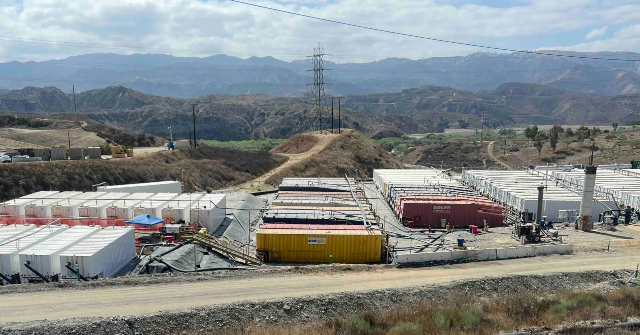
A national refuse company has lost nearly a billion dollars in income and spent a billion more trying to satisfy a dozen “green” agencies in California with conflicting demands and regulations that have kept Los Angeles’s second largest landfill shut down for nearly two years. That’s the case with a 639-acre Chiquita Canyon Landfill, which was shut down on New Year’s Day in 2025 after a gang of regulators began acting on complaints from nearby residents of odors. A class action lawsuit was filed claiming the fumes were the source of, among other conditions, “headaches, dizziness, eye, nose, and throat irritation, as well as mental health concerns.” Nuisance odors were one thing. But claims of serious health conditions allegedly suffered by people miles away were another, though they appear unsupported by two health studies at the height of the odor problem, according to documents reviewed by Breitbart News in its investigation of the controversy. Despite that, the narrative by opponents of the landfill would terrify most anyone if accepted at face value. That narrative includes a dangerous, cancer-causing “fire” purportedly raging deep in the bowels of an old section of the mountainous landfill, according to the Los Angeles Times, CBS News, Democratic lawmakers, and bevy of personal injury litigators. Yet “fire” is an entirely inaccurate description, company officials say. In fact, federal documents show the Environmental Protections Agency (EPA) won’t even use that term. Democrats Not Letting A Crisis Go to Waste That distinction didn’t stop 40th District Assemblymember Pilar Schiavo (D), who represents the area, from telling the California Insider last fall that by April of 2025 “the fire” had tripled in size. He also claimed there were cancer clusters appearing in nearby neighborhoods. Schiavo said two toxic chemicals were detected in the air: Benzyne, a known cancer-causing substance and one of the most widely used chemicals in products in the U.S., and Acrolein, a suspected carcinogen but only after long-term exposure. Last year, Shiavo also led a delegation of Democratic state lawmakers to visit the landfill to view unsuccessful attempts to “reduce the size of the fire.” The issue was handy fodder for California’s ubiquitous environmental activist Democratic base, from high office to local boards. U.S. Rep. George Whitesides (D-CA) pushed for relief funds for residents. A local water board candidate touted her opposition to the landfill, promising to stand up against “corporate polluters.” All the attention resulted in squads of regulators from government entities pouncing on Waste Connections and its subsidiary which operates the Chiquita Canyon Landfill. Since then, the company has been desperately trying to satisfy the EPA and 12 state and local agencies who, company insiders say, have thwarted the firm’s more than $1 billion in solutions at almost every turn. “Just when we satisfy the requirements of one regulatory agency, one of the others comes along and says, ‘Oh no, you didn’t do it the way we want,’ and we’re back to square one,” said Kevin Green, district manager of the Chiquita Canyon Landfill. In 2024, alongside the gangs of bureaucrats, personal injury litigators joined the fray with lawsuits flying in all directions. One L.A. firm allegedly hired an actor dressed up as a “cowboy” to go door-to-door signing up plaintiffs in a nearby neighborhood — a crime in California. In short, as one company insider put it, Chiquita Canyon became Southern California’s favorite environmental “punching bag.” An Inherited Problem The Chiquita Canyon Landfill, in operation since 1972, is about an hour north of downtown Los Angeles in the I-5 corridor. It is roughly two miles from the town center of Castaic, a town of some 18,000 known for its recreation area and as an interstate trucking stopover. It’s also about eight miles north of Santa Clarita, a suburb of some 220,000 residents. Waste Connections, the disposal firm that bought the half-century old landfill in 2009, has facilities throughout the U.S. In other states, company lawyers and officials say, their landfills deal with one or tw0 regulatory agencies, instead of the dozen they are experiencing in California. The Chiquita Canyon Landfill became a public controversy in May of 2023 when one of the local agencies, the South Coast Air Quality Management District (AQMD), “began receiving hundreds of odor complaints that agency investigators traced to the landfill,” according to the agency. Many of the complaints came from Val Verde, the unincorporated community of 3,200 just north of the landfill. The agency issued its first air quality violation that month and followed with more than 140 after that, with the odor complaints increasing to more than 1,200 and some residents reporting to the county that besides eye and throat irritation, they were unable to sleep and therefore had to “stay away from their homes for extended periods.” Engineers already suspected the culprit in 2022, noting that higher subsurface temperatures were present in an old section of the landfill prior to Waste Connections’ acquisition of the site, according to an EPA “reaction event history” on the matter. The reaction, known as an Elevated Temperature Landfill (ETLF), combined with historic rainfall in 2023, was producing increases of “leachate,” or contaminated water generated by the landfill. That summer, Waste Connections engineers and administrators went to work to stop the problem and began proposing solutions for the future as well. According to a report by the county’s Chief Executive Office in September of 2023: Waste Connections has already taken the following actions to mitigate the impacts of the odors: expanded the Landfill gas collection system by installing one temporary flare to capture as much landfill gas as possible and plans to install additional temporary flares. Waste Connections also installed deodorizing misters and towers, industrial blowers and fans, and additional extraction wells and pumps to remove leachate liquid from the landfill. In addition to the long and short-term solutions, Waste Connections implemented a program to provide residents with free air purifier units upon request. The efforts, however, would turn out to be not nearly enough for the Biden administration’s EPA. Waste Connections installed a dozen sophisticated air quality monitoring stations in nearby communities at a cost of more than $1 million each. Still, regulators are not satisfied. Credit: Lowell Cauffiel / Breitbart News By February of 2024, with the odor complaints reportedly numbered more than 6,800, the EPA issued an order and a subsequent violation “to mitigate off-site community impacts caused by noxious odors and hazardous waste leachate” at the site. The scrutiny didn’t stop with the federal government. Twelve other agencies soon took a hand in regulating the landfill, claiming jurisdiction over everything from air quality to building permits. The high number of agencies scrutinizing a single landfill operation was unheard of in other states. Agencies included the California Environmental Protection Agency, California Air Resources Board, CalRecycle, California Department of Toxic Substances Control, Los Angeles Regional Water Quality Control Board, South Coast Air Quality Management District, the County Department of Public Works, the County Department of Public Health, the County Department of Planning, and the state Office of Environmental Health Hazard Assessment. On top of all that, the EPA put them all under an umbrella regulator called the Multi-Agency Task Force (MCAT) which the landfill would have to satisfy. That’s when everything got really complicated, company officials said. Unable to meet the blizzard of requirements, overlapping orders, and requested responses generated by the agencies, in January of 2025 it stopped taking in refuse. The result, which continues to this day, means that it would no longer be handling 25 percent of the trash generated by Los Angeles and other municipalities in the county. It would no longer be taking in some 60,000 tons of refuse a week at its former average, meaning that at the typical price of $150 a ton, it is losing as much as $9 million a week in unrealized revenue. Currently, L.A.’s garbage is going to the county’s largest refuse facility, the Sunshine Canyon Landfill, 26 miles to the south in Sylmar. Sunshine, run by Republic Services, has its own set of problems, including an abatement order after dozens of odor violations and nearly 9,000 odor complaints since the 2023 heavy rains. Yet, Sunshine remains open, and has increased its disposal rates since Chiquita closed, according to Green. At Chiquita, the stoppage was made even though the old section of the landfill producing the gases was inherited from prior operators and had no connection with sections being used before deposits stopped, according to the company. A Paper Blizzard: Thousands of Pages a Month Since, Chiquita staff has been generating “four to five thousand pages” each month to the dozen regulating agencies in documented responses to their demands, company insiders say. More than 60 employees and as many as 100 contractors are involved in making all the necessary changes not only to meet agency demands but to install equipment and measures the company believes will solve the odor problem. While local media continually report ongoing landfill “violations,” rarely are these explained. One recent violation, for example, from an agency called the South Coast Air Quality Management District (AQMD), faulted them for “failing to maintain” on a “weekly basis” a dedicated page of its website “in Spanish.” Many of the other violations, despite the thousands of pages generated by the landfill in its ongoing response, appear to be procedural reporting errors, but are often portrayed by local media as Chiquita being a scofflaw causing public health risks. Most have nothing to do with actually addressing an environmental problem, said a company spokesman, who listed what he called “absurdities”: One agency issued duplicative penalties for not relocating a tank farm (totaling as much as $145,000 per day) while simultaneously refusing to approve any location to move it to. Chiquita received a formal violation for filing a 1,000-page report 45 minutes late. Another violation came for filing a report 12 days late following a cyberattack. A permit application for critical pollution controls has sat unanswered for almost three years. Meanwhile, the company has spent more than $1 billion in remediation measures, its representatives say. Those include: Installation of more that 330 gas-collection wells. An around-the-clock incident command center. Treatment on-site of thousands of gallons of the contaminated liquid (leachate). Payment of more than $23 million to neighboring households. Distribution of nearly 3,000 air purifiers, including at local schools. The facility also installed more “flares,” smokestack-like devices which senior project engineer William Haley told Breitbart News are used to burn off any methane gasses, reduce greenhouse emissions, and stop odors coming from decomposing waste. It also has been installing a 90-acre “geosynthetic” cover over the problem area to capture “excess surface emissions,” he said, with a completion date this December. Almost completed is a 90-acre “geosynthetic” cover over a problem area producing odors the company inherited from previous operators. Credit: Lowell Cauffiel / Breitbart News The result from such measures, as determined by a dozen multi-million-dollar air monitoring stations it also installed, “show progress,” including higher overall gas recovery and “no nitrogen sulfide or benzine detections above health protective thresholds.” The costly stations were installed to nail down exactly what gases were being detected and to report the air quality to residents to reassure the community the company was addressing their concerns, according to the company. Green said the last odor violation the landfill had was on September 11, the only such citation in the last 90 days. Regulations Equal More Pollution Ironically, say Waste Connections executives, the shutdown and the regulatory requirements are effectively causing more pollution, not less, particularly of greenhouse gases in a state that promotes itself as the greenest in the U.S. The collected and treated “leachate” — the polluted water that comes from it passing through the refuse — has to be shipped to available disposal sites after it has been largely purified. However, local disposal companies no longer will accept it. Chiquita officials suspect that is because those facilities fear regulatory blowback. So, Chiquita Canyon averages sending 40 to 50 truckloads of “nonhazardous leachate” to disposal companies as far away as Arizona, Oklahoma, and Michigan, as well as Mexico. “If the goal is to reduce pollution by the agencies,” said one landfill engineer, “that certainly represents a big increase in carbon emissions shipping that so far away when it could be handled locally.” Allegations: The Cowboy Who Signed Up Personal Injury Cases Talk of cancer clusters and horror stories of health hazards have found their way into news reports since early in the controversy. But those claims have also come into question and will no doubt be disputed in pending discovery and a trial if one occurs in the class action lawsuit. Two air quality studies, one prepared for Los Angeles County in 2023 and another done in 2024, stated that no short or long-term health effects were expected from the emissions that wafted into nearby communities in recent years. The cancer “clusters,” which Assemblywoman Shiavo claims go back years, also are in dispute. A study reported in March by the Keck School of Medicine at the University of Southern California showed no significant increase in the incidence of cancers in the area through 2021, though the study could not predict the impact of more recent odor complaints until data comes in many years later. All this hasn’t deterred the lawsuits, more than a dozen of them from the community now consolidated into one that includes 10,000 different plaintiffs, some of them more than a dozen miles away from the landfill, according to Waste Connections’ legal department. Plaintiffs seek damages ranging from alleged health issues to “more typical nuisance claims,” as one lawyer put it, such as “loss of use and enjoyment of their property.” One law firm known as DTLA (Downtown Los Angeles Law Group), which represents 1,300 of the plaintiffs, has been accused by local lawyer Oshea Orchid of “unethical solicitation and fraudulent conduct” by hiring an actor from Las Vegas whom it dressed up as a cowboy to sign up clients in the Val Verde community with 3,000 residents near the landfill. Hitting a payout through the lawsuit would appear attractive in the largely Hispanic, working-class community of Val Verde, with individual incomes well under $50,000 and homes in the $600,000 range — a modest investment by California’s high real estate averages. Orchid turned her legal fire toward the law firm in 2024 after she allegedly “spotted the cowboy promising lawsuits to patrons,“ according to a complaint Orchid filed with the State Bar of California. According to Los Angeles Times reporting: “He admitted he was an actor and that the DTLA Law Group had paid him $5,000 to drive from Las Vegas, put him up in a hotel, given him Western attire and directed him to pretend to be a local cowboy to solicit residents of Val Verde in front of the Fast Stop,” Orchid recounted in the April 2026 complaint. “Before agreeing to leave, he gave us the chaps he didn’t know how to use.” DTLA Law Group was already under investigation by the county district attorney’s office over claims that some of its clients made up stories of sexual abuse in juvenile halls in order to sue, the Times also reported. DTLA disputed the claim, saying they hired the man to display “educational flyers” and blamed the charge on a “competing” lawyer. But the complaint made it into a motion in the federal court case. “Credible allegations suggest that this case has been infected with lawyer misconduct or even criminal activity that has caused the filing of fraudulent claims,” Paul Chan, an attorney representing the landfill owners, wrote in an April 24 motion. Orchid, however, who filed the case’s first class-action lawsuit, has also raised eyebrows among the landfill company and its legal team. While she claimed publicly the landfill is posing a health hazards to people in Val Verde, “for years,” that hasn’t stopped her from maintaining her home and business there since 2020. Waste Connections’ legal department told Breitbart News they plan on vigorously defending the class action suit because the company officials “firmly believe” they are right and have acted with “integrity.” They predict any trial would be years away. Company lawyers have also struck back. Waste Connections’ subsidiary in June sued the county, its supervisors, and its water quality control board seeking $825 million in damages. The suit alleges the landfill should have been able to continue to operate but was forced to close because of the onslaught of “illegal” actions by the county that prevented it from accepting waste. Meanwhile, the company keeps reporting its progress to the local Community Advisory Committee, most recently saying that only four incidences of benzene detection occurred in all of 2026 but were found to be false readings due to a sensor failure. An Unlikely Agency to the Rescue? Ironically, the resolution to the entire debacle may come from what previously would be the most unlikely source — the EPA. That is the same agency under the Biden administration in 2024 that cited the company for violating the Clean Air Act. At the time, CBS told Southern Californians the company had emitted “excessive toxic gases, including benzene, hydrogen sulfide, and other chemicals that can damage lungs.” But company officials note a distinct change in the EPA under current administrator Lee Zeldin and President Donald Trump, who appointed the former lawmaker to head the agency. “We approached the EPA and asked for help,” said Green, who took over running the landfill in January. Unlike previous administrations, where the EPA would have likely added to the bureaucratic morass, the agency under Zeldin is offering to help by herding the feral bureaucratic cats and consolidating their demands. As Green put it, the federal agency has been “streamlining” what needs to be done instead of leaving the company “stuck in a morass” of a dozen agencies. In short, the Trump administration may very well untangle the web of questionable claims and redundant and conflicting orders to stop the landfill from hemorrhaging money and get it back to disposing of L.A.’s garbage. Some might wonder why the company just doesn’t abandon the landfill with the millions being lost each week in revenue and the continuing costs of solutions. Officials say they will likely face even more losses in the form of sanctions from the county. However, a company spokesman maintained there is a higher principle in play. “Because we believe so firmly in integrity that we’re going to do the right thing at the right time, we’re going to continue to operate this facility to ensure that it does not impact the environment,” he said. Chiquita Canyon continues to churn out paperwork, generate reports to the community, answer queries from the agencies, and evaluate and install equipment while banking on the EPA to free it from bureaucratic limbo and one day help it reopen. Executives and workers remain busy doing everything but what the landfill was designed to do — disposing of people’s garbage. Breitbart contributor Lowell Cauffiel is the best-selling author of the Los Angeles crime novel Below the Line and nine other crime novels and nonfiction titles. See lowellcauffiel.com for more.
Exclusive — Bureaucratic Nightmare: L.A. Landfill Losing Millions Each Week Due to a Dozen Green Agencies and Dubious Cancer Claims
Full Article
Original Source
Read the full article at Breitbart →KhanList aggregates and links to publicly available news content. We do not host full articles from third-party sources. Always verify important information with original sources.