
When meeting Gandhi in jail in 1932, Ambedkar told him: ‘Let there be no repetition of the old method when the reformer claimed to know more of the requirements of his victims than the victims themselves.’ Reading this warning now, almost a century later, one can see it as prescient. There had to come a time when Dalits would be represented by one of their own, rather than spoken for by a reformer from the upper-castes, however well-meaning he might be.Gandhi’s courage and resolveAmbedkar’s posthumous emergence as the great icon and exemplar of Dalits is thus entirely understandable. But whether the attacks on Gandhi by Ambedkarites are entirely merited is another matter. For Gandhi’s own campaign against untouchability was conducted with great courage and resolve. Had he not been around, the issue may never have acquired the salience and importance that it did. None of his important colleagues in the Congress Party — not Jawaharlal Nehru, not Vallabhbhai Patel, not Subhas Chandra Bose — understood how gravely the cause of Indian independence was undermined by the pervasive inequalities of caste. Nor did left-wing anti-imperialists such as Bhagat Singh and company. Indeed, Indian Marxists completely ignored the caste question. This was because they looked at justice exclusively in economic terms, through the prism of their master category of ‘class’. Derived from Marx’s own focus on European history, this analytical framework had little (and often no) room for the social, cultural, and psychological aspects of caste discrimination in India.Among the major Indian nationalists of the day, only Gandhi recognised the hypocrisy inherent in demanding freedom from the British while allowing so many Indians to live and suffer in conditions of unfreedom. Moreover, he saw it not just as a political problem, but a moral one. Untouchables had to be given equal rights so as to make a more persuasive case for India’s political independence. At the same time, upper-castes Hindus had to atone for the ‘sin’ that untouchability represented.While his fellow Congressmen were, by and large, indifferent to Gandhi’s anti-untouchability campaign, a broad swathe of the general public was implacably opposed to it. Indeed, the unreasoning and extreme hostility to Gandhi from orthodox Hindus helps explain why he adopted an incremental approach in challenging caste prejudice. Between 1915 and 1920, when he was first establishing himself in Indian politics, he attacked untouchability without calling into question the caste system itself. As he grew more certain of his hold over the Indian people, and especially the Hindus among them, he began to encourage inter-mingling, inter-dining, and, eventually, inter-marriage itself.Notably, as Gandhi’s challenge to social orthodoxy became more direct, the opposition to him intensified. There was an unrelenting barrage of hate mails received by Gandhi for daring to question what his right-wing critics claimed was the divinely ordained hierarchy of caste. Adding to the verbal abuse were threats of violence, with at least one assassination attempt provoked by his anti-untouchability campaign.Ambedkar saw Gandhi as a timid and hesitant reformer. Orthodox Hindus, on the other hand, saw Gandhi as a dangerous revolutionary attacking the very basis of scripture and tradition. This disjuncture in viewpoints brings to mind some comments of the great black abolitionist Frederick Douglass on his great white contemporary Abraham Lincoln. In a speech of 1876, Douglass remarked that ‘viewed from the genuine abolition ground, Mr. Lincoln seemed tardy, cold, dull, and indifferent; but measuring him by the sentiment of his country, a sentiment he was bound as a statesman to consult, he was swift, zealous, radical, and determined.’The two greatest opponents of untouchability in the first half of the twentieth century were Gandhi and Ambedkar. Their differing social locations and political affiliations produced sharp disagreements between the two men. In recent decades, as Dalits have grown more self-aware and better organised, they have turned more, much more, to Ambedkar than to Gandhi, to the activist intellectual who was himself a Dalit rather than to the guilt-ridden upper-caste reformer. This elevation of Ambedkar over Gandhi was inevitable, and appropriate. However, the politics of the present have also led to a wholesale repudiation of Gandhi on the part of those who seek to fight against the injustices of caste.A posthumous reconciliationWhen, back in the 1990s, this demonisation of Gandhi by Dalit activists was gathering pace, the social theorist D. R. Nagaraj wrote an essay with the telling title ‘Self-Purification versus Self-Respect’, capturing the different paths taken by the two reformers. The self-purification of Gandhi sought to make upper castes abandon their arrogance and contempt for those whom the mere accident of birth had consigned to the bottom of the social hierarchy. The self-respect of Ambedkar was aimed at his fellow Dalits, urging them, as he famously put it, to ‘educate, agitate, and organise’ to claim rights of full and equal citizenship in the Indian Republic.With the star of Ambedkar in the ascendance, Nagaraj reminded his readers that it was Gandhi who first made the eradication of untouchability ‘one of the central questions of Indian politics.’ Now, ‘from the point of view of the present’, he argued, there was ‘a compelling necessity to achieve a synthesis’ of the legacies of Ambedkar and Gandhi. To build a more caring and just society, one needed both to awaken afresh the upper-caste conscience and to consolidate the efforts for Dalit self-respect. Hence, insisted Nagaraj, ‘Gandhiji and Ambedkar can and should be made complementary to each other.’Nagaraj understood that his call for a posthumous reconciliation between two figures whom both history and politics had made implacable adversaries might not meet with approval. As he presciently wrote, ‘surely such efforts will be met with stiff opposition from hardened ideologues and researchers, and they are bound to unearth fresh evidence to fuel the fire between the two’.D. R. Nagaraj died a few years after writing these words. His call to bring these apparently opposed legacies in productive conversation has been continued by his friend, the Dalit novelist and activist Devanuru Mahadeva. Speaking to the journalist Amrita Dutta on the eve of Gandhi’s 150th birth anniversary, Mahadeva urged democrats not to view Ambedkar and Gandhi as rivals and adversaries. In the journey towards true equality, he said, they should rather be seen as colleagues and co-workers. Thus, as Mahadeva remarked, ‘Ambedkar had to awaken the sleeping Dalits and then make the journey. Gandhi had to make the immense effort of uplifting, correcting, changing those who were drowned in Hindu caste religion, in caste wells, to take a step forward. When you see all this, maybe Gandhi would not have traversed far without the presence of Ambedkar. Similarly, I feel that without the liberal tolerant atmosphere created by Gandhi in the wells of Hindu caste religion, then this cruel Savarna [upper caste] society may not have tolerated Ambedkar as much as it did then.’Mahadeva continued: ‘If it is our understanding that it is the Savarnas who need to change if India has to liberate itself from caste, then Gandhi is necessary. In the fight for Dalit civil rights, Ambedkar is absolutely necessary. Hence, I say that both should be brought together.’ This is a sentiment which I whole-heartedly endorse.Excerpted from Arguments with Gandhi (HarperCollins India).
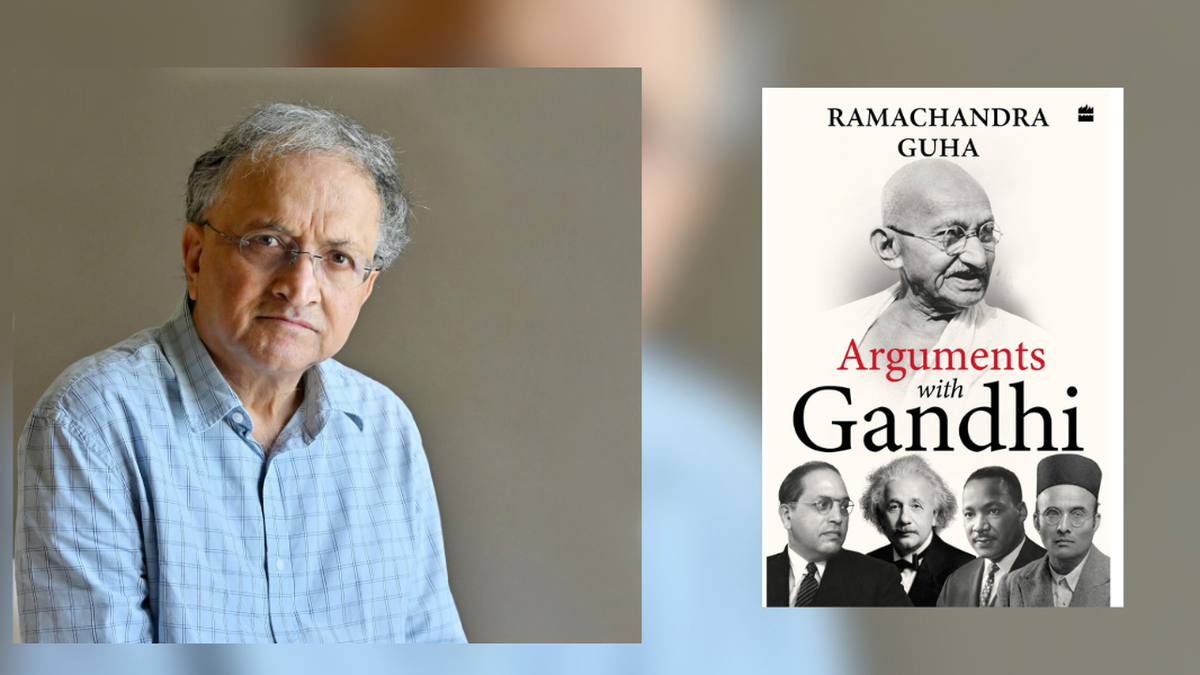
Excerpt from Ramachandra Guha’s Arguments with Gandhi
Full Article
Original Source
Read the full article at Thehindu →KhanList aggregates and links to publicly available news content. We do not host full articles from third-party sources. Always verify important information with original sources.