
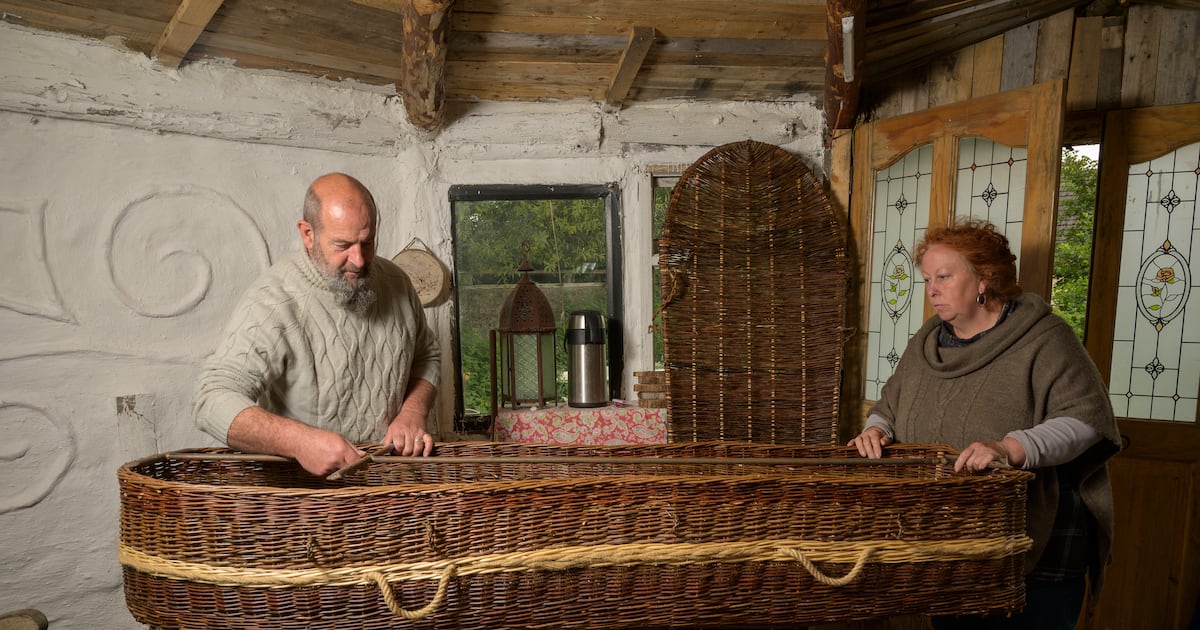
The Irish funeral is a cornerstone of the nation but the nature of how we say goodbye to loved ones is evolving.Whether it’s wicker coffins, services at home or spiritual send-offs, new trends are starting to emerge alongside traditional ceremonies. But the biggest change is a shift towards cremations, which were once frowned upon in the Catholic Church. Cremations now account for about 70 per cent of all funerals handled across the five Dublin cemeteries managed by Dublin Cemeteries Trust. Across the rest of the country, the proportion is estimated to be about 25-30 per cent.“Burial is now the minority choice in Dublin,” says Gus Nichols, managing director of Fanagans Funeral Directors. The first cremation in Ireland took place in 1982 and “there’s now four crematoriums here in Dublin”, he saysREAD MORESpeaking at the company’s Aungier Street office, he says he would like to think cost is not the main factor in this choice but acknowledges cremation is less expensive. Gus Nichols of Fanagans Funeral Directors at their office on Aungier Street in Dublin. Photograph: Enda O'Dowd For families who already own a burial plot, the average charge to open a grave is about €1,000 – roughly double the cost of a cremation.Nichols says there are different types of burial sites: local authority/public provision, trust/charity provision and private provision.New plots in Shanganagh Cemetery (managed by Dún Laoghaire-Rathdown County Council) cost about €2,900 plus associated service fees, plus €1,000 to open a grave Glasnevin Cemetery is a private, operational cemetery managed by the Dublin Cemeteries Trust, a registered charity. The price of a grave here ranges from €1,875 to €9,500, depending on the section and capacity of the plot. While this is a “lot of money”, Nichols says it is “a realistic charge for something that’s going to be needed for 150 years. If you think about the lifetime of a family, the generation impact of a family, 100-150 years”.[ Funerals are the only aspect of Catholic life I engage with any moreOpens in new window ]In privately owned cemeteries such as Kilternan and Glasnevin, prime grave sites can cost €12,000-€15,000. “If it’s nicely designed and kept well, and people are prepared to pay for it because they see the long-term value with it, then people will make that decision to buy, but you’re not forced to make that decision. “And there are other options which are less than that. But undoubtedly, if you’re looking and analysing funeral costs overall, if a family doesn’t have a grave, the bill is always going to be higher,” Nichols says.Costs for new grave sites outside Dublin range from about €260 to €1,600 for a standard single plot. While the Catholic Church lifted its ban on cremations in 1963, Nichols thinks it has taken a long while for devout Catholics to come around. Now traditional funeral services accompanied by cremations – either for burial in a grave plot or to be stored or scattered elsewhere – are far more common.A solid eco pine coffin from Private Cremation in Mount Jerome Victorian Chapel. Photograph: Private Cremation Alan Massey, the owner and proprietor of Mount Jerome Cemetery and Crematorium in Harold’s Cross, Dublin, feels the rising number of cremations is “primarily economic”.An adult cremation fee at Mount Jerome is €490, with additional optional charges such as the use of the chapel for a service, which costs from €120.“You’re looking at €4,000-€5,000 for a coffin burial,” Massey says. “I would say it’s economics [and] people becoming more secular. It is an urban/rural divide: in the countryside churches often have graveyards beside them whereas in the city that’s not the case.”[ My English friend was shocked that I got drunk at my grandmother’s funeralOpens in new window ]Mickey Doyle runs Private Cremation, a company that offers “low-cost, compassionate and professional cremation”. This starts at €1,950 for a private unattended cremation (which includes items such as transport of remains, a coffin, administration fees and the return of the ashes), while a bespoke cremation, including a service, costs €2,250. Prepaid plans for the services cost €2,750-€2,995. “There are 35,000 deaths a year and not all of them want a traditional funeral,” he says. “People want different aspects, and we offer a simplified but beautiful service at an affordable cost.”An Post Insurance/Red C statistics put the average cost of a funeral in Ireland in 2024 at €6,252, up from €4,062 in 2016. Based on this trajectory, the average cost could hit €9,000 by 2036, according to Doyle.With this in mind, Doyle says the fixed price will not change. “It just gives people peace of mind. You never have to worry about rising prices.”Westcountry Willows: Kate and Alan Burrows. Photograph: Michael McLaughlin Westcountry Willow: Kate and Alan Burrows make coffins created sustainable Irish willow grown on their own land. Photograph: Michael McLaughlin Further variety in funeral services in Ireland can be seen in the choice of coffin, with rising demand for biodegradable models.In Co Roscommon, husband and wife Alan and Kate Burrows set up their business Westcountry Willows in 2023.Kate explains that a win in the Irish Business Design Challenge Awards in 2023, which included a €15,000 prize, helped the couple to launch the business. Their hand-woven willow coffins range in price from €1,200 to €2,000.Kate has been weaving for years but when her mother opted for a wicker coffin, she saw it as a “more soft way to send off a loved one, almost like a nest”. “I met a man in Cavan who was a basket maker and he made a coffin for somebody that I know. I asked him if he would teach me how to make coffins. Eddie McGrath was his name and he was taught to make coffins in Somerset. “Here I am, from Somerset living in Ireland, and I learned how to do it from an Irishman who had learned it in Somerset.”Kate Burrows making a coffin. Photograph: Michael McLaughlin Kate and Alan soon found “a calling” in willow coffins, and then something they never anticipated happened: people starting coming to them asking to help with making their own coffins.“When I started making coffins, I soon realised I was making them for people who weren’t dead yet. “I’ve also had to learn to deal with people who are at the end of their life, and people come to me – for example they may have stage four cancer – and they want to come and help weave their coffin. “This is a service that we offer, and people often bring family members.”Kate says more of her customers are looking into alternative funerals and “celebrations of life”. “I find that a lot of the funeral industry is quite set in its ways and quite old-fashioned,” she says.“More people are wanting to have different types of ceremonies, or no ceremony, or no religious service and just want to have a quiet affair with a few friends and things like that. Times are changing. More people are also wanting to make those choices that are also not doing any harm to the planet.”[ ‘He was only 88’: There is a cosy familiarity to Irish funeralsOpens in new window ]Last year they held a weekend workshop in Co Clare where they helped people create a mock funeral ritual.“I got people helping to make a shroud, which is another thing becoming more popular, and helping people to write messages to put inside the coffin, to make wreaths to put on the coffin, and then we walked around carrying the coffin ... singing songs and seeing and exploring how funerals can be done differently.“It’s something that’s definitely growing and gaining momentum in Ireland now,” she adds. “People just want something different.”
Evolution of the Irish funeral: ‘Some people want to help weave their own coffin’
Full Article
Original Source
Read the full article at Irishtimes →KhanList aggregates and links to publicly available news content. We do not host full articles from third-party sources. Always verify important information with original sources.