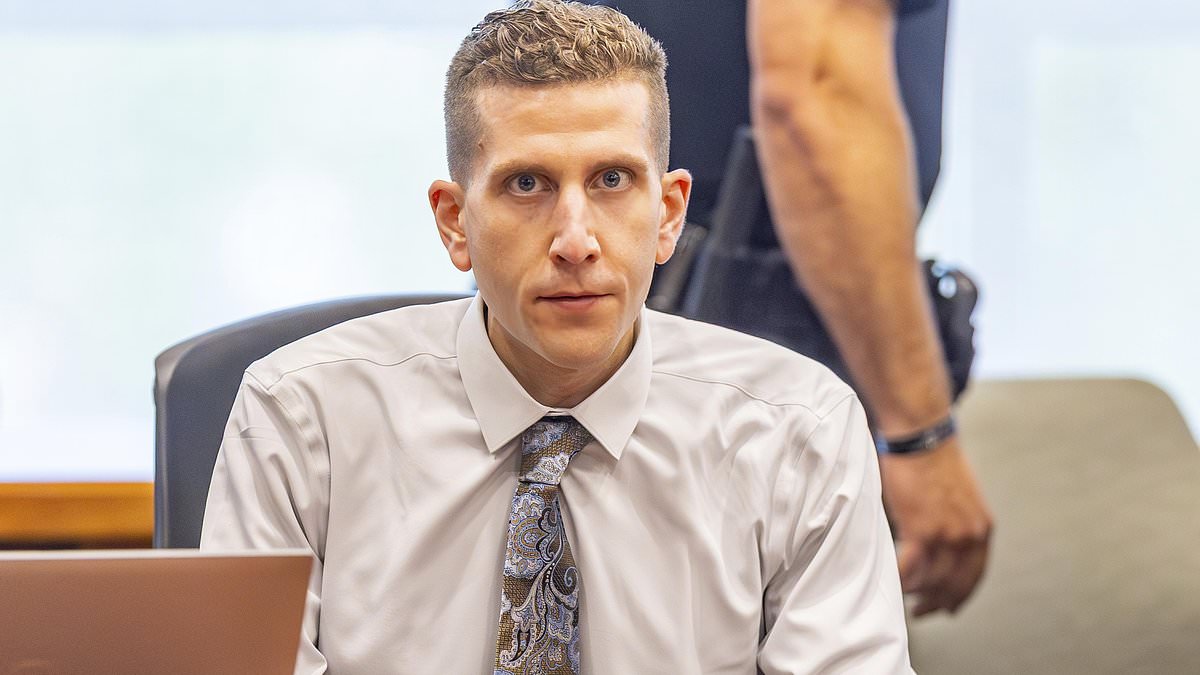
Idaho college killer Bryan Kohberger has petitioned to revoke his guilty plea and is demanding to stand trial after he previously admitted to slaughtering four students.Kohberger, who is currently serving four consecutive life sentences, revealed his decision to file the petition in an interview with the New York Times and claimed he had an 'absolute claim of innocence.''My actual innocence is my truth, and the plea, hinged on by false promises and blatant disinformation, MUST be withdrawn,' he told the newspaper. Kohberger pleaded guilty to the November 2022 murders of University of Idaho students Madison Mogen, Kaylee Goncalves, both 21, Xana Kernodle and Ethan Chapin, both 20, last July.He was sentenced to life without parole in August 2025.Though Kohberger, 31, admitted responsibility for the killings as part of a plea deal that spared him the death penalty, he has never publicly explained why he targeted the four friends. He declined to comment on specifics about the alleged evidence that he says will exonerate him, the Times reported.He also reportedly refused to talk about the concerns he has surrounding the plea process. Best friends Mogen and Goncalves, both 21, were sleeping in the same bed in Mogen's room after a night out. They were both stabbed multiple times Young couple Ethan Chapin and Xana Kernodle were murdered by KohbergerMogen, Kernodle, Goncalves and Chapin were found stabbed to death on November 13, 2022 in a rented off-campus house in the small, rural town of Moscow.Prosecutors say that Kohberger, who was masked, snuck into the home and brutally murdered the students. Kohberger, a graduate student in criminology at nearby Washington State University, was arrested in Pennsylvania, where his parents lived, roughly six weeks later.A Q-tip from the garbage at his parents' house and genetic genealogy were used to match Kohberger's DNA to material recovered from a knife sheath found at the home, investigators said. They also used surveillance camera footage to help locate a white sedan that was seen repeatedly driving past the home on the night of the killings.Cellphone location data also showed that Kohberger had been in the neighborhood multiple times before the attack. Kohberger's attorneys got the trial moved to Boise after expressing concerns that the court wouldn't be able to find enough unbiased jurors in Moscow.But Judge Stephen Hippler rejected their efforts to get the death penalty taken off the table and to strike critical evidence - including the DNA - from being admitted in trial. The student home at 1122 King Road in Moscow, Idaho, where the murders were committedNo blood or DNA was found in Bryan Kohberger's white Hyundai Elantra after his arrest Left to right: Dylan Mortensen, Kaylee Goncalves, Madison Mogen (on Kaylee's shoulders) Ethan Chapin, Xana Kernodle and Bethany FunkeIn exchange for Kohberger admitting guilt and waiving his right to appeal, prosecutors agreed not to seek his execution. Both sides recommended that he serve four consecutive life sentences without parole.After his arrest in December 2022, Kohberger's initial court-appointed lawyer said that the murderer was 'eager to be exonerated.'The defense spent more than two years challenging the evidence against him, before accepting the surprise plea deal just weeks before he was set to go to trial.Kohberger acknowledged he committed the 'willful, unlawful, deliberate' murder of the victims 'with premeditation and with malice aforethought' as part of this agreement. But it didn't force him to provide a narrative or say why he did it.It's unclear why Kohberger killed the four students and spared two roommates who were home at the time.Investigators also never found a connection between Kohberger, the four victims or the two surviving roommates.Judge Steven Hippler suggested in court that he too wanted to know why Kohberger did it, but he cautioned against continuing to wonder.'By continuing to focus on why, we continue to give Mr Kohberger relevance, we give him agency and we give him power,' the judge said at the defendant's sentencing. 'The need to know what is inherently not understandable makes us dependent upon the defendant to provide us with a reason, and that gives him the spotlight, the attention and the power he appears to crave.'This is a breaking news story. Check back for updates.
Evil Bryan Kohberger says he wants to REVOKE his guilty plea a year after he admitted murdering four Idaho students after claiming that new evidence exonerates him
Full Article
Original Source
Read the full article at Dailymail →KhanList aggregates and links to publicly available news content. We do not host full articles from third-party sources. Always verify important information with original sources.