
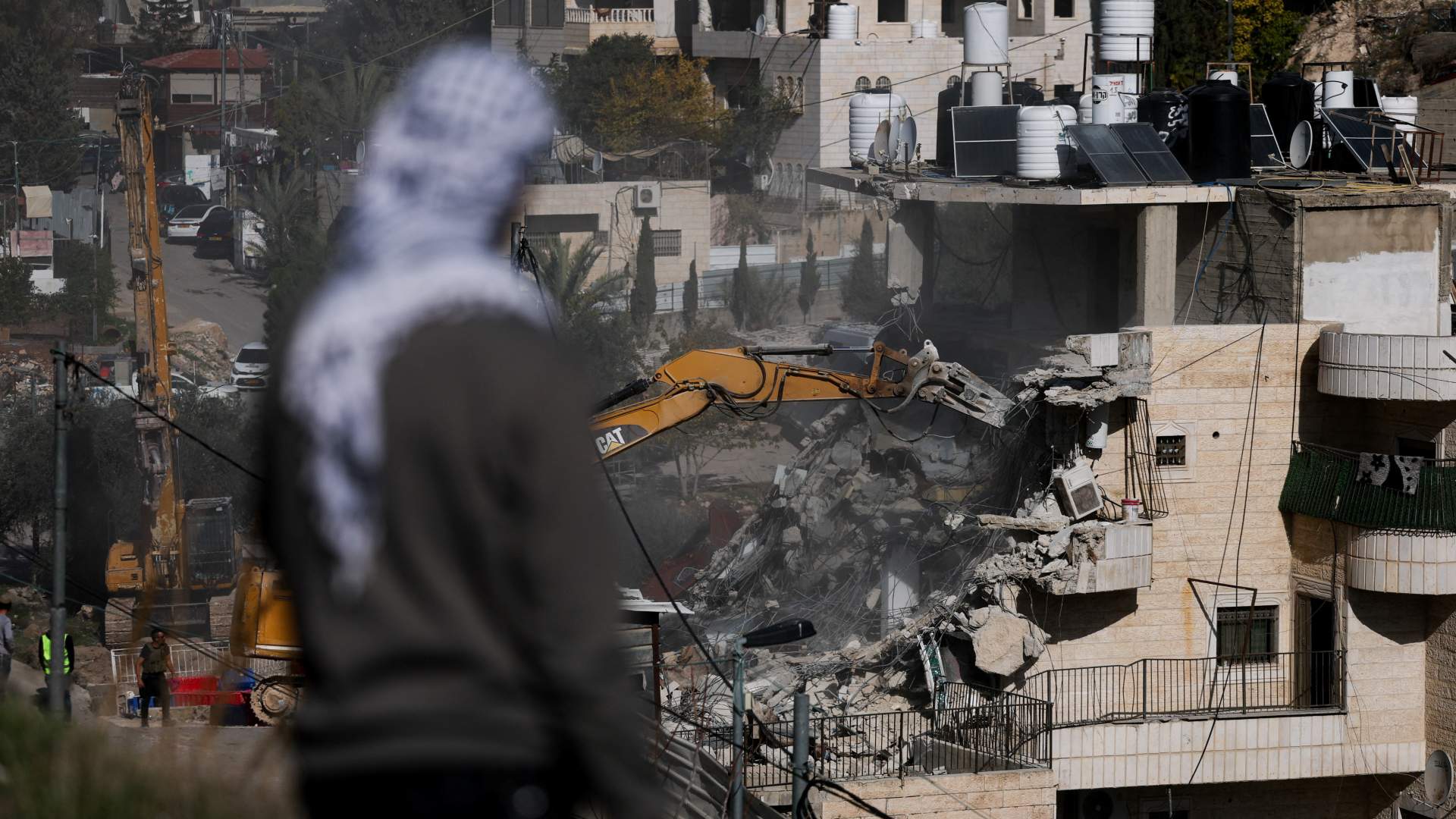
Teachers arrested, bookshops shuttered, homes demolished, and violent settlers running amok – under occupation, no one is safe from brutal Israeli expansionism"The first step in liquidating a people is to erase its memory. Destroy its books, its culture, its history. Then have somebody write new books, manufacture a new culture, invent a new history,” wrote the Czech novelist Milan Kundera. “Before long that nation will begin to forget what it is and what it was. The world around it will forget even faster.” Kundera’s subject was Czechoslovakia under Soviet communism. His words also apply to life as it is lived in East Jerusalem today under Israeli occupation. An extinguished city where people live abandoned lives of quiet desperation. For Palestinians, any form of politics has become dangerous. All political activity - campaign meetings, press conferences, canvassing - is banned and punishable by jail. The governor of Jerusalem appointed by the Palestinian Authority (PA), Adnan Ghaith, once a busy political activist in the Silwan neighbourhood southeast of the Old City, has been arrested 37 times in his seven years in office. New MEE newsletter: Jerusalem Dispatch Sign up to get the latest insights and analysis on Israel-Palestine, alongside Turkey Unpacked and other MEE newsletters Symbols of national identity are not allowed. Fly a Palestinian flag and you will be arrested. The national anthem is banned. The authorities search schoolchildren's bags, then confiscate books carrying the PA logo. Shopkeepers in the old city are banned from selling T-shirts with Palestinian national symbols. I asked a teacher what would happen if he flew the Palestinian flag. “They would close down the school,” he said. What if he flew the Israeli flag? “They would send me flowers.” He told me that a school celebration of the national poet Mahmoud Darwish was halted by the authorities. “We are raising up a peace message in our schools,” he says. “Our only weapon is our books. Why are they treating our schools like this? We are preparing our students to go to university. Not to fight and not to kill.” Israel replaces Damascus Gate name on East Jerusalem signs Read More » On Thursday, Israeli police raided and ordered the closure of Al-Shabat Comprehensive High School, an all girls school in the Wadi Al-Joz neighbourhood east of the Old City, on the grounds that they had found “incitement material”, including Palestinian Authority textbooks. Israeli activists erase Arabic from street signs. Municipality workers are already taking down signs bearing the name Damascus Gate, in use since the early Ottoman period. A meeting on Jerusalem’s Mamluk architectural heritage, especially splendid around western entrances to Al-Aqsa in the Old City, was stormed by police earlier this year and the organisers were arrested. One Palestinian says: “We used to gather, but we are afraid of collaborators. Of private detectives. Of attack.” Everyone remembers the funeral of Shireen Abu Akleh, the Al Jazeera journalist shot dead by an Israeli soldier while reporting from Jenin in the West Bank in May 2022, when Israeli forces attacked people with batons, causing mourners to drop the coffin on the ground. So much for freedom of assembly. Freedom of speech is also suppressed. An East Jerusalem head teacher was held in detention during my stay in Jerusalem. She was not calling for violence or even resistance. She had publicly criticised the barbaric treatment endured by Palestinians in Israeli jails, described as “torture camps” by the Israeli human rights organisation B’Tselem. Mob rule Damascus Gate used to be a gathering place for Palestinians. Now it can turn into a place of terror. Palestinians told me that gangs from Lehava, a far-right Jewish supremacist movement whose Hebrew name is an acronym for “Prevention of Assimilation in the Holy Land”, congregate there. “They start hitting us,” I was told. “Throwing things at us. You cannot respond. If you do, you will be arrested on the spot. Most people go home before 7pm [5pm GMT], when it gets dark.” In September, an elderly Palestinian, Ahmed al-Husseini, was chased and repeatedly beaten to the ground as he tried to pass through a crowd of men described in Israeli media as “an ultra-Orthodox mob”. Film of this assault went viral. The person filming the incident was heard declaring in delight: “Wow, they’re fucking up an Arab.” Israeli security forces standing nearby could be seen looking on without intervening. Right-wing Jewish Israeli youths gather at Damascus Gate for the Jerusalem Day march through the Old City on 14 May 2026 (Reuters) Almost all violence goes unreported. Young people are the most vulnerable. A teacher told me his students are regularly assaulted on the way to and from school, and nothing can be done to stop this. A receptionist in an East Jerusalem hotel frequented by Israelis was attacked by settlers. When she complained, the manager told her to get used to it because it was part of the job. This account is based on conversations conducted over a three-week period with Palestinians living in occupied East Jerusalem. Some of those interviewed gave permission to quote them by name, but most were reluctant. I have chosen to leave all interviewees anonymous because it became clear in the course of my research that, for those I spoke to, East Jerusalem has acquired the characteristics of a police state. Palestinians are subject to ubiquitous surveillance and constant monitoring. Israeli police monitor closed-circuit cameras and use tracking and monitoring tools to join WhatsApp groups and scrape social media content. They also run an extensive, well-developed network of secret informants. The arbitrary power of the Israeli state has replaced or bypassed every legal or judicial safeguard. Palestinians live in fear of being hauled into al-Moskobiyya. The notorious Israeli detention facility takes its Arabic name from the local district known as the Russian Compound, which sits just outside the New Gate linking the Old City’s Christian Quarter to West Jerusalem. During the mandate period, the British held and tortured Jewish prisoners there. More recently, it has become the local headquarters for the Shin Bet, Israel’s security service. Palestinians speak of abuse inside the jail, recounting stories of sexual humiliation for women and torture (frequently involving anal rape, with sticks) for men. Accounts of cruelty and torture inflicted on Palestinian detainees in Israeli prisons are taken seriously and documented by Israeli, Palestinian and international human rights groups such as B’Tselem, Addameer and Amnesty International. “I have never seen my people terrorised like today,” one Palestinian intellectual remarked to me. He explained that there were, in his view, three reasons for Palestinian political numbness in East Jerusalem. “First, we have been watching the genocide in Gaza. You can see how Palestinian life is worth nothing to Israel,” he said. The second factor, he said, was the oppressive presence of the Israeli police. Palestinians suffer grave punishment even for writing a social media post. “You can be prevented from working, arrested, and imprisoned. Bus drivers have lost their job because of a post years ago.” 'Prison is not the same' The third factor, he continued, is torture: “If you go to prison today, it’s not the same as it was. Nobody gets out of today’s prisons physically and psychologically sound. The levels of torture are beyond all imagination. One month of prison today is worse than several years in prisons in the past.” He described accounts he had heard of beatings, rape and deprivation, then added: “The International Red Cross is not allowed to visit and we have found that, when lawyers do get access, prisoners beg them not to visit again because after the visit the prison guards beat them up and torture them as punishment. “So now the only news we get is from those who come out of prison. They come out brutalised. There have been cases where they come out with their anuses so damaged that the bleeding cannot be controlled.” Israel has barred the International Committee of the Red Cross from visiting Palestinian detainees since October 2023. In September, a Red Cross team met Israeli officials at a military detention facility after Israel’s Supreme Court ruled that its access to detainees should be restored. The Red Cross called the meeting “a step in the right direction”, but visits to detainees have not resumed. Occupied by Israel since 1967, East Jerusalem had until quite recently nonetheless sustained a relatively rich civil society with its own history of activism and protest. Consider the protests five years ago involving sit-ins, neighbourhood gatherings and the raising of Palestinian flags against the expulsion of Palestinians from the Sheikh Jarrah neighbourhood. In 2017, Palestinians protested against Israeli plans to install metal detectors around the Al-Aqsa complex by boycotting the site and praying outside. Israeli security forces violently cracked down on the protesters, but the government was forced to withdraw the plans. Palestinians pray outside Jerusalem's Old City in protest over new measures at the entrance of Al-Aqsa Mosque in July 2017 (Reuters) That kind of civic resistance has been quashed. I learnt of one senior activist, well known and respected in his professional field, who had recently emerged from an Israeli jail. Because of his political activities, he had been inside prisons often, and had always emerged strong despite the suffering he had endured. This time, according to a friend who knew him well, he came out broken. He has explained to colleagues that he will never return to political work. He could not endure the same torture again. War on civil society Israel is waging a merciless war on Palestinian civil society. In 2021, several leading Palestinian civil society and human rights groups were proscribed by Israel as terrorist organisations. They included the prisoner support organisation Addameer; human rights group Al-Haq; the Union of Palestinian Women’s Committees; and the Ramallah-based Bisan Center for Research and Development, which helps women who have been victims of violence. Any organisation is now vulnerable. Earlier this month, the Abnaa al-Quds (Sons of Jerusalem) sports club in the historic al-Sadiya neighbourhood in the Muslim Quarter of the Old City was closed under an order issued by Israeli National Security Minister Itamar Ben Gvir. Israel raids beloved Palestinian bookstores and detains owners Read More » The Israeli authorities raided and closed Maktabat al-Quds (Jerusalem Library), a cherished Arabic bookshop, in February 2025. The Educational Bookshop, a 40-year-old literary hub on Salah al-Din Street just north of the Old City, has been raided twice, with the owners arrested and books seized. In January, Israeli forces raided the Yabous Cultural Centre to stop screening of Palestine 36, the highly acclaimed Oscar-nominated film which tells the story of the 1936-39 Palestinian revolt during the British Mandate. Three years ago, Palestinian schools in East Jerusalem went on strike in reaction to an attempt by the Jerusalem municipality to censor Palestinian textbooks and introduce an Israeli curriculum in classrooms. Christian and Muslim worship is under attack. I was in the Old City at one of the entrances to Al-Aqsa Mosque with a Palestinian friend as settlers streamed past us during one of their regular invasions of the site. One settler suddenly halted, turned towards us, and addressed my friend in Hebrew. My friend told him that he did not understand, but the settler talked back regardless, becoming angry and aggressive. Eventually, he left us alone and continued his journey up the steps into the compound. My companion, who understands Hebrew well, explained the settler had been repeating aggressively: “Do you know what I am going to do tonight? I am going to Al-Aqsa Mosque where I will drink wine. What do you think about that?” As the settler would have known, this was a grossly offensive and insulting suggestion. My friend pretended not to speak Hebrew to avoid a confrontation. If he had shown anger, he probably would have been arrested. “In the past you could be rude,” a Jerusalem lawyer explains. “Now you cannot respond. The police are totally on the side of the settlers, to protect them when they provoke a fight.” The settler was taking advantage of this impunity for Israeli Jews to insult a Palestinian’s religion. Israeli National Security Minister Itamar Ben Gvir displays an Israeli flag inside Al-Aqsa Mosque complex during a settler raid in May 2026 (X) Inside Al-Aqsa, Israeli security forces are ubiquitous, with an Israeli police station set up at the centre of the compound. Mosque workers cannot repaint their offices or mend a water pipe without Israeli permission. This year, even picking olives from the trees within the compound - a tradition stretching back to time immemorial - has been criminalised. The walls of the ancient prayer hall at the southern end of the site are pitted with bullet holes, where Israeli forces have opened fire on worshippers. This defies international law, as well as the Ottoman-era Status Quo agreement that has governed interfaith relations in the Old City for hundreds of years. Not even the dead rest in peace. It is heartbreaking to visit the 1,400-year-old Bab al-Rahmah Cemetery just outside the outside wall of Al-Aqsa, where Israeli security forces routinely damage gravestones and knock down tombs. The Mamilla Cemetery in West Jerusalem dates back to the time of Sultan Saladin. Israel has destroyed hundreds of ancient graves here, digging up human remains to clear ground for development projects. Part of the site is now occupied by the Simon Wiesenthal Center's Museum of Tolerance. 'Urban renewal' and ethnic cleansing The term East Jerusalem came into common use when the city was physically divided after the 1948 Arab-Israeli war. East Jerusalem, which includes the Old City, became part of Jordan. The west of the city came under Israeli rule. This arrangement persisted until 1967, when Israel annexed the Old City and East Jerusalem. This move breached the Geneva Conventions. Even the United States, Israel’s great ally, voted for UN Resolution 242 in 1967, calling on Israel to withdraw from the occupied territories. But the Knesset, Israel’s parliament, greatly expanded Jerusalem’s municipal boundaries, gerrymandering the area to exclude Arabs and create space for Israeli settlements. This programme continued with demolitions of Palestinian houses enabled by a Janus-faced legal system that supported Israeli demands while ignoring Palestinian rights. There was, however, no wholesale act of ethnic cleansing - with one exception. On 10 June 1967, 619 inhabitants of the Mughrabi Quarter were given three hours to evacuate. Immediately, bulldozers moved in to demolish this exquisite part of the Old City, founded in the 12th century by al-Malik al-Afdal, a son of Saladin, to provide accommodation for Muslim scholars and pilgrims from North Africa. Teddy Kollek, then mayor of Jerusalem, mandated this destruction to create space for Jewish pilgrims who wished to visit the Western Wall. The scholar Karen Armstrong wrote in 1998: “This was only the first act in a long and continuing process of ‘urban renewal’, a renewal based on the dismantling of historic Arab Jerusalem and in which demolition, archaeology, and a selective preservation of antiquities all play their part in imposing a new Jewish identity on the city.” Now, Israel has returned to a programme of destruction that is far more wide-ranging and audacious than that undertaken by Kollek six decades ago. Israel is evicting Palestinians through a massive programme of home demolitions while installing new settlements that will isolate East Jerusalem by cutting it off from the West Bank. The attack on foreign consulates and NGOs is part of the programme to cut East Jerusalem Palestinians off from the world. Earlier this year, Israeli demolition crews with bulldozers moved in to destroy the UN Palestinian refugee agency (Unrwa) offices in Sheikh Jarrah. The expulsion of British diplomats and downgrading of the nearby British consulate was part of the same project. mployees of the Israeli authorities remove belongings from a Palestinian home in the Silwan neighbourhood of East Jerusalem on 25 March (Faiz Abu Armila/MEE) One of Israel’s weapons is biblical heritage. I accompanied a group of diplomats to al-Bustan (The Orchard), a neighbourhood a few hundred metres south of the Old City at the southern tip of the Mount of Olives. It is destined to make way for a recreation area and car parks, with the entire neighbourhood renamed the "King’s Garden" despite doubt among scholars about whether any connection truly exists between al-Bustan and the royal gardens of ancient Israelite kings. Half of the area’s 1,500 Palestinians residents have already been forced out, with the rest scheduled to be made homeless within a year. Packed suitcases Many houses have already been demolished. We met a grandfather standing in front of the ruins of what used to be his family home. He lives in a caravan outside, but a demolition order has been served on that, too. Two packed suitcases stand by the front door. He explains that bulldozers can come without warning at any moment, leaving no time to pack. I ask him where he and his wife will live. “We don’t know. Some people are now sleeping in cars.” Another East Jerusalem neighbourhood is demolished as the world fails to act Read More » He takes us around his neighbourhood. On the right is a playground, also marked for destruction. On the left is a condemned football pitch. Everything will be destroyed. Property. Public amenities. Communities. Families. Lives. The grandfather makes a despairing plea to the diplomats: “We ask the world to pressure Israel not to demolish our remaining homes. The international community is allowing Israel to be above international law. “ We climb some steps into the living room of another house. It belongs to a blind man in his 50s who is challenging his demolition order in court. “I am disabled,” he says. “I live with my wife, who is also disabled, and our son, whose house has already been demolished. In my situation, how do I look for a home? Even if there was a place to go, how could I afford the 6-7,000 shekels a month?” Our expert guide Danny Seidemann, a Jewish Israeli lawyer, told us of other neighbourhoods scheduled for demolition, describing a “government programme” to encircle the Old City. “The primary objective is a radical transformation of Jerusalem, establishing the presence of a specifically Jewish biblical messianic narrative which is being etched into the landscape of the settlement project, fragmenting Palestinian East Jerusalem and marginalising the Christian presence,” he said. “They are establishing a Jerusalem where one empowered stakeholder is Israel - and a specific interpretation of Israel - and all others are minorities who live here at our pleasure.” Nothing and nobody is safe. Last June, the Jerusalem municipality seized land in al-Bustan, south of the Old City, belonging to the Monastery of St Onuphrius. The Greek Orthodox Patriarchate ineffectively protested what it called “an unlawful and illegitimate seizure of established Church property in the heart of Jerusalem”. Earlier this month, resident Mahdi Tounsi, a student at Hebrew University, was seized from his dorm by Israeli police. When he appeared by video link at a court hearing last week, there was visible bruising on his face. According to Israeli media, Tounsi has told his lawyer that police beat him in the dorm, later in their patrol car and also at the police station. 'Collective deterrence': Detention of Palestinian student in Israel fuels fears of wider crackdown Read More » Interrogators reportedly questioned him about his activism with Israeli-Palestinian organisations Standing Together and Ir Amim. Standing Together is the largest Arab-Jewish grassroots organisation in Israel. It opposes the occupation of Palestinian territories. Ir Amim is an Israeli non-profit which monitors events in East Jerusalem where it works to ensure the "dignity and welfare of all its residents and that safeguards their holy places, as well as their historical and cultural heritages". Both groups have called for Tounsi's immediate release, while warning against using security agencies to silence political activity. As this article went to press, Tounsi is still held under administrative detention, which allows suspects to be held for long periods without charge. According to Human Rights Watch, more than 3,000 Palestinians are currently in administrative detention. After our tour, I walk away up the hill. In these streets Israeli settlers, some armed with assault rifles, have become a familiar sight. This is now legal under Israeli law. In March, Ben Gvir - himself a settler - announced that all Israeli Jewish residents of Jerusalem, including East Jerusalem, would be allowed to carry firearms. As I prepare to leave East Jerusalem, I attend a play at the Palestinian National Theatre (el-Hakawati) in Sheikh Jarrah. The building, once a cinema, as the Jerusalem Story puts it, has an “unfortunate history”. It was, according to the website, “hit by an air missile in the June 1967 war and later torched by religious fundamentalists who believed that it showed erotic films”. Actors set to work restoring the burnt-out shell and reopened it as a theatre in May 1984, and it has since provided space for artists to stage plays, mime performances, carnivals, workshops and seminars. It has faced problems, including repeated threats, bans and temporary closures. Last November Israeli security forces stormed the building just minutes before a children's musical, Dreams Under the Olive Trees, was about to start. The audience was given five minutes to empty the theatre. Children were in tears and inconsolable. The closure of the occupied West Bank and Gaza, the permit regime and the separation wall now make it all but impossible for Palestinians from beyond East Jerusalem to attend the theatre’s productions. In an effort to overcome this, the theatre developed a mobile theatre and works with artistic and cultural institutions around Palestine to share its cultural output as widely as it can. A scene from El Manshiyyeh, performed at the Palestinian National Theatre (Facebook) Tonight’s play, El Manshiyyeh, scripted by the playwright Samer al-Saber, tells the story of two families in the eponymous neighbourhood of Jaffa before the outbreak of the Second World War. It begins as a lively but generally carefree comedy about family disputes, business problems, and love affairs, set against the backdrop of British occupation. In the second act, the British depart and Jewish militias arrive. The cheerful protagonists of the play’s first act face terrible decisions about whether to leave or to stay, and what to do with possessions. As the fighting worsens, they have no choice but to flee. Amid the chaos, they get separated. Some take the boat to Beirut, others to Egypt, others head to Gaza. By this point, the play is almost too painful to watch. I look around at the audience of about 300, mainly young Palestinians. Will history repeat itself as they too are evicted and made refugees? Are they watching their own future? Will they face the fate of El Manshiyyeh families as chronicled in Saber’s play? That is the direction of travel in East Jerusalem. It is hard to see what will stop it. As this article was being prepared for publication, Israeli police stormed the Palestinian National Theatre once more during a musical event and kicked out the audience.
Evictions and erasure: How Palestinian life in East Jerusalem is being extinguished
Full Article
Original Source
Read the full article at Middleeasteye →KhanList aggregates and links to publicly available news content. We do not host full articles from third-party sources. Always verify important information with original sources.