
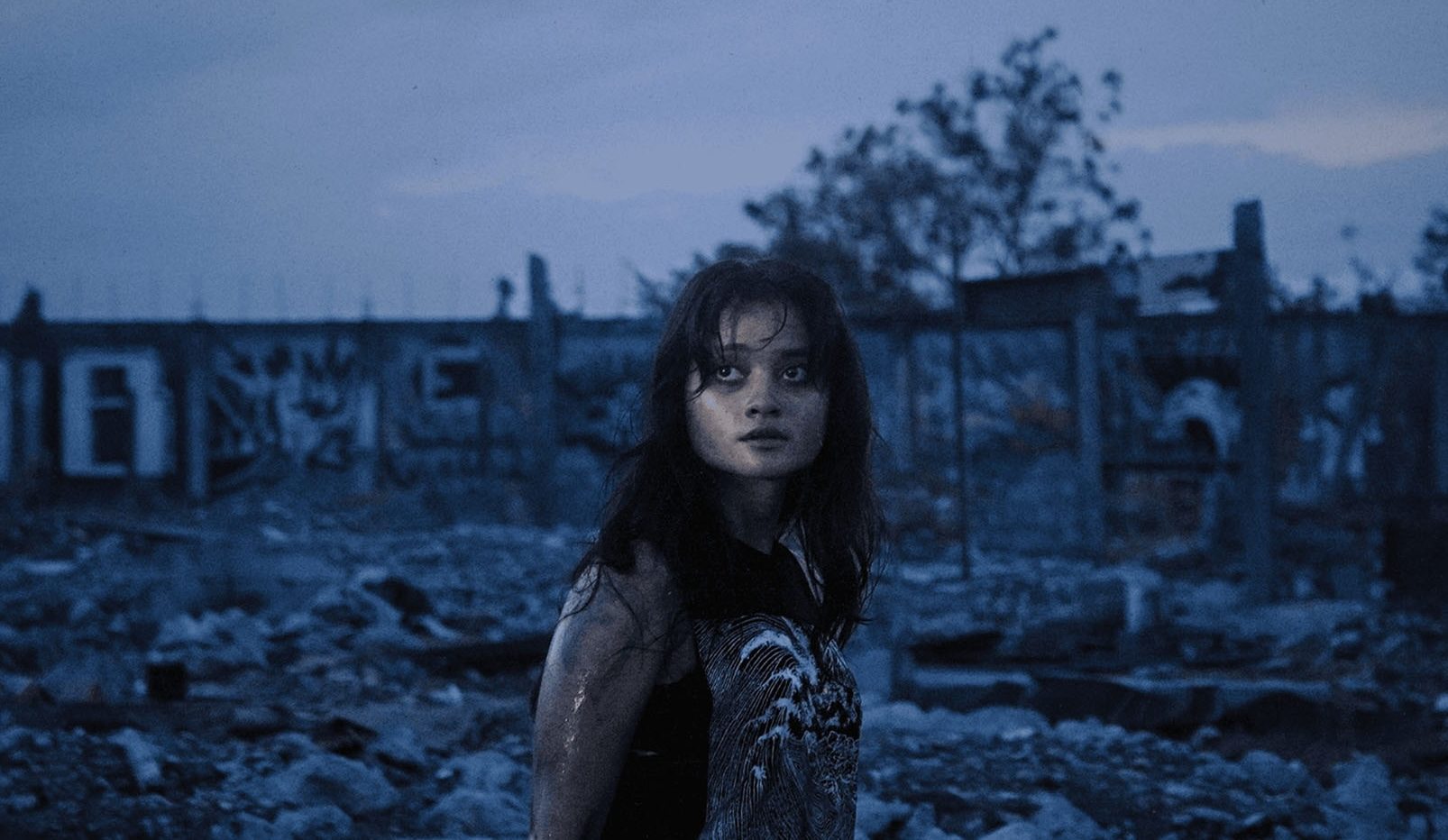
Some years ago, while studying theater arts at the University of the Philippines, Nour Hooshmand would always look forward to the rehearsals of Dulaang UP. There, she was supposed to learn direction and lighting design under the tutelage of the likes of Dexter Santos and the late Floy Quintos, but would instead hone her penchant for performance as a stand-in for actors who couldn’t make it to practice sessions. She was beside herself for having to act with such accomplished thespians as Shamaine Buencamino and Stella Cañete. “I enjoyed it so much to the point that I’d wish some actors would not come to the rehearsals so I could do their parts,” said Hooshmand. Her directors would even hand her notes clandestinely, despite knowing she wasn’t there as an understudy. “Kahit hindi ako ‘yong mag-act sa show pero ‘yong makaeksena ko lang sila even just for a moment, okay na sa akin ‘yon,” Hooshmand continued. “I never really expected na may future dito.” (Even though I’m not the one acting in the show, just getting to share a scene with them, even if only for a moment, is enough for me. I never really expected that there would be a future for me here.) At the time, Hooshmand thought she was meant to remain behind the curtains, learning everybody’s blocking and knowing their lines by heart, but never stepping on stage, let alone performing. “Malala talaga ‘yong battle ko with self-image (My battle with self-image is really bad),” she revealed. She would often hear comments about the implausibility of her becoming an actor and landing roles due to her facial features. “‘Di raw ako pang-leading lady (They say I’m not leading-lady material),” she said. Today, the Filipino-Iranian actress is practically everywhere and impossibly hard to miss. Even for the briefest of moments as in David Corpuz’s Tayo Lang Ang Nakakaalam, one of three films at this year’s Cinemalaya that featured her, or in a scene with Judy Ann Santos in the HBO series Call My Manager. A month later, she would win her first acting award at Cinepanalo for her work in the short film Starfish. She also appeared in Katski Flores’ historical drama Edjop, as well as in three films that all premiered at various film festivals abroad, including Rafael Manuel’s Filipiñana, the Philippines’ official bet for the 2027 Best International Feature Oscar race, John Torres’ The Remotes, and, finally, Arvin Belarmino’s debut feature Ria, Hooshmand’s second lead role, which just played at the Busan International Film Festival. Porvenir’s El Fuego del Alma, an adaptation of Tennessee Williams’ Summer and Smoke, likewise saw her return to theater. Not bad for someone still in her late 20s. For someone who supposedly didn’t look the part. For someone people didn’t think could do it — including, for a long time, herself. As Ria Sometime in 2024, after a suggestion from three people, the actress auditioned for the titular role of Ria, though she was initially asked to test for Kim, Iana Bernardez’s part in the film. That day, she was terribly under the weather, too tapped out to even buy food, and was dealing with heartbreaking news about their home. But she proceeded with the audition anyway. Theater artist Mijon Cortez, who was among the hundreds of applicants, sensed Hooshmand was about to pass out and decided to get her something to eat, while waiting for her turn. “I feel like kung hindi niya ako binilhan ng pagkain, hindi ako nakapag-perform the way I did,” said Hooshmand, recalling how crucial the gesture was, given the audition had no script and required her to improvise based on a scenario. (I feel like if he hadn’t bought me food, I wouldn’t have been able to perform the way I did.) “Ang galing kasi parang the universe gave me a cosmic baggage so that I could relate in a way na hindi ko kailangang umarte nang sobra,” she said. “Dine-describe pa lang ni direk ‘yong eksena, tumutulo na ‘yong luha ko.” (It’s actually amazing, it’s as if the universe handed me some cosmic baggage, allowing me to relate to things in a way that doesn’t require me to overact. The director was just describing the scene, but my tears were already falling.) Hooshmand got the part and decided to focus on the project, dropping another title role offered by another international production. Belarmino and Kyla Romero’s Agapito, which premiered at last year’s Cannes Film Festival and is now campaigning for Best Live Action Short Film at the 99th Academy Awards, was in part shot to test the waters for Ria, since Hooshmand had not met both filmmakers prior to her audition. Nour Hooshmand in the short film ‘Agapito.’ Photo courtesy of Cannes website Ria finds the actress playing a young woman protecting her folk-punk community against the threat of demolition, in a film that is less interested in crystallizing any sense of inner life than it is in weaponizing its languidness. Positioned to bear the film’s entire political messaging, Hooshmand is arresting in her rage, in her resolve to fight for her found family and the less fortunate, which eventually whisks us off to a closing frame in which she meets the camera’s gaze and shatters it altogether, a final gesture that’s surprisingly less bleak than the rest of the proceedings. Throwing herself into preparation involved forming a folk-punk band called Karnal with the cast and crew and playing in the local community, on top of organizing film screenings and “food, not bombs” feeding programs. With all those immersions, Hooshmand was well aware of the sheer magnitude of what she had to take on. “I know that while I understand what they’re fighting for, I wouldn’t be able to grasp their lived experiences as deeply as they could,” she explained. “There were many occasions where I would pray to the spirits of the punks who had passed away to help me bridge their stories with truth.” It came to a point that the rage lodged inside Ria began to take a heavy toll on the actress playing her, heightened by the tragic demise of Hooshmand’s Iranian father while shooting the film. She even dreamed of her father on the day they wrapped production. “I was lucky that Direk Arvin was there,” she said. “He was really my anchor. He never abandoned me, despite all the struggle I went through.” An accumulation For Hooshmand, it has always been an accumulation of constantly showing up, putting in the work, gaining confidence, getting people to put their faith in her, and loving the craft. “It’s always about the process,” she said. “I feel like I’m always a work in progress. I’m always learning from everyone I worked with, whether that be a veteran filmmaker or a student director. That’s what I would want to keep for as long as I work in this industry.” That eagerness to learn includes completing Ricky Lee’s screenwriting lab earlier this year, or undergoing a Meisner acting workshop alongside friend and Filipiñana co-star Jorybell Agoto three years ago. Hooshmand credits Agoto, now in critical condition due to her battle with cancer, as among the first people who helped her find her bearings early in her career. “I really love her as a human being and as an artist,” she said of Agoto, who was celebrating her birthday on the day of the interview. “I just hope that she gets better real soon. Marami pa kaming gagawin (We still have a lot to do).” She learned of Agoto’s condition earlier this year but opted not to pry into it for her friend’s privacy, and instead, just offered her support and accompanied Agoto during the press tour for Filipiñana. “I know how exhausting it was to promote a film, and I really wanted to be with her,” she said. This kind of kinship has always been there since they first worked together in Kevin Mayuga’s When This Is All Over, in the way they share roots in theater, in the way their zodiacs go well together — Agoto is a Libra, Hooshmand is an Aquarius. “Kaya naming mag-usap hanggang umaga (We can talk until morning).” Playing parts Hooshmand’s interest in the arts was first nurtured at home. “Noong bata kasi ako, sobrang hilig ko maglaro. Sobrang hilig ko gumawa ng imagined worlds (When I was a child, I really loved to play. I was very fond of creating imagined worlds). I guess it’s rooted in that playfulness,” she said. Her mother Belinda was a founding member of Teatro Tomasino, the official theater guild of the University of Santo Tomas, which has remained active since the Martial Law era. Her brother is a devoted musician, while her sister is a massive hoarder of bootleg DVDs, which would introduce her to the allure of the movies. “I’m lucky that I’m surrounded with this kind of people who pushed me to be creative and pursue the arts,” said Hooshmand. Such artistic spirit would only heighten growing up and eventually led her to the Diliman campus and to the late National Artist for Theater Tony Mabesa, who, in 2018, would cast Hooshmand in her first lead role on stage, in Dulaang UP’s adaptation of Luigi Pirandello’s Six Characters in Search of an Author, one of the last plays Mabesa would bring to life. “It was so demanding and difficult. I had to really transform, but it gave me courage,” said Hooshmand. “Na-feel ko kahit papaano na baka kaya ko ngang umarte kasi naniwala siya sa akin, eh (I felt, in a way, that maybe I actually could act because he believed in me).” Her time in the state university almost entirely revolved around Dulaang UP, given the lore behind its theater-making and Mabesa’s methods. “We were there every day,” recalled Hooshmand. “When we’re not in class, we’re building sets, we’re building props. It really grounds you in how much time and effort and collaboration it takes to build a production. So that’s my core.” “Hindi ka puwedeng maging mayabang. Sasaktan ka nila. Naabutan ko ‘yong era na ‘yon. Pinanday nila ‘yong pagkatao ko,” she added. (You can’t be arrogant. They’ll hurt you. I lived through that era. They shaped my character.) The pivot to acting in film, however, would not happen immediately. After college, Hooshmand took an office job at the Cultural Center of the Philippines. Then came the pandemic and the bouts of depression that followed when the working environment around her tipped into machinic existence. She longed for her creative side. Fan Girl, Antoinette Jadaone’s coming-of-age drama, kept her going. Lounging on a rooftop with her best friend Joshua Chan, she shouted into the cosmos that she would one day work with Jadaone. Of course, she knew it was a long shot. A week later, she received a call asking her to tape and send an audition for an ad she hardly had any details about. She got a Zoom callback the next day where she met Jadaone, who, to the actor’s surprise, was set to direct the project. “Hindi ako makapaniwala,” she said. “Ang serendipitous na lang ng mga bagay after that.” (I can’t believe it. Things just turned out so serendipitously after that.) That unexpected booking became her way into the industry. And so began the grind, from TV series The Kangks Show, also directed by Jadaone, and Sleep with Me, to the Cinemalaya-winning film Blue Room, and to all her projects that came and will come out this year, including the Netflix series BuyBust: The Undesirables, directed by Erik Matti, which has been in development for years. But even then, life hasn’t radically transformed for Hooshmand yet. Between shoots, she would still take on voice-over and events jobs. Subsisting on acting alone, especially as an independent artist, is becoming progressively harder, this she admits. She’s still in survival mode. But there’s a maxim she keeps close in moments of doubt and struggle: “Faith can give you wings.” It was faith that allowed her to manifest working with Jadaone and sending an audition tape without knowing what it was for. It was faith when Mabesa believed she could lead an entire production. It was still faith when she pushed through the audition for Ria, despite a body on the brink of collapse. And despite having her most prolific and breakout year, what Hooshmand ascertains is that she won’t just jump from one project to the next, a glaring contrast to an industry that would often capitalize on momentum. It has been her default to connect with the people she works with and genuinely care for them. “Everything has a reason,” she said. “It’s either to teach you something or to teach them something.” To that end, she disclosed declining major offers from big corporations a couple of times. “I wanted to try to pave a new path for myself,” she explained. She’s well aware that it’s a stubborn principle, one that her friend and fellow actor Maris Racal said would prove difficult for her career. “But I wanted to show that it’s possible,” Hooshmand insisted, somehow echoing the worldview of her character, Ria. As she has come to realize early on, everything eventually accumulates. “If you work hard, if you are kind to people, if you show up, organically you will find work, you will find the right people.” – Rappler.com
Everywhere, all at once: The year of Nour Hooshmand
Full Article
Original Source
Read the full article at Rappler →KhanList aggregates and links to publicly available news content. We do not host full articles from third-party sources. Always verify important information with original sources.