
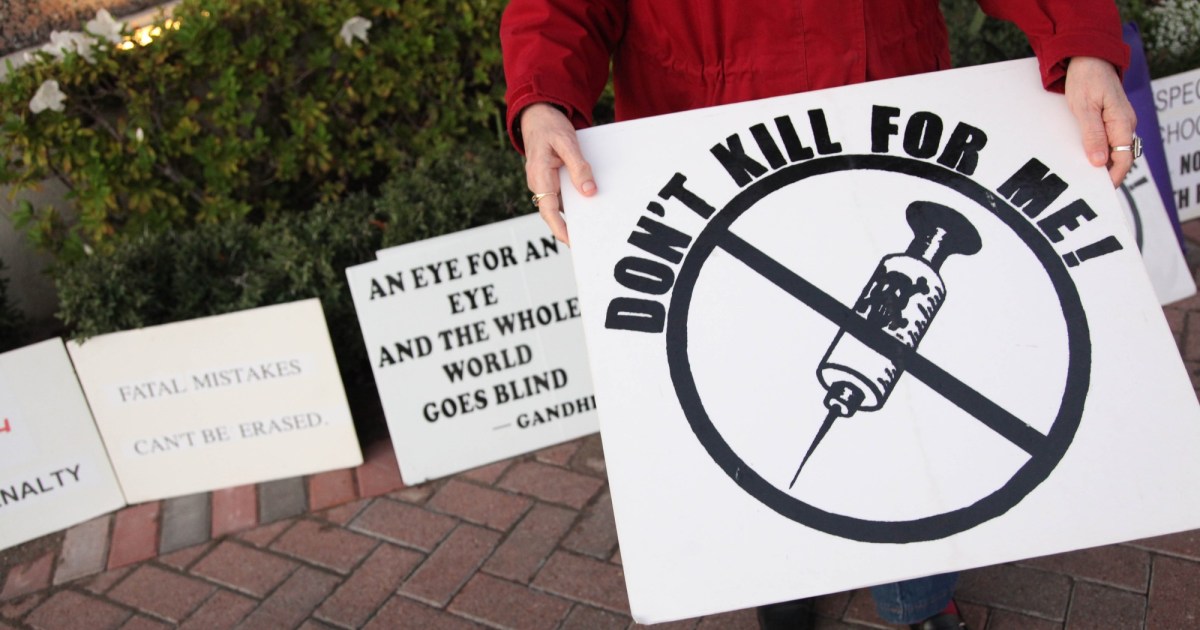
An execution vigil for death row prisoner Rodrigo Hernandez in Houston, Texas, January 26, 2012.Mayra Beltran/Houston Chronicle/Getty Get your news from a source that’s not owned and controlled by oligarchs. Sign up for the free Mother Jones Daily. In the months leading up to Christa Pike’s execution date, she and her legal team made it clear that she, the lone woman on Tennessee’s death row, 50 years old, wasn’t afraid to die. She was terrified of the execution itself. “Her greatest fear wasn’t dying,” attorney Stephen Ferrell told USA Today in a press conference. “It was a fear of a prolonged, painful, traumatic death.” Citing her blood-clotting disorder and a history of difficult blood draws, her attorney argued that there could be problems properly affixing the IV into Pike’s arm and that executing her via lethal injection would amount to cruel and unusual punishment. About a month before her execution, her lawyers had pushed for her to be hanged or shot by a firing squad instead. At the eleventh hour, the Sixth Circuit Court of Appeals stayed her execution, only to have the Supreme Court overrule it. When she finally arrived in the prison’s death chamber, Pike and her lawyer’s concerns would be proven true to a degree they couldn’t have anticipated: she became the first person to survive the administration of a double dose of lethal injection drugs. What should have been a ten- to twenty-minute process took two hours, according to the Associated Press, and ended with Pike alive but in critical condition. Christa Pike reportedly remains intubated, on a ventilator in a Nashville hospital, receiving life-saving care after being pumped with what should have been two fatal doses of pentobarbital, a barbiturate used by many states for lethal injection. When she arrived at the hospital, Pike’s arms were “swollen, burned and blistered,” according to an emergency filing from her legal team. There’s still a lot that we don’t know about the actions of prison officials leading up to and during Pike’s execution. Pike’s attorneys believe that a problem with the state’s IV lines caused the pentobarbital to flow into her tissue, instead of her veins. Tennessee Gov. Bill Lee has halted all executions in the state and ordered an “independent investigation.” The head of Tennessee’s Department of Correction resigned days after Pike’s hospitalization, but defended the execution, saying the state “carried out its responsibilities in accordance with the established protocol.” Christa Pike’s case, while unusual in many respects, is a perfect encapsulation of the pitfalls of lethal injection as an execution method in the United States. Most people’s understanding of lethal injection—as a humane alternative to more overtly brutal executions of yore—is in stark contrast to the actual barbarism behind the procedure. This misconception is no coincidence: it’s by design. Death penalty states are incredibly secretive about every step of the lethal injection process. Why? According to University of Richmond law professor and former prosecutor Corinna Barrett Lain, it’s because lethal injection has the best political optics—as long as people don’t know much about what’s happening behind the scenes. As Lain wrote in her 2025 book, Secrets of the Killing State: The Untold Story of Lethal Injection: Every other execution method—hanging, the electric chair, gas chamber, and firing squad—lays bare the brutality of the state that kills in our name. Lethal injection hides it. With lethal injection, we don’t have to deal with the sight of blood, or the smell of burning flesh, or the sounds of suffering, all potent reminders of what the state is actually doing. Instead, we get to tell ourselves that prisoners are just drifting off into forever-sleep. Secrets of the Killing State pulls back the curtain that shrouds lethal injection, revealing how everything from the drug suppliers to the science behind this method of execution is riddled with issues. I reached out to Lain to learn what might have gone wrong in Pike’s execution, and how the problems with lethal injection are not individual but systemic, baked into its very foundation. This interview has been edited for length and clarity. What was your initial reaction to hearing about the failed execution of Christa Pike? Yet another botched execution. I had some ideas of how it happened, why it happened, but of course, part of the problem is we don’t have any information. I’ve been studying [lethal injection] for seven years, so hearing about Christa, it’s really sad and frustrating. “For the first 35 to 40 years, states used a paralytic…that would ensure it would look like putting down a pet.” You know, in some ways, her case is a paradigm example of both everything that’s wrong with lethal injection and everything that’s wrong with the death penalty. More broadly, it’s an example of what’s wrong with lethal injection. We now have a growing list of people whose executions are so badly botched that they survived their own execution. But we also know we’ve seen executions that are one hour long, two hours long, three hours long. I’ve seen autopsies with 14, 16, 18 puncture wounds. This is the stuff that’s been happening, but now, finally, it has drawn the public’s attention. In your book, you spend a good chunk of the beginning pulling back the curtain on the real horrors that come with lethal injection and how execution states have pretty brilliantly rebranded it. Can you describe people’s biggest misconceptions when it comes to the death penalty vs. the actual reality of the procedure? The public has been told for the last 45 years that lethal injection is akin to putting your beloved pet down, and none of that’s true. The public has been sold a bill of goods, and for the first 35 to 40 years, states used a paralytic as one of the drugs in lethal injection that would ensure it would look like putting down a pet. The paralytic was also a muscle relaxant, so it relaxed all the muscles in the face, and then it froze them that way. So you’re going to get this nice drifting-off-to-sleep look, no matter what is actually happening, and we know what’s actually happening because now we have hundreds of autopsies that show us that those are violent deaths too. What happened to Christa Pike was simply the truth breaking through. That goes perfectly into my next question. Can you talk about why the use of pentobarbital in lethal injections is, for lack of a better word, problematic? Pentobarbital is the drug that we use in physician-assisted suicide and also in animal euthanasia. So one might think that it is a better drug for lethal injection than the traditional three-drug protocol that states were using all these years. But what we know from autopsy studies is that the pH of pentobarbital, which is between 10 and 11, is chemically burning the delicate capillaries in the lungs, causing the capillaries to become leaky and the lungs to take on fluid. This condition is called flash pulmonary edema, and it shows up, depending upon the study, in between 84 percent of all pentobarbital executions. Flash pulmonary edema happens in seconds when you inject a drug into the veins. It goes first to the heart. Then to the lungs. So, as the body is trying to buffer that difference in the pH so that it can metabolize the drug and use it as an anesthetic, it’s already gone to the lungs, and that happens immediately. These people are essentially drowning in their own fluids. Some of the cases show acute flash pulmonary edema. It’s also called fulminating pulmonary edema. That’s where the lungs are so congested that the froth—the mixture of air and fluid—actually moves up into the windpipe, into their throats, and they choke on it. “One of the things [the report] found was executioners, on the eve of an execution, looking in Wikipedia to figure out how much of the drugs to inject.” One court asked a medical professional on the stand, while explaining pulmonary edema, if the sensation would be one of drowning from within. The court said, “Is this the same sensation as waterboarding?” And the medical professional said yes. The public has this view of lethal injection as just putting a pet to sleep. In reality, we are actually waterboarding people to death, and I don’t say that to be dramatic. I say that to be clear, honest, and candid about what we’re actually doing. Before her execution, Pike was issued a stay by an appeals court, which was quickly overruled by the Supreme Court. A throughline throughout Secrets of the Killing State is the role that politics plays in pushing executions forward. Can you describe why—and do you believe that politics played a role in the fast-tracking of Christa Pike’s execution? Politics played a role in the sense that this “pro-life” Supreme Court is uniquely excited about death and advocates for it. So what happened in Christa Pike’s case is actually not unusual at all. This is a theme that we saw in the executions from Trump’s first term too, where a court had heard a challenge to the one-drug pentobarbital protocol; the prisoners had presented two weeks’ worth of evidence, thousands of pages and documents, expert testimony, all of that stuff, and the district court issued a preliminary injunction on the execution and said—by the way, to issue a preliminary injunction, you have to make a factual finding, and the court did—that the plaintiffs were likely to succeed on the merits of their claim. So stop and think about that. A federal court that heard two weeks’ worth of evidence paused the execution just till they could get to trial. But the standard for that is incredibly high. You have to be able to find that the plaintiffs are probably going to win. They are likely to succeed. So she issues the preliminary injunction, and the Supreme Court lifts it and greenlights the Trump executions. That was the first of, I think it was 13 Trump executions, and it all started with the court lifting a stay on the shadow docket. It’s incredibly perverse that the court in those Trump executions would lift the stay over executions. Litigation over the very method of execution that they were then subjected to. They made a claim. They said this is unconstitutional. The court said, “You know what? I think you’re probably going to win this. Let’s at least let you get to trial.” And the Supreme Court lifts the stay. They can’t even get to trial, and then they are executed by the very method that they had shown was probably unconstitutional. It’s pure power. Purely unjudicious. One large part of the branding for lethal injection is that it’s a “scientific procedure”: “We put down animals all the time, and euthanasia is legal in some countries for humans. Why can we do the same thing here?” But chapters two and three of your book unveil just how much these procedures are not, forgive the pun, “a perfect science.” Can you talk about this? We assume it’s science because we know that there is science behind animal euthanasia and physician-assisted suicide. But it’s quite telling that in the traditional three-drug protocol that every state used for the first 35 to 40 years of lethal injection—not a single one of those drugs was the drug that we use for animal euthanasia and physician-assisted suicide. Not one of those drugs. When the man who invented lethal injection was asked about that—“Hey, how did you come up with the drugs?”—he said, and I quote, “I didn’t do any research.” He just made it up off the top of his head. It’s so fantastical that it would be hard to believe if it weren’t true. But it is true, and it’s not just about what happened in 1977 when lethal injection was invented. In 2024, Arizona botched three executions in 2022, and the governor put executions on hold and said, we’re going to have an independent investigation. They hired a retired federal judge. The judge looked into it, drafted a report that found all kinds of things. And the governor dismissed him and said, “We’re going to go a different direction.” That’s literally what she told him. The different direction was having the Department of Corrections do a review of itself, which it then did, and said, “We’re great. Now give us our warrant, and we’re going to start with a volunteer.” So there’s no adversarial process at all. But this made the judge so mad that he actually released his draft report. You can find it on the internet. And one of the things he found was executioners, on the eve of an execution, looking in Wikipedia to figure out how much of the drugs to inject. “It’s easier for them to argue about secrecy, and to take the hit for secrecy, than for the public to know.” That’s 2024. This didn’t even make it in the book. They don’t know what they’re doing. The problem with lethal injection, at its core, is that medical scientists are not going to tell states how to do this. They are very much believers in the Hippocratic Oath. They are healers. They’re creating this knowledge for healers, and they are not going to tell you how to kill. So, you’ve got people looking on Wikipedia. The American public hears them saying, “Oh yes, we’re careful. Oh yes, we care. We’re following the protocol.” And the fact of the matter is, it’s a hot mess that would make any citizen outraged if they knew what was really happening behind this curtain. Which goes into my next question: the secrecy. One of the biggest realizations that I learned from reading this book was how much secrecy goes into an execution via lethal injection, from who the executioners are, where the drugs were obtained, to even the events happening within the death chamber. And this secrecy is by design. Why is this the case? My sense is states can’t fix what is broken with lethal injection. They can’t get the drugs because pharmaceutical companies didn’t make medicine for killing. They can’t get the medical professionals they need to competently do these executions. They can’t get access to the veins. The death row population is a geriatric population with notoriously weak veins. These are people with histories of poor health in general, and many of them are former IV drug users. Even Christa Pike- her lawyers were saying she has bad veins. These are problems inherent in the project of using drugs to kill. So what do you do when you can’t fix the problem? You hide it. It’s easier for them to argue about secrecy, and to take the hit for secrecy, than for the public to know where they’re actually getting their drugs from, how they’re breaking laws, who they’re using; it’s easier for them to defend secrecy with the state at its most powerful moment than to defend their practices on the merits.
Everything You’ve Been Told About Lethal Injection Is a Lie
Full Article
Original Source
Read the full article at Motherjones →KhanList aggregates and links to publicly available news content. We do not host full articles from third-party sources. Always verify important information with original sources.