
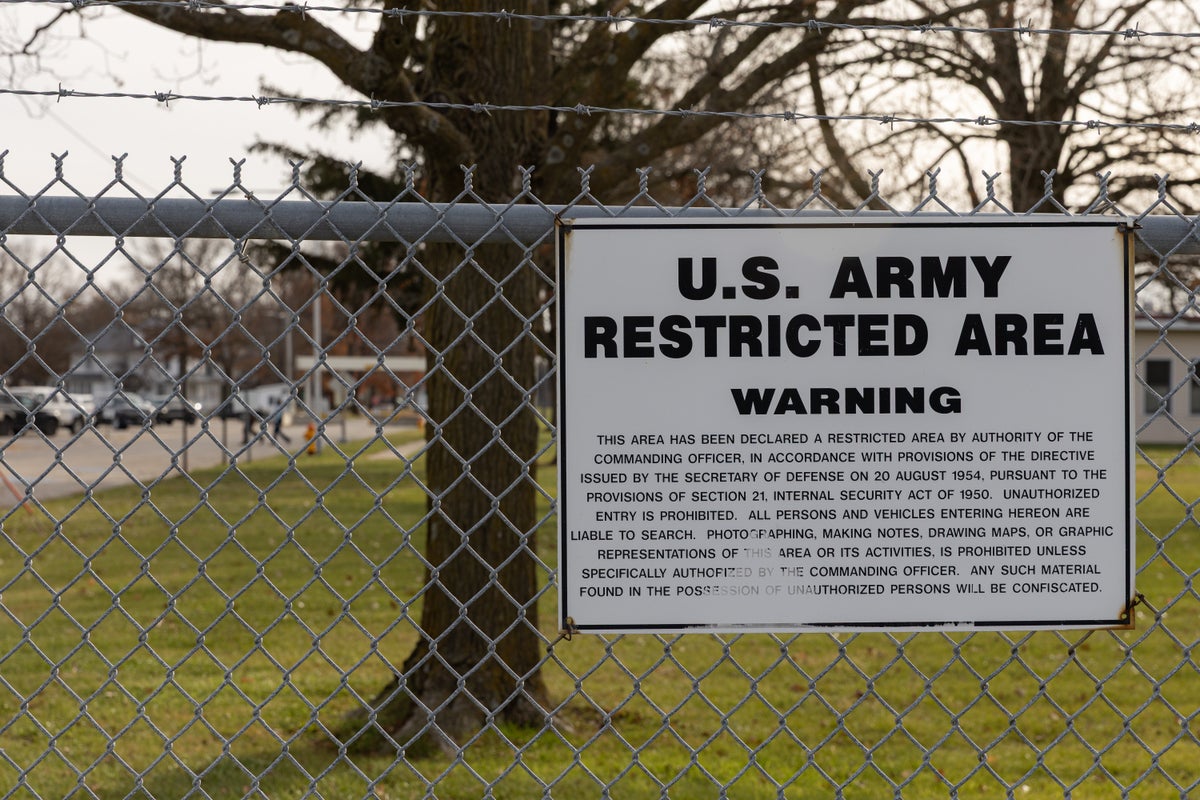
The U.S. Army will destroy the country's entire stockpile of lead azide on Wednesday morning, detonating roughly 5 tons of the degraded explosive at the Iowa Army Ammunition Plant in Middletown.The controlled blast is scheduled for 9 a.m. local time, or 1500 GMT. The operation will destroy nearly 10,000 pounds (4,500 kg) of the chemical, held in 68 barrels. The Army has warned that the dangerously degrading material could otherwise explode at any time.“Inaction is no longer an option,” said Maj. Gen. Eric Shirley, the Army's leader of the operation. Staff at the Iowa Army Ammunition Plant discovered during a routine monitoring inspection in March that the lead azide had partially crystallized.Warning signs surround the administration building at the Iowa Army Ammunition Plant in Middletown (AP)The crystallization made the chemical sensitive to friction and cold temperatures and created the risk of spontaneous detonation. The controlled blast is intended to prevent the aging explosive from detonating on its own. The stockpile was brought to the Iowa plant from bases across the country in 2009, after the Army moved away from using it.Robert Cekada, director of the Bureau of Alcohol, Tobacco, Firearms and Explosives, said the chemicals, used in munitions production, were stored in barrels in case the military needed to use them again. Some of the lead azide was already more than 60 years old when it was moved to Iowa, he said.The Army contacted the ATF in March seeking guidance on the stockpile, according to ATF Director Rob Cekada. Cekada said falling temperatures make lead azide more sensitive to shock and friction, raising the risk that it could detonate on its own. The Army assembled experts to formulate a planThey found that alternative solutions like thermal treatment and neutralizing the drums' contents were not as safe as a controlled detonation. Environmental groups filed a lawsuit to halt the plan.Glass is taped to reduce the chance of shattering at a home near the Iowa Army Ammunition Plant (Getty)A federal appeals court ruled Monday that the U.S. Environmental Protection Agency had adequately incorporated safeguards to minimize lead dust dispersal, putting the detonation back on track. The blast was originally planned for last Friday.The Army changed the detonation date three times amid public backlash and to allow more time for safety measures and favorable wind, according to court documents.The Army announced the original November 20 detonation date only the Sunday before. Acting Army Secretary Adam Telle said the public should not panic.Telle said the detonation at the Iowa Army Ammunition Plant in Middletown was scheduled for 9 a.m. (1500 GMT) on Wednesday, when weather conditions were expected to be "ideal to protect public health and safety across the region."At a press conference on Tuesday, officials said the mitigation measures, some put in place in recent days, included a series of earthworks encircling two subsurface concrete bunkers containing the lead azide.They also included a misting apparatus to dampen the surrounding terrain and a system to flood the blast site with special foam designed to capture dust from the blast. The Army has set up additional “blast barriers” around the bunkers where the 68 barrels of lead azide will be detonated.Trump has said that Iowa’s Governor-elect Rob Sand must agree to the detonation (AP)Concrete and sand barriers two stories high will surround the materials. Ballistic gels and foams will absorb the lead dust. The Army plans to douse the materials with thousands of gallons of water to tamp down the plume.The U.S. Army said it was working to keep toxic lead dust to a minimum when it detonates the materialOfficials overseeing the detonation plan say Wednesday's wind is expected to carry the plume southwest toward Missouri and away from nearby Burlington. Burlington is a city of just under 25,000 people that sits along the Mississippi River.Government officials encouraged residents within 5 miles (8 kilometers) of the site to evacuate to avoid lead dust in the air. They also assured residents that barriers around the blast zone should limit much of the plume from the detonation.The Federal Emergency Management Agency said residents within 5 miles (8 km) of the blast may be evacuated. Those within 5 to 20 miles were advised to stay indoors with windows closed to avoid exposure to lead dust. Army projections released on Tuesday showed lead dust could settle on surfaces as far as 40 miles southwest of the blast site, extending through southeastern Iowa into northern Missouri.Multi-agency responseAirborne particles could travel nearly 100 miles within eight hours, according to the projections. The Army said it would release updated projection maps hourly beginning six hours before the scheduled explosion. It also said it would release a final estimate of the affected area afterward.US Army Acting Secretary Adam Telle speaks at a press conference with other representatives from the military and federal government on Tuesday (Reuters)Lead azide is an explosive chemical used to detonate military munitions. Lead exposure can cause a range of health problems, particularly in children, in whom it can interfere with cognitive development, according to Patrick O'Shaughnessy, a public health professor at the University of Iowa.Once it settles in the environment, it does not break down, he said. The last major disposal of lead azide was an open-air detonation of 7,000 pounds of the chemical in Colorado in 1977, Army Colonel Aaron Teller, a munitions emergency response specialist, said.Teller said that detonation occurred with "zero mitigation" and that 75% of the lead particulate remained at the incident site. "We believe we can reduce that last 25% with the mitigation strategy that we have in place," he said.The detonation has raised concerns about potential health and environmental impacts from lead dust, as well as frustration over a lack of information. Residents in southeastern Iowa have struggled to keep up with changing information about where a plume of lead dust could travel after the explosion.Officials said information about the problems with the lead azide stockpile had been made public and town halls had been held to inform members of the community closest to the detonation site. Some residents said changing guidance over the timing of the blast and the likely path of the lead plume had left them confused and frustrated.Residents are still seeking answers Ahead of the blast, schools near Middletown shut down and businesses closed. Some residents sealed their windows and doors as a precaution. Residents expressed mixed concerns about the planned blast.Entrance to the administration building at the Iowa Army Ammunition Plant (AP)Some said the timing could be better given it is happening the day before Thanksgiving but acknowledged it needed to be dealt with now. Others expressed concern about the effect it will have on water, farms, animals and their own homes.“I don't think lead danger goes away any time soon," said Lucy Giehl, who lives nearby in West Burlington. "It seems someone might have thought about all of this a little sooner before it came to this.” Jill Holler, 51, took soil samples from her two family farms near Middletown this week to compare lead levels after the detonation.She is also worried about her cattle, which have no indoor shelter. Holler welcomed the additional information the U.S. Army released on Tuesday but questioned why it took so long, noting the detonation had originally been scheduled for last Friday.“I’m not opposed if this is the only safe option,” said Holler, who organized a protest in Middletown last week. “What I’m saying is that it’s been so mishandled that people are confused and don’t trust anything they’re saying.” Patrick Wall, a beef field specialist with Iowa State University Extension and Outreach, said he fielded calls throughout the week from cattle producers seeking advice on how to protect their herds. Wall said he learned of the planned detonation only on November 16 and has since put together recommendations for local producers."Communication was probably the poorest part of how this was handled," he said. The Misinformation Monitor newsletter rounds up international misinformation narratives, with a "Real or Fake?" quiz in every edition. Sign up here.
Everything you need to know about the U.S. Army’s 5-ton lead azide explosion in Iowa today
Full Article
Original Source
Read the full article at Independent →KhanList aggregates and links to publicly available news content. We do not host full articles from third-party sources. Always verify important information with original sources.