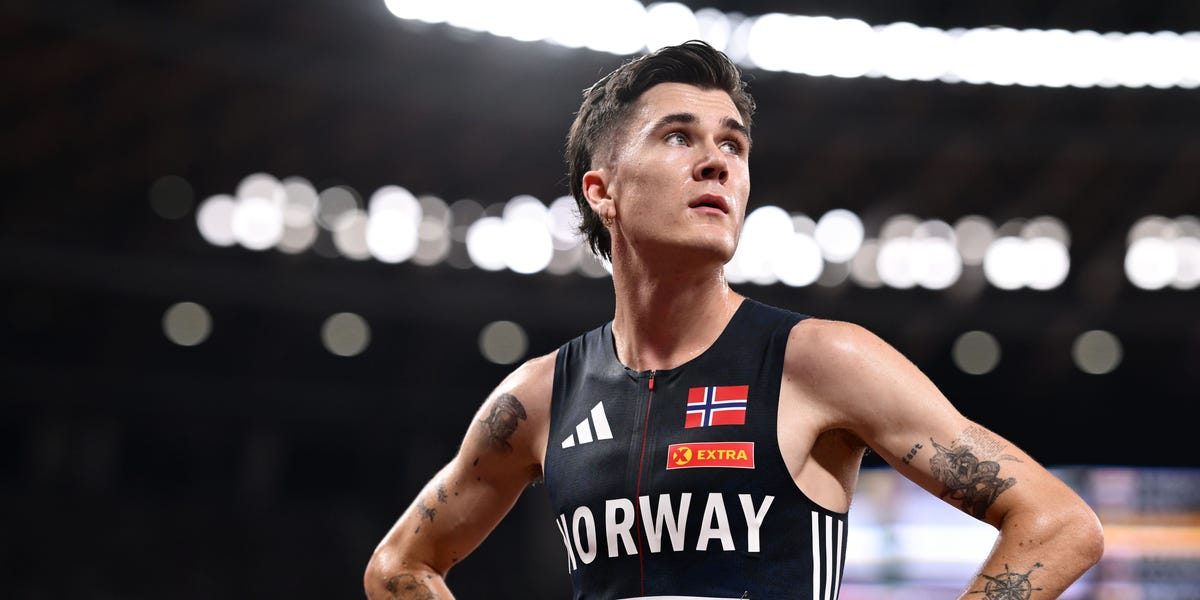
With six global titles and five world records to his name at just 25 years old, Jakob Ingebrigtsen is one of the most notoriously competitive athletes on the planet. Yet he’s not fazed by rival Josh Kerr’s declaration of war against the world record in the mile, which Kerr intends to chase at the London Diamond League later this summer.“I think every professional runner has a goal of breaking a world record,” Ingebrigtsen said in a video call with Runner’s World. “The difference is if you say it.”“It’s definitely a good thing. I remember he’s been critical of going after times in the past. So maybe he found out that [it] is something fun to do.”Ingebrigtsen started 2025 with a world record in the indoor mile and two world indoor titles in the 1500 meters and 3,000 meters, before an Achilles injury derailed the rest of his year. In the fall, he announced his intention to break world records in the 1500 meters, mile and 5,000 meters in 2026 but prolonged issues with his Achilles tendon sheath caused him to go under the knife in February.Now, three months later, Ingebrigtsen is back to training and more measured about his own goals for the year.“I’m trying to train as much as I can and that’s the main focus right now,” he says. “I am a competitor and of course, I’m going to compete once I’m ready for it. However, it’s not my main goal right now.”Ingebrigtsen was able to return to racing by the end of 2025 for the World Championships in Tokyo, but he was clearly not in his typical world-beater condition as he failed to make the final in the 1500 meters and was a non-factor in the 5,000 meters and finished just 10th overall.“Right now, my main goal is training and just making sure that everything is running smoothly and just being a little bit careful,” he says. “I’m not committing to [racing]. I’m very much aware of what happened last year and I was in all of these races [and] everything went to shit. That’s not a fun position to be in.”He said that he’s not necessarily doing anything different in training (“the problem that I had in my Achilles is removed, so it’s physically impossible to get it back”), but he does pay close attention to metrics such as heart rate and lactate threshold in order to monitor his progress as he builds back from an injury.He’s worked with wearables sponsor Coros for the past three years, before which he knew the data was valuable but didn’t even wear a heart rate monitor because “it was so annoying.” Now, he’s the face of the company’s new Jakob edition Pace 4 watch and heart rate monitor.The measurement tools are especially valuable while working to maintain fitness during injuries, setbacks, or time off from running like Ingebrigtsen’s recent surgery, which removed the Achilles tendon sheath on his left foot. He says he mostly uses the elliptical to maintain fitness, logging sessions like 14 x 3 minutes hard (“40 percent more than I do when I’m running … going down to 10 x 1K now when I’m running is the easiest session in the world”).“The effect of it is so crucial in terms of training the aerobic system,” he says. “It’s so crazy to see how fast you’re able to recover and keep a high level when you’re actually back running.”He’s also taken to cycling, typically on the stationary bike for up to two hours (his longest session was just over three).“I’ve been doing two hours [cycling] of second sessions indoors, but it’s also destroying my quads and my legs when I’m back running the next couple days,” he says. “So I have been monitoring that very closely in terms of being able to stop cycling because you quickly realize that fitness is preventing recovery because it’s so different, but so demanding even though it’s low intensity.”Though many professional runners have taken to cycling as a low-impact cross-training method over the past few years (Georgia Hunter-Bell, Keely Hodgkinson, Cole Hocker, and Cooper Teare to name a few), Ingebrigtsen has no intention of adding it to his standard training routine.“Never, 100 percent not,” he said of including cycling in his long-term plan. “It’s not something for a runner.”Best Running Gear Deals Right NowBest Garmin Running WatchGarmin Forerunner 265Now 22% OffBest Value HeadphonesJLab Go Air Sport+ HeadphonesBest Anti-Chafing StickBodyGlide Original Anti-Chafe BalmBest Handheld BottleAmphipod Hydraform Handheld Water BottleBest Energy GelsHüma Chia Energy Gel Variety 12 PackBest Value Massage GunBOB AND BRAD Q2 Ultra Mini Massage GunEasy Shoe DeodorizerMarsheepy Activated Charcoal Odor Absorber BagsNow 31% OffJohanna Gretschel is a freelance writer and broadcaster living in Austin, Texas, who has covered elite track and field and running in all its forms. She contributes to Runner’s World, ESPN, Austin American-Statesman, FloTrack, MileSplit, Women’s Running and Podium Runner. Yes, she has run a marathon!
‘Everything Went to S**t’: Inside Jakob Ingebrigtsen’s Mindset Shift After an Injury-Riddled Season
Full Article
Original Source
Read the full article at Runnersworld →KhanList aggregates and links to publicly available news content. We do not host full articles from third-party sources. Always verify important information with original sources.