
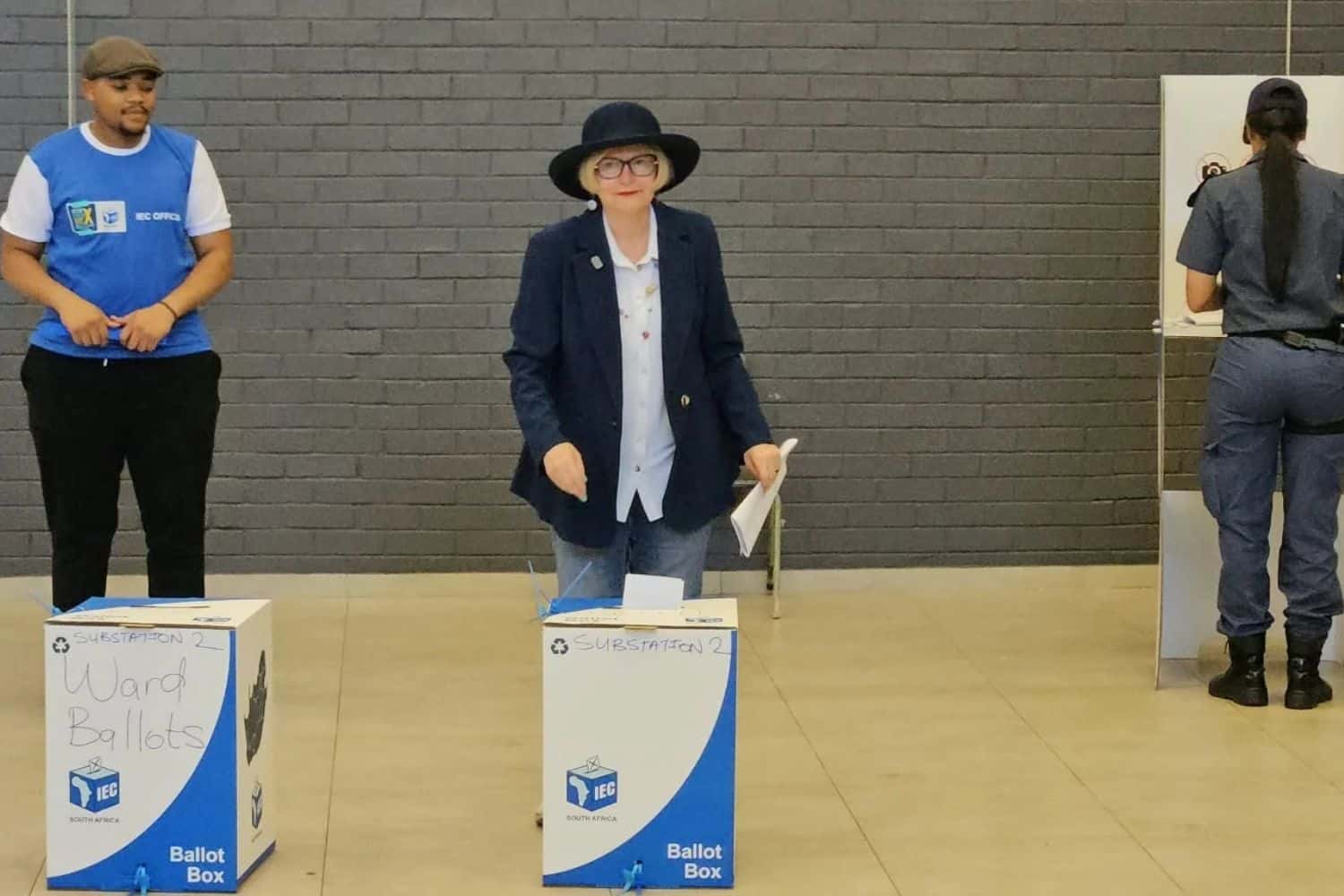
In recent weeks, disgruntled residents have taken to the streets to express their growing frustration over deteriorating municipal services in Joburg. Johannesburg’s crippling water crisis has become a defining issue on election day, with DA mayoral candidate Helen Zille warning that residents are growing desperate as repeated outages leave dozens of suburbs without water. She has vowed to make restoring a reliable water supply her first priority if elected. As millions of South Africans head to the polls on Wednesday, Johannesburg residents are voting against the backdrop of a deepening service delivery crisis, a reported R220 billion infrastructure backlog and growing frustration over failing municipal services, including water shortages, power outages, potholes and crime. Water crisis Residents queued at voting stations from as early as 5am on election day, while more than 29 million registered voters are expected to cast their ballots at more than 23 000 voting stations nationwide in the local government elections. LIVE interactive map, latest news, multimedia and more! View Map Speaking on election day, Zille, who cast her ballot at Emmarentia Primary School in Johannesburg, said the city’s water crisis represented the most urgent challenge facing Johannesburg. “My answer is water. The 50 suburbs that haven’t had water this last weekend, and that is a major crisis for a city the size of Johannesburg,” she said. Impact Zille said the outages hit hardest for residents who cannot afford alternatives when municipal services fail. “Some people can afford to go buy water, others can’t, and the desperation that comes with no water is palpable.” She acknowledged that residents would expect immediate action but warned that years of neglect had left the city facing a long-term infrastructure crisis. “Our first port of call will be to mobilise resources to try and address the water crisis.” “We can’t address it instantly because this has been a long period of decay over decades, literally. We’re going to have to find emergency solutions in the short term, but fix the infrastructure in the medium and long term.” Coalitions Beyond service delivery, Zille used the opportunity to draw a hard line on coalition politics, insisting the DA would not return to unstable governing arrangements dependent on the EFF. “We won’t run it in a nine-party coalition that depended on the EFF to get through.” She doubled down, saying the DA would rather sit in opposition than govern under those conditions. “If we have to run a nine-party coalition dependent on the EFF, we will go into opposition because that is ungovernability defined.” “I’m not going into unworkable coalitions.” Political instability Zille argued that political instability had contributed significantly to Johannesburg’s decline and said stable government was essential if the city was to reverse years of deterioration. “The best solution is for us to get an outright majority because then we can have a solid, stable blue government for five years, and then you can see what we can do.” ANC She reserved some of her strongest criticism for the ANC, blaming years of governance failures for the collapse of key state and municipal entities. “How can things be under more threat than they have been under the ANC?” she asked. “The ANC has destroyed every state asset there is.” Zille said the effects of that decline are visible across both national and municipal institutions. “It’s destroyed Eskom, it’s destroyed the entities in Johannesburg, Joburg Water, City Power and the Joburg Roads Agency.” “Everything is destroyed.” Negotiations Despite the uncertainty that could emerge from coalition negotiations after the election, Zille remained unequivocal about one scenario. “If we actually depend on the EFF to stay in power, then we would go into opposition.” Her message to voters was clear: Johannesburg’s next administration must focus on restoring basic services, starting with water, while avoiding the unstable coalition politics that have defined much of the city’s recent governance. Gaza Zille was also questioned about the genocide in Palestine. “First, learn to spell genocide,” a person passing by told her at the voting station. Zille responded as follows: Last year, the ANC condemned the DA’s defence and “continued support of the apartheid State of Israel” after Zille sidestepped a question about whether genocide was being committed in Gaza. Zille evaded questions during an interview about Israel’s attacks on Gaza, where widespread destruction and mass civilian deaths have led international observers and rights groups to label the assault as genocide. “Genocide is a very big word. I haven’t been to Gaza, and I don’t know. But I certainly do know that Hamas has spent all its energy trying to obliterate the state of Israel,” Zille said. Pushed to answer if Israel was committing genocide after the UN Independent International Commission of Inquiry, which does not speak for the main body, found that a genocide was being committed, Zille sidestepped the question.
‘Everything is destroyed’: Zille blasts ANC as water crisis dominates Joburg election [VIDEOS]
Full Article
Original Source
Read the full article at Citizen →KhanList aggregates and links to publicly available news content. We do not host full articles from third-party sources. Always verify important information with original sources.