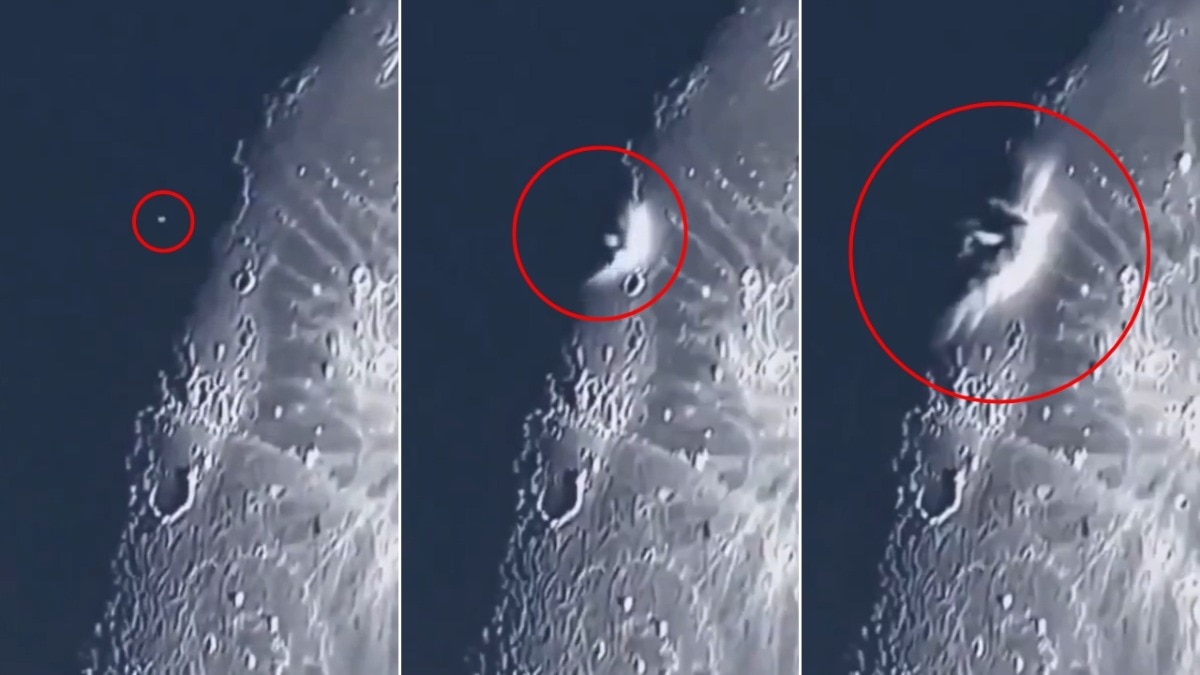
You did not see the SpaceX Falcon 9 rocket upper stage crash into the Moon. No one did.Our distance from it hides just how pockmarked the Moon is. Almost 10,000 craters are scattered across the lunar surface. Yet, a new one is vying for everyone’s attention.What happened feels straight out of a sci-fi movie.The Moon’s gravity pulled in the discarded upper stage of a SpaceX Falcon 9 rocket. The object weighed four tonnes. It hurtled towards the Moon at a speed of 8,690 kilometres per hour. At around 2.30 in the morning (Eastern Time) on August 5, half past noon in India, it crashed into the surface with resounding silence.Imagine the impact: a flash of light followed by lunar dust and debris flying everywhere in slow motion because of low gravity. What a sight that must have been. Everyone wanted to see it. And soon they found a video that was just as spectacular as what they had imagined. Unfortunately, it was AI-generated! Hours after the incident, a gold-checked X account called Valuetainment shared a video allegedly showing the crash. Valuetainment’s video was reposted by Elon Musk, the owner of the rocket — and the platform where the video was shared. Musk did not say anything.And soon, others did the same; as did news outlets like the Maharashtra Times and ETV Bharat. Both Valuetainment and Musk later acknowledged the video was fake. Musk guffawed with a tears-from-laughter emoji while posting that.But if that video is synthetic, then where is the real one? As New York Times science correspondent Kenneth Chang asked: "If a rocket stage crashes into the moon and no one sees it, did it really crash?"Well, yes.WERE WE READY FOR THE CRASH?The reusable Falcon 9 rocket, a veteran of space travel, blasted off from Florida in January 2025, carrying two lunar landers. Once its mission of taking these landers out of Earth’s orbit was accomplished, the reusable part of the rocket returned home. The part that has now crashed was discarded, left to drift in space for eternity. And it did that for some time. But soon, the Moon’s gravity beckoned it into her turf. The Falcon 9, before its launch on January 15, 2025. (Photo: SpaceX) Scientists noticed this. They predicted its course. And soon, calculated when and roughly where it would crash. And they sat at the edge of their seats, hoping to see this cosmic crash.DID WE SEE THE CRASH?Not really. Unfortunately for both amateurs and professionals ready with their telescopes, big and small, the Moon at the allotted time looked the same. There was no flash. And there was no cloud of dust.According to the BBC, there was no realistic chance of seeing the flash, given that it would have lasted a fraction of a second and occurred on a part of the Moon that’s bathed in daylight.The same report also noted that spacecraft orbiting the Moon were not in the right place at the right time to watch the impact happen live. Reportedly, South Korea's Danuri orbiter passed near the crash site just before it happened.The predicted crash also reportedly took place at a precarious spot, near the Moon’s terminator line, the boundary of its visible side and the “dark side”. This also makes visibility a problem.THEN WHAT DID WE SEE?According to reports, the European Southern Observatory’s Very Large Telescope at the Paranal Observatory in Chile observed “spectral lines”.These are colourful illustrations of sodium and lithium gas. The sodium gas likely originated from the lunar soil, and the traces of lithium from the rocket. These were visible for 5–10 minutes, and measured several kilometres in size.Carl Schmidt, the lead astronomer conducting the impact observations, told reporters that the observation did not “go perfectly”, but that he was “100 per cent confident” that the readings came from the impact.WILL WE EVER SEE WHAT HAPPENED?Possibly. The Danuri Orbiter team has told Korean media that any footage will only be released once researchers have completed their analysis. NASA's Lunar Reconnaissance Orbiter will be in position to photograph the site in a few days. Then it can compare photos from before and after the crash. South Korea’s Pathfinder Lunar Orbiter is also planning to take images of the site after impact. Hopefully, these orbiters will find something new.Neil Armstrong, Edwin Aldrin, and Michael Collins, in humankind's maiden voyage to the Moon, left many things behind. Adding to that legacy today is debris from a discarded rocket part. It may not be as monumental as the first footprint. But the resulting crater will be etched there forever.- EndsPublished By: Pathikrit SanyalPublished On: Aug 6, 2026 19:31 IST
Everyone knew about the crash on the Moon. No one was there to take photos
Full Article
Original Source
Read the full article at Indiatoday →KhanList aggregates and links to publicly available news content. We do not host full articles from third-party sources. Always verify important information with original sources.