
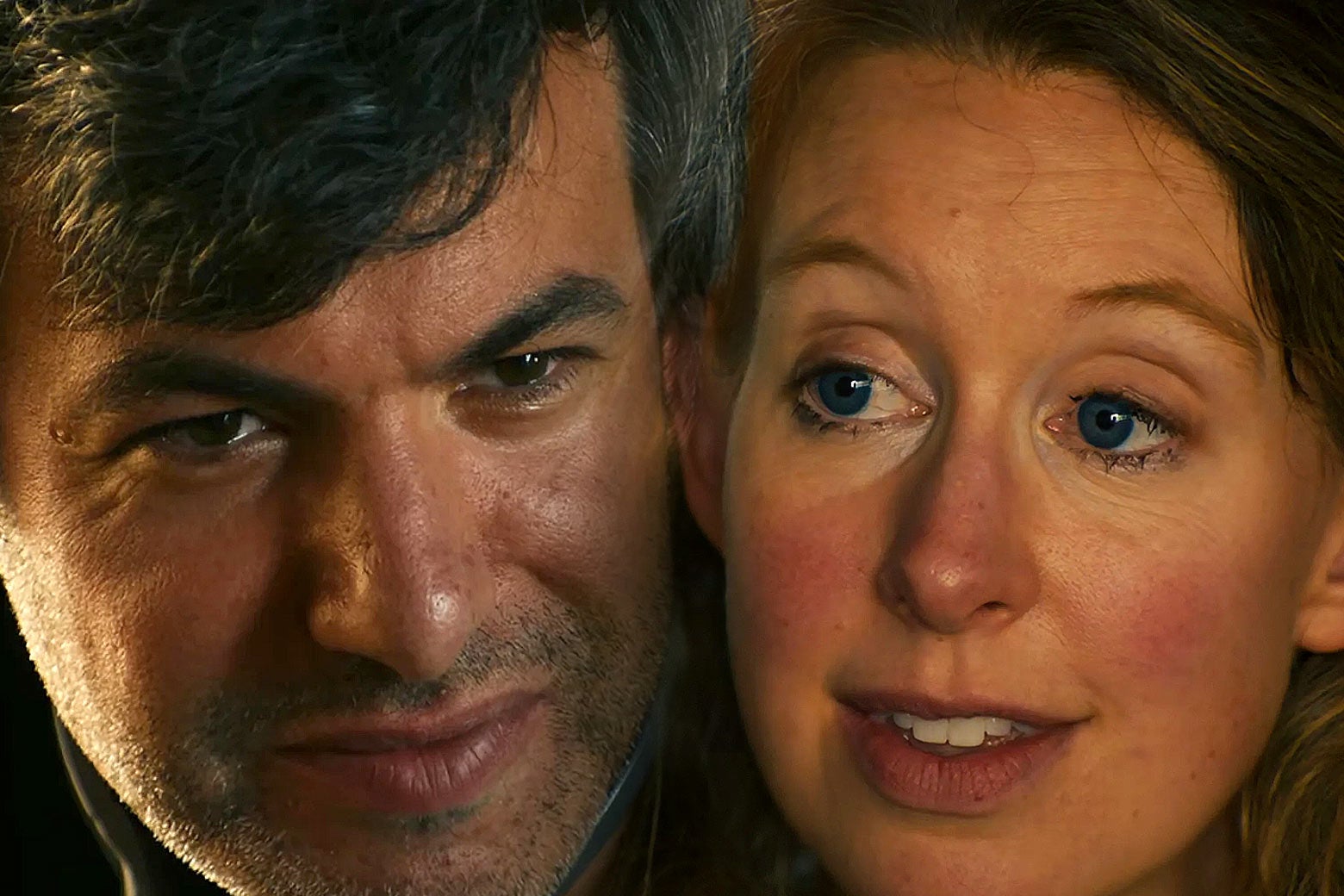
Movies In You Can See Everything, All the World’s a Stage Photo illustration by Slate. Photos via A24. This article contains spoilers for You Can See Everything. In one of You Can See Everything’s key—and most discussed—scenes, Nathan Fielder sits with convicted fraudster Elizabeth Holmes and her partner Billy Evans, and shows them Abbott and Costello’s legendary “Who’s on First?,” which Fielder hails as “maybe the most famous comedy routine of all time.” “Who’s on First?” is a bit of complicated rapid-fire wordplay so important to 20th-century culture, and so perfect in its construction, that I performed it in sixth grade drama class opposite a kid I despised, and we still killed. After they watch the routine, Fielder asks Holmes if she understands why it is funny. At first she says yes, but it becomes clear as he questions her further that she does not understand it. She doesn’t even understand that the source of the confusion is that the first baseman’s name is Who. John Carreyrou, who reported out Holmes’ fraud for the Wall Street Journal, sees the scene as a brilliant demonstration of how she lies. “You would expect someone who hadn’t initially understood a joke to blurt out ‘Oh!’ or show some flicker of recognition when it registers,” he explains. “But Ms. Holmes has no visible reaction. To me, it was another tell: She had understood the joke but was playing dumb.” The most important part of Carreyrou’s analysis might very well be the small qualification to me. Over the weekend, I asked a friend who is autistic about the scene, and they said it was clear proof (to them) of Holmes’ “profound” autism, and a textbook example of “masking,” the practice of aping the gestures of neurotypicality to fit in and survive. My favorite interpretation, however, belongs to my wife, who said that Holmes is clearly an exhausted mother of two small children, up too late, preoccupied by her upcoming prison sentence. She hadn’t really paid attention while the routine was playing, and then was attempting to politely bluff her way out. The scene, like the rest of You Can See Everything, is thus less a window into Holmes and more a window into ourselves. The thing I hear most often about the film is that you emerge from its three-hour tour of her world with fewer answers than when you went in. Like Shakespeare’s Hamlet—another narrative filled with unreliable narrators, doubles, strange twists, and contradictory pieces of evidence—your interpretation will rely inevitably on what you carry with you into it. You Can See Everything thus holds, as Hamlet famously said, “the mirror up to nature,” but what nature? The nature of lying? Of autism spectrum disorder? Or the nature of our own psyches? As an acting obsessive, then, it’s perhaps inevitable that I see it as a film about the nature of performance, and about the multiple definitions of to act, which can mean both to do something and to pretend to do it. When Hamlet talks about the mirror up to nature, he is providing instruction to a traveling theater company. His monologue—often called the “advice to the players”—is filled with good tips. Speak clearly. Don’t gesticulate too wildly. Don’t pander to the crowd to get cheap laughs. Hamlet, a character who is acting all of the time by pretending to be insane in order to investigate his father’s murder, has learned a thing or two about how to convincingly perform, and has the temerity to tell professionals how to do their job. What Shakespeare knew, and what acting teachers beginning with Stanislavski in the late 19th century made a core of their pedagogy, is that, as all the world’s a stage, we are all acting all the time. We are not stable, authentic selves at every moment. We emphasize different aspects of who we are depending on the situation. How we behave at work and how we behave on a date and how we behave on the internet and how we behave around small children don’t fully cohere. We are all, to various extents, masking all of the time. The great acting teachers sought to harness this constant juggling of roles and have their students use those daily performances more self-consciously, while appearing to behave naturally. Few artists are more self-conscious about, well, everything than Nathan Fielder, a man whose recent work is all about the consequences of failing to act like a normal person. In his HBO show The Rehearsal, Fielder—or perhaps the character “Nathan Fielder”—begins by trying to help other awkward people accomplish their life goals through elaborate pre-creations of potentially fraught encounters. Within a few episodes, he has all but dropped this pretext in order to instead explore the nature of acting itself, and then, in a series of ever-more-reflexive moves, turns the show into an attempt to prove his own worth as a human being despite having a “personality [that] makes people uncomfortable.” In the show’s second season, Nathan’s concern for airline safety and the mental health of pilots turns out to be an elaborate excuse to reassure himself that he is OK, despite the deep alienation he—or the character he plays that shares his name—feels everywhere he goes. Yet The Rehearsal and You Can See Everything are given an extra layer by Fielder being their creator and (co-)director. The Rehearsal’s extensive voice-over and careful editing foreground Fielder’s construction of its narrative. As with any well-constructed first-person narrator in fiction, we can’t help but wonder how reliable he is. Is Fielder actually this socially clumsy, this pained, this isolated, or has he created a persona that allows him to investigate the themes he’s interested in? Is he acting or … well … acting? You Can See Everything drops the voice-over, but it is no less controlled, no less constructed, and no less reflexive about that construction. In its second half, Fielder and co-director Lance Oppenheim turn the film into a hall of mirrors by roping in Amanda Seyfried, who portrayed Holmes in the campy Hulu show and meme factory The Dropout. Seyfried is a game scene partner, enthusiastically reviewing Fielder’s footage with him as if they were two true-crime fans rehashing the latest episode of their favorite podcast. Before too long, Seyfried volunteers not only to reenact anything Fielder wants as Holmes but to use her skills as an actress to get under the off-putting Billy Evans’ skin and cause him to reveal more of himself than he otherwise would. When this gambit works, it leads to the film’s most chilling scene, as Seyfried—playing, or perhaps being, drunk—goads Billy into revealing not only his love of Charlie Kirk but his performance as Holmes online, and his desire to “ruin [the] lives” of everyone who has done her wrong, including, presumably, Seyfried herself. Later, she helps Fielder reenact a conversation he had with Holmes in prison, giving a far more convincing performance as Holmes than she did on her Hulu show, and discussing, as Holmes, how Seyfried has ruined her life. She even mispronounces her own name in deference to authenticity. Her work in the film is remarkable, and, in its willingness to look bad, quite brave. Seyfried, who was puzzlingly left out of the Oscar nominations for Best Actress for The Testament of Ann Lee, may even wind up being nominated for a documentary in which she spends most of the time playing herself. By adding a professional actor into the film, Fielder and Oppenheim emphasize the feeling, lurking throughout the entire movie, that we have watched three cagey operators performing for each other and the cameras. Fielder and Holmes may very well be on the spectrum somewhere, or they may be playing to our stereotypes of autistic people for their own ends. Well before Billy emerges as the film’s villain—well before he even grabs the infamous bowl of eggs—we sense something wrong about him because of his odd presence on camera. Knowing Fielder’s work, one cannot help but feel from the very first shot that a twist is coming, and that it will have something to do with performance. Originally, I suspected that twist would be that Evans was being played by an actor in some kind of elaborate re-creation that Holmes had agreed to star in, because he seemed so stiff and to be clearly thinking out what he was going to say before saying it. I realized, however, that Billy was acting in a wholly different style from Fielder and Holmes. This style was pioneered on reality shows like Laguna Beach and The Hills, in which subjects are given prompts and then improvise scenes as themselves. Now, thanks to Bravo and the Kardashians, this slightly forced and slightly heightened way of being yourself in front of the camera is the dominant acting style on television. But it’s still one that documentarians try to avoid. In documentary, we usually want the sense that we are getting the real deal all the time. We want a subject to ignore the camera, rather than let it ogle his hog in the shower and then turn and smile at the camera as he struts into the bedroom. It is only Seyfried—who, presumably, is well versed in playing herself in front of the camera—who comes across clearly as a “real” human being. But our understanding of that reality is based on conventions, and those conventions tend to exclude lots of people, including the neurodivergent. As I’ve gained more experience appearing as both myself and characters for the camera over the past few years, one thing I’ve learned is that my everyday theater-kid personality comes across as bizarre, grandiose, and affected when captured by the merciless gaze of the camera lens. It is only by artificially reining myself in, both vocally and physically, that I come across as telling the truth. When Elizabeth Holmes, her eyes unblinking, claims to Fielder that she not only won’t lie but in fact cannot remember a single instance in which she has lied, it is impossible to know for sure what is going on. Her own definition of a lie—saying something she believed at the time was untrue—provides a little penumbra in which untold numbers of falsehoods could hide. In Shakespeare’s time, that penumbra was a terrifying innovation in dishonesty called equivocation, and it was essential to the political and religious context of Elizabethan England. The nation, after all, was in the midst of a war on Catholicism, and the pope was attempting to overthrow the queen. Catholic priests smuggled themselves into England to perform rituals and recruit more people to their cause. If a suspected priest was caught, exposing them should have been easy. It’s a sin to lie, and a much greater one to deny your faith, so if you simply ask them “Are you a Catholic priest?,” they’re supposed to answer yes. But equivocation officially allowed priests to avoid the mortal sin by reserving an oasis in their heart for the truth. Using words with double meanings—as Holmes does with can or Bill Clinton did with is—was one form of equivocation. Another was to allow the priest to add an unspoken phrase in their minds that turned a lie into the truth. Thus “I am not a priest” could become “I am not a priest of your faith.” Given this, how could agents of the crown know the truth for sure? Shakespeare’s answer, in masterpiece after masterpiece, is that you actually can’t. There is no single truth to his great characters, which is why we love reinterpreting them time and again. But his plots often hinge on the impossibility of knowing the truth as well. Antony and Cleopatra die in part because they cannot prove to each other their love in a way that can be verified. The ghost of Hamlet’s father might be telling the truth about his murder or might be a demon sent to tempt him into hell. Othello tells Iago to bring him “ocular proof” of Desdemona’s infidelity, and Iago complies, but the proof is a real object that Iago surrounds with a fabricated narrative until its meaning completely changes. As with Theranos’ Edison device, there’s plenty of ocular proof; it just happens to point in a misleading direction. We can see everything, but so what? As our lives have moved ever more online, and our televisions have become clogged with reality slop, we have become ever more conscious of the ubiquity of performance. While for some this consciousness can be liberating, it has also destabilized our belief in reality, in facts, in objective truth. Just look at Elizabeth Holmes. In order to have committed fraud, she had to have intentionally misled people. Her defense is that she never meant to do so. I find the evidence contradicting her persuasive, and so did the jury who convicted her, but that evidence is not to be found in You Can See Everything, which is not an attempt to forensically demonstrate guilt or innocence. Instead, it is about whether we can truly know each other, and if we can’t, what ground remains on which to build our trust. When it comes to lying, which relies in part upon the hidden interior mechanisms of another’s psyche, seeing isn’t all that much help. We can’t know another person’s soul, after all, when we barely know our own. Read more in Slate about You Can See Everything. Crime Fraud Medicine Movies Documentaries You Can See Everything
Everyone in You Can See Everything Is Playing a Character, but Only One Performer Is Utterly Convincing
Full Article
Original Source
Read the full article at Slate →KhanList aggregates and links to publicly available news content. We do not host full articles from third-party sources. Always verify important information with original sources.