
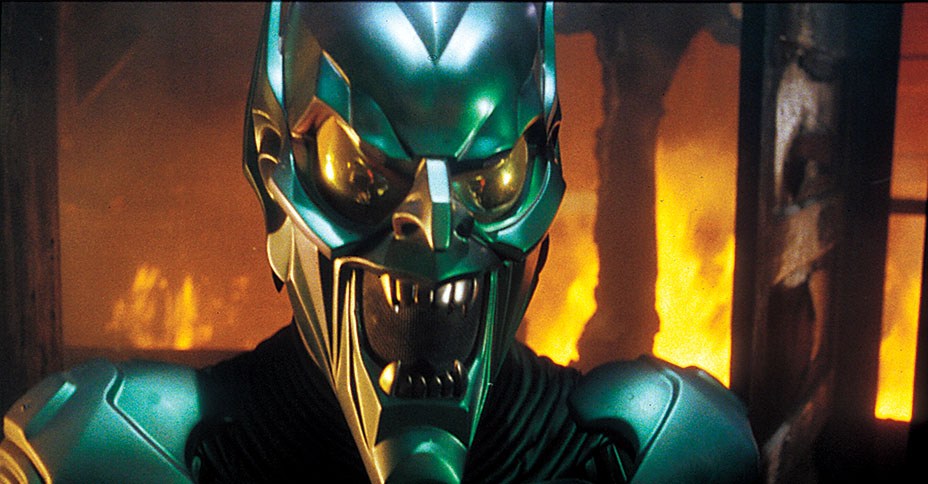
Heat Vision Home Movies Movie Features With the release of 'Spider-Man: Brand New Day,' The Hollywood Reporter ranks Spidey’s cinematic crooks and creeps — from worst to best, below. September 1, 2026 11:12am Published on September 1, 2026 The Green Goblin in 'Spider-Man.' Columbia Pictures/Sony Pictures/Photofest Logo text When it comes to rogues’ galleries, no Marvel superhero has a better one than Spider-Man. Since 2002, web-slingers Peter Parker and Miles Morales have faced no shortage of super-villains across both live action and animation. The release of Spider-Man: Brand New Day, Tom Holland’s fourth outing as the world’s most popular superhero, adds even more adversaries to the already sizable and sinister list of character adaptations. With the latest Marvel Cinematic Universe’s release, Spider-Man: Brand New Day, The Hollywood Reporter ranks Spidey’s cinematic crooks and creeps — from worst to best, below. 19. Dr. Ashley Kafka – The Amazing Spider-Man 2 In one of the more curious choices in Marc Webb’s The Amazing Spider-Man 2 (2014), Dr. Ashley Kafka (Marton Csokas), who experiments on Electro, entirely deviates from the comic book character. Instead of being portrayed as a woman, whose psychiatric expertise made her an ally to Spider-Man in the comics, Kafa is depicted as a male, crazed German scientist who feels like a leftover from one Joel Schumacher’s Batman films. 18. Gustav Fiers – ‘The Amazing Spider-Man’ and ‘The Amazing Spider-Man 2’ Teased in the post-credit scene of The Amazing Spider-Man (2012), The Man in the Shadows (Michael Masse) who appears in Curt Conners’ cell launched all sorts of fan theories at the time. From Electro, the Chameleon to Norman Osborn, who was pulling the strings was anyone’s guess. It turned out to be someone no one would’ve guessed: Gustav Fiers, a very minor Spider-Man villain known as The Gentleman, from Adam-Troy Castro’s trilogy of Spider-Man novels that began in 1999. When his name was revealed in The Amazing Spider-Man 2, where he really doesn’t do anything, Fiers hadn’t even debuted in the comics yet. Talk about obscure! 17. The Rhino – ‘The Amazing Spider-Man 2’ Image Credit: Niko Tavernise/Columbia Pictures/Courtesy Everett Collection Paul Giamatti advocated for himself to play the Rhino for a few years, and he got his wish in The Amazing Spider-Man 2. After being de-pantsed in the movie’s opening, Aleksei Sytsevich returns in the film’s final moments sporting a big, bulky rhino mech. With a hokey Russian accent and a rhino suit that breaks all credibility, the Rhino is both an eyesore and an earsore. 16. The Tinkerer – ‘Spider-Man: Homecoming’ Image Credit: Sony Pictures There’s really nothing wrong with the depiction of The Tinkerer in Spider-Man: Homecoming (2017), and I honestly feel a little bad ranking him this low. Michael Chernus delivers some great deadpan humor and the idea of a guy using alien technology from the Battle of New York in The Avengers (2012) is a great application of the character. But given how little screentime he ultimately has, and the fact that the character has yet to return — although he should ± makes it difficult to justify him being listed any higher. 15. The Shocker – ‘Spider-Man: Homecoming’ Image Credit: Sony Pictures Here, we have another great reinvention saddled by too little screentime and no returning appearances. Logan Marshall-Green plays Jackson Brice, the film’s first iteration of the Shocker (who, in the comics, is an all-together different character: the lasso-wielding Enforcer named Montana). After Brice is handily dispatched, Bokeem Woodbine’s Herman Schultz, the Shocker of the comics, takes on the role and has a brief but memorable encounter with Spider-Man in the school bus lot. Woodbine’s an incredible actor and it’s about time to get Shocker back in the mix as a low-level adversary. 14. Venom – ‘Spider-Man 3’ Image Credit: Sony Pictures/Courtesy Everett Collection Sam Raimi introduced one of Spider-Man’s most famous enemies, under duress, in Spider-Man 3 (2007). I’ll argue that the film itself is quite good, albeit overcrowded, largely due to the Eddie Brock/Venom plotline (Topher Grace). The addition of Venom was a studio note, and it feels like one that Raimi’s heart wasn’t fully in, given his affinity for Spider-Man classic ‘60s adversaries. The film presents a pretty comic-accurate depiction of Venom’s origin, and it’s not hard to see what the filmmakers were going for in terms of casting Topher Grace as the dickish alternative to Peter Parker. But Venom never feels entirely convincing in his revenge plot. He disappears for a long stretch of the movie and, while the stakes are personal, at least on the page, Venom never feels like a true threat to Spider-Man as he’s dealing with Uncle Ben’s killer and best friend-turned-enemy. 13. The Lizard – ‘The Amazing Spider-Man’ and ‘Spider-Man: No Way Home’ Image Credit: Jamie Trueblood/Columbia Pictures/Courtesy Everett Collection Rhys Ifans imbues Doctor Curt Conners with a cautious humanity and calculating lizard brain in The Amazing Spider-Man. In his effort to regrow limbs, as reptiles do, Conners, experiments on himself and becomes The Lizard. He provides a significant physical threat in both TASM, and No Way Home, though the design choice has never wowed me. Todd McFarlane’s Lizard design has always been the best version to me. Still, he serves his purpose and making him Spider-Man’s first villain in The Amazing Spider-Man franchise works quite well narratively and thematically. 12. Olivia Octavius/Doctor Octopus – ‘Spider-Man: Into the Spider-Verse’ Image Credit: Sony Pictures The magic of the Spider-Verse is that it allows for a myriad of interpretations for Spider-Man’s major and minor enemies. In Into the Spider-Verse (2018), Olivia “Liv” Octavius (Kathryn Hahn) makes for a memorable antagonist as Kingpin’s chief science advisor, equipped with her own set of technologically advanced arms. A formidable threat to both Miles Morales and his Spider-verse friends, her mad science threatens to destroy the entire universe and, most alarming, she doesn’t really seem to care. 11. Harry Osborn/Green Goblin – ‘The Amazing Spider-Man 2’ Image Credit: Columbia Pictures/Courtesy Everett Collection The second Spider-Man franchise didn’t waste much time bringing Harry Osborn back into the fold. It wasted even less time on his transformation into the Green Goblin. Foregoing Norman Osborn’s time on the glider, Marc Webb’s Spider-Man sequel dives right into Harry’s descent. There is something quite compelling about Dane DeHaan’s depiction of Harry. No longer cool in all the ways Peter wasn’t, this depiction of Harry is also a nerd, whose wealth doesn’t change that or the fact that he’s dying. His ensuing rage over Spider-Man not giving him a sample of his blood, which could cure his rare disease, is somewhat understandable, and does kind of put Peter in bad light. While Harry’s ultimate transformation, after being injected with venom from genetically altered spiders, has been the source of much discussion, his toothy, Kewpie Doll visage is rather creepy despite being ever so slightly goofy. And however one might feel about the death of Gwen Stacy, Green Goblin certainly came through on his promise of revenge and villainy in this film. 10. Electro – ‘The Amazing Spider-Man 2’ and ‘Spider-Man: No Way Home’ Image Credit: Columbia Pictures/Courtesy Everett Collection Admittedly, I’m of two minds about Electro. The pre-transformation Max Dillon that we are first introduced to in The Amazing Spider-Man 2 is a pretty cringeworthy nerd caricature, with buck teeth, broken glasses and slicked down hair smoothed over a bald patch. Initially, it feels like Jamie Foxx’s character stumbled out of a Nutty Professor movie. But after falling into a tank of experimental electric eels, the new blue Dillon is a neat take on the character. There’s no subtly in how he fits into the film’s theme of great power, but Electro makes for some of the film’s most visually arresting action sequences and soundtrack moments. When he returns in No Way Home, no longer blue, Foxx makes Electro an immensely likeable smooth criminal behind some of the film’s funniest lines. 9. Kingpin – ‘Spider-Man: Into the Spider-Verse’ Image Credit: Columbia Pictures and Sony Pictures Animations One of the most memorable designs of any onscreen Spider-Man villain, Into the Spider-Verse’s Wilson Fisk aka Kingpin, is depicted simply as mass — a blot on New York, a tumorous, seemingly immovable stain of humanity. He fills up the frame, and the anatomical incorrectness of his tiny head on his massive body speaks to the freedom that animation allows in its depiction of characters as ideas. Voiced by Liev Schreiber, Kingpin, the force behind the multiverse collider, the death of Peter Parker and Aaron Davis on Miles’ world, is the central villain of the film. What’s great about the Kingpin, despite his lack of superpowers, is that in his efforts to be seen as a man rather than a monster, he only becomes more monstrous and irredeemable in the eyes of the family he wants to rebuild with multiversal variants. 8. The Sandman – ‘Spider-Man 3’ and ‘Spider-Man: No Way Home’ Image Credit: Sony Pictures/Courtesy Everett Collection There’s an earnestness in Spider-Man 3’s depiction of Sandman, and Thomas Haden Church brings layers to the character. There’s no attempt to try to make him bigger or more threatening than Ock or Goblin, or a genius scientist, or failed father figure. Flint Marko is simply a crook, not even a particularly good or ill-intentioned one, whose bad choices result in bad consequences. Even in the decision to retcon Uncle Ben’s death from the first film, by making Marko the man who fired the shot that killed Ben, there’s a simplicity and matter-of-factness about it. The revelation doesn’t feel like a gamechanger in the way that Jack Napier/The Joker being behind the murder of the Waynes does in Batman (1989) but rather a means to explore the cycles of hurt that every single character, including Peter Parker, takes part of in this film. Marko’s desire to save his ailing daughter makes him empathetic, a trait that continues into No Way Home in which all Marko wants to do is get back to his daughter Penny. Obviously, the Sandman’s powers make him a great visual adversary, but it’s the character’s humanity that proves to be the strongest foundation. 7. Harry Osborn/Nu Goblin – ‘Spider-Man 3’ Image Credit: Sony Pictures/Courtesy Everett Collection Built up across Raimi’s Spider-Man trilogy, Harry Osborn’s fall is both inevitable and heartbreaking. Yes, the snowboarder design of the Nu Goblin leaves a lot to be desired. But much like Willem Dafoe, James Franco is just as, if not more, effective out of the costume. Harry’s quest for revenge against Peter for the death of his father takes an abrupt turn in the first act when Harry crashes during a fight with Peter and gets amnesia. It’s a classic soap opera trope that feels right on par with ’60s and ’70s Spider-Man comics. But the amnesia allows Franco to find new shades to Harry, from a dopey sweetness to a knowing, almost fourth-wall breaking, smirking menace. After being disfigured by the symbiote corrupted Peter throwing a pumpkin bomb in his face, he becomes an almost gothic monster, reduced to the shadows. That is, until he returns in the third act to save his friends and sacrifice his life in a well-earned emotional beat. 6. The Spot – ‘Spider-Man: Across the Spider-Verse’ Image Credit: Sony Pictures Releasing/Marvel Entertainment/Courtesy Everett Collection While typically considered a joke of a character who ranks among Spider-Man’s D-list comic villains, The Spot is given both menace and purpose in Across the Spider-Verse. Jason Schwartzman voices the vindictive scientist-turned-supervillain who seeks to become Spider-Man’s (Miles Morales) nemesis by opening dimensional portals and wreaking havoc across the Spider-Verse. The Spot’s power set and monochrome design make him the perfect choice for Across the Spider-Verse’s groundbreaking animation. And with The Spot set to return as the major adversary Spider-Man: Beyond the Spider-Verse, his status among Spider-Man movie villains will only grow. 5. The Prowler – ‘Spider-Man: Into the Spider-Verse’ and ‘Spider-Man: Across the Spider-Verse’ Image Credit: Sony Pictures In a twist on Peter Parker’s relationship with the saintly Uncle Ben, Miles Morales’ uncle, Aaron Davis, leads a double life as the mercenary, The Prowler. Mahershala Ali provides voice of Miles’ Uncle Aaron and imbues the character with a streetwise toughness that’s only softened by his nephew. He’s both likeable as Aaron Davis, and terrifying as the ruthless Prowler. Davis’ role as the Prowler is the result of losing contact with family and community, rather than an outright desire to be a supervillain. Into the Spider-Verse makes it clear that he’s not a bad guy, but the result of bad choices. In his dying moments, he teaches Miles the importance of moving forward and remaining grounded by the people who care about him. The impact that moment has on Miles makes his encounter with a variant version of Aaron Davis, who has passed his mantle of The Prowler on to his world’s Miles Morales, all the more traumatizing for the young hero who believed that part of his past was behind him. 4. Mysterio – ‘Spider-Man: Far From Home’ Image Credit: Columbia Pictures/Marvel Studios/Courtesy Everett Collection Quentin Beck takes center stage in Spider-Man: Far From Home (2019). This adaptation of the character forgoes the Hollywood special effects background. Instead, Beck is a former Stark Industries employee fired by Tony Stark because of his extreme behavior. In gaining access to the drone system Stark left to Peter Parker, Beck as Mysterio, positions himself as a multiversal hero who can fill the void left by the Avengers by stopping threats that he creates. Despite the lack of a Hollywood background, Mysterio isn’t lacking in theatrics as Jake Gyllenhaal based his performance off director Dan Gilroy. Gyllenhaal imbues Mysterio with a pedantic level of expectations for his employees, and a tightly wound attempt at creating the charisma that Stark had, which he obviously lacks. Most importantly, Mysterio puts Spider-Man through the ringer, first pretending to be his mentor and manipulating him, and ultimately revealing his secret identity, an act with ramifications that are still playing out and impacting Peter’s life. 3. Vulture – ‘Spider-Man: Homecoming’ Image Credit: Columbia Pictures/Courtesy Everett Collection Michael Keaton portrays a different kind of Birdman in the first installment of the MCU’s Spider-Man series. As Adrian Toomes aka the Vulture, Keaton creates a working-class villain with a grudge against Stark for putting himself and his crew out of work. With wings put together from alien technology and Stark Industries assets, Vulture steals from Stark’s inventory of weapons, selling to the highest bidder. That is, until Spider-Man interferes. What’s great about the Vulture is that he’s from the same neck of the woods as Peter, scrapping for what he can, and relying on Stark tech to get an edge in a world that doesn’t care about the little guy. There’s a cool, blue collar vibe to him and he certainly has a point about the collateral damage Stark leaves in his wake. Vulture’s standout moment in the film comes when Peter picks up his date, Liz, for homecoming, only to realize that Toomes is her father. On a tense car ride to the dance, Toomes pieces together that Peter is Spider-Man, giving the Vulture a frightening edge and creating a personal stakes for Peter. 2. Doc Ock – ‘Spider-Man 2’ and ‘Spider-Man: No Way Home’ Image Credit: Columbia/Courtesy Everett Collection Sam Raimi introduced Spider-Man’s second most iconic villain in Spider-Man 2 (2004). Eschewing the bowl cut and inferiority complex, Alfred Molina’s Otto Octavius is a good man, driven mad by his own creation. Rather than controlling the metal arms that are bonded to him in an explosion, the damaged inhibitor chip allows for the artificial intelligence in the extra appendages to take control of him, driving him to crime. But it’s not just money for the sake of money that Ock is after, but money to complete his renewable energy project and prove that his equation wasn’t wrong. In arguably one of the most interesting angles for a cinematic Spider-Man villain, what Otto wants to create through science isn’t a thing of evil, but of ultimate good. Ock speaks directly to Spider-Man 2’s theme of sacrificing, even dreams, to save those around you and live with nobility. But before Otto can achieve redemption, he pushes Spider-Man like never before during the film’s standout train battle and the climatic battle at the wharf. When he returns in No Way Home, he quickly goes from adversary to ally, aiding the Spider-Men in their climatic battle at the Statue of Liberty. While there’s still a desire to see a fully, morally corrupt version of Doc Ock, Molina gives a conscience to one of Spider-Man’s oldest villains. 1. Green Goblin – ‘Spider-Man’ and ‘Spider-Man: No Way Home’ Image Credit: Columbia/Courtesy Everett Collection The OG Spider-Man movie villain is still the best. Willem Dafoe’s Norman Osborn aka Green Goblin set a precedent for comic book movie villains. And while the genre has exploded since 2002, Dafoe’s Osborn remains one of the best portrayals. From disappointed father, and strained industrialist to mad man, Dafoe gives every side of Norman a layered portrayal that’s impossible to look away from. I’m not the first to point out that Dafoe’s facial expressions and distinct voice changes are so great that he didn’t even need the mask, something Spider-Man: No Way Home took to heart. Take the Thanksgiving scene for example. Norman carving the turkey is a sweat-inducing experience. While his loftier plans to rule the city in Spider-Man doesn’t really make much sense, Dafoe’s portrayal of Norman, which feels part schizophrenic and part dementia-addled, erases most concerns about how a costumed villain could logically take over NYC. He’s so good at posing as a mentally feeble elder that you almost believe him when he begs Peter to help him in the film’s finale. In No Way Home, Dafoe escalates Norman’s seeming mental deterioration as well as his manic evil. Right after he sabotages Peter’s plan to cure him, Norman engages Spider-Man in one of his most visceral fights, one in which he laughs while being repeatedly punched in the face. It’s the unexpected nature of Dafoe’s Green Goblin performance that makes him feel truly dangerous and like a threat that Spider-Man can’t reason with in an attempt to bring out his better nature. Cure or no cure, it’s Norman Osborn that feels like the mask and Green Goblin the true face.
Every ‘Spider-Man’ Movie Villain, Ranked
Full Article
Original Source
Read the full article at Hollywoodreporter →KhanList aggregates and links to publicly available news content. We do not host full articles from third-party sources. Always verify important information with original sources.