
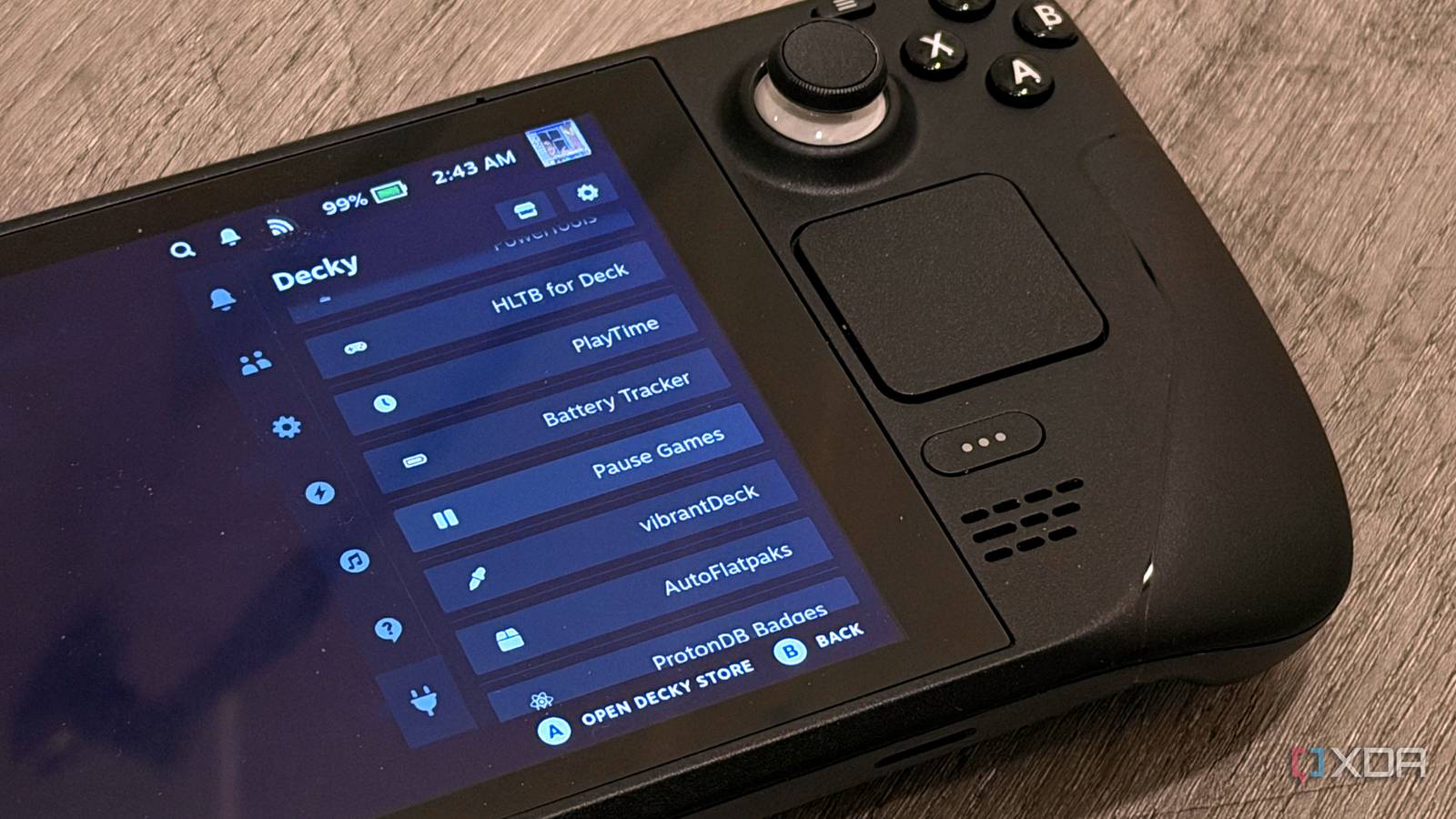
Published Aug 23, 2026, 9:00 AM EDT His love of PCs and their components was born out of trying to squeeze every ounce of performance out of the family computer. Tinkering with his own build at age 10 turned into building PCs for friends and family, fostering a passion that would ultimately take shape as a career path. Besides being the first call for tech support for those close to him, Ty is a computer science student, with his focus being cloud computing and networking. He also competed in semi-pro Counter-Strike for 8 years, making him intimately familiar with everything to do with peripherals. When Valve released the Steam Deck in 2022, they spawned an entire industry. Being able to play PC games on-the-go meant bringing a laptop with you, and the concept of a "gaming handheld" wasn't mainstream until that year, and it wasn't solely due to the silicon becoming performant enough to support that form factor. It was also because of how well Valve executed on the form factor itself. If you take a look at the handheld market in 2026, you're mostly looking at variations of the Steam Deck design: two sticks flanking a widescreen panel, triggers and bumpers on the shoulders, and grip buttons around the back. Valve essentially created the template, but consistently, even today, there's one feature most other handhelds leave out, and it happens to be one of the most valuable assets of the Deck: the dual trackpads. Two trackpads and everything underneath And yes, they're trackpads The size and placement of the pads is what makes them so useful. They're 32.5mm squares sitting directly beneath each thumbstick, close enough that your thumb can slide from the stick to the pad without needing to re-grip the device. On paper, that sounds pretty trivial, but if you've actually held one and used it, it's pretty ergonomic. If you have smaller hands, it can be a little bit more of a stretch. The haptics matter just as much as where they're placed, and they make a huge difference in the usability. Each pad has its own actuator underneath, and it provides that haptic tactile feedback as your thumb moves, which is what makes it feel great to use. Valve considered this important enough to carry it forward into the 2026 Steam Controller, where the pads are even a little bit larger at 34.5mm. One pad would've been a good addition, but it's the inclusion of two that makes them really great. One gives you a cursor, but adding another gives you the ability to add a radial menu, hot bar navigation, or camera controls in your selected game, alongside a mouse. The software is the part that is difficult to replicate Valve has a lock on this element of the trackpads Credit: Ayaneo Kun Hardware is the part that most other companies can (and have, to some extent) try to copy, but what makes them actually useful is Steam Input, the software layer that gives the pads the ability to be a mouse, joysick, directional buttons, or anything else you could feasibly conjure, all configurable per-game and shareable. The proof is in the support for older titles, because chances are someone has already built a working configuration that you can apply in two clicks. There simply isn't an equivalent on Windows handhelds. Input runs through vendor software like Armoury Crate, Legion Space, AYA Space, and so on. These are built to make Windows navigable primarily, not to make an included touch surface into game controls. AYANEO gets the closest to the Deck, but it's still not the same. The KUN's dual pads use HD linear motors for haptics and splits each pad into four pressable regions pre-mapped to functions, which is good, but not quite as complete as Valve's offering. Valve had a clean sheet, and chose to use them again They're clearly popular Perhaps the strongest evidence for the trackpads being one of the Steam Deck's best features is their inclusion on the 2026 Steam Controller, a device that has a clear design lineage from the Deck. Valve wasn't under any obligation to keep them on their new controller, and you could even make a strong argument for cutting them to take that $100 price tag even lower, but Valve simply cannot help themselves. The original Steam Controller was the first sign that Valve really wanted to make touch controls work on a controller, and while it was questionable then, it seems to be catching on now. They're dead space to many users Only useful for a handful of things For many gamers, the trackpads are just wasted space, unfortunately. If your library consists of platformers, action games, or console ports that can't take advantage of them, then you can go a long time without touching them once. There's also the gyro conversation: gyro handles fine aim correction a lot better than a trackpad does, and for navigation, the touchscreen is right there. The pads are a big reason for why the Deck is so wide, and without them, it's possible Valve could've saved on weight and overall footprint. I love the trackpads, personally As someone who does play a fair bit of RTS and point-and-click games, the trackpads on the Steam Deck and Steam Controller are an incredibly welcome addition. Competitors have made attempts to include similar control schemes, but nobody has really been able to match Valve, and the fact that they kept them on their newest input device means they must be used by a good chunk of people. Until someone manages to integrate their own as well as Valve's, I can't see myself preferring another handheld. Steam Deck OLED Dimensions 11.7 x 4.6 x 1.9 inches (298mm x 117mm x 49mm) Weight 1.41 pounds (640 grams)
Every handheld copied the Steam Deck's design except for the one feature that actually matters
Full Article
Original Source
Read the full article at Xda-developers →KhanList aggregates and links to publicly available news content. We do not host full articles from third-party sources. Always verify important information with original sources.