
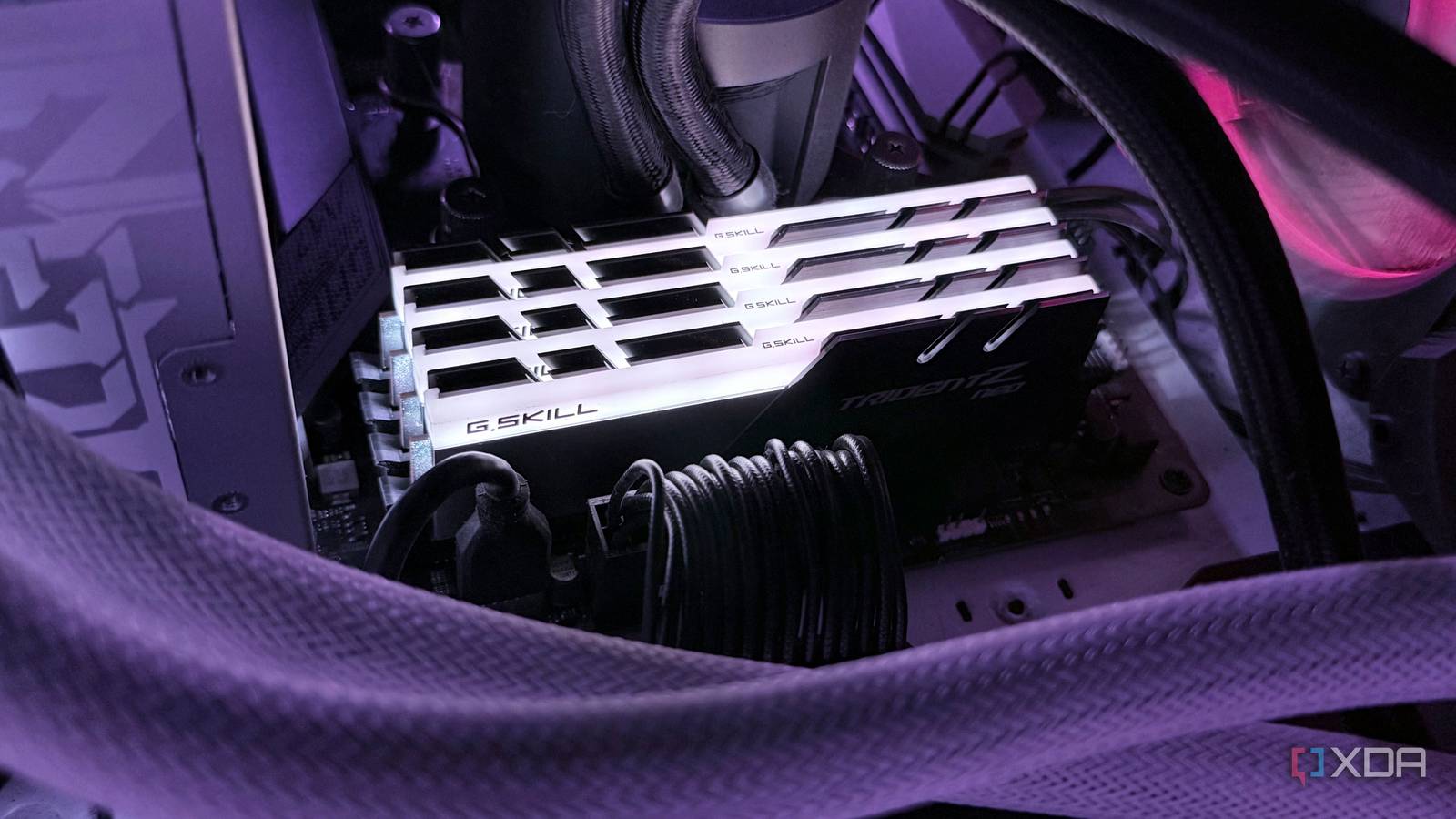
Published Sep 27, 2026, 12:00 PM EDT His love of PCs and their components was born out of trying to squeeze every ounce of performance out of the family computer. Tinkering with his own build at age 10 turned into building PCs for friends and family, fostering a passion that would ultimately take shape as a career path. Besides being the first call for tech support for those close to him, Ty is a computer science student, with his focus being cloud computing and networking. He also competed in semi-pro Counter-Strike for 8 years, making him intimately familiar with everything to do with peripherals. If you're a PC enthusiast and you've heard of ECC memory, it was almost certainly in the context of a server machine or the enterprise hardware world. That is where it's most commonly found, but what if I told you that all DDR5 sticks have ECC capabilities of their own? Every DDR5 stick has "on-die ECC" and it is doing real error correction work in your system right now, but it isn't the ECC that servers and workstations rely on. It protects a narrower part of your data's journey, and it fixes errors without telling your system anything happened. For most PCs, that's fine, and you're probably not missing out on anything meaningful by not having full-fat ECC at home, but it's still worth knowing the difference. On-die ECC exists to keep DDR5 working Without it, it'd be a lot more unstable With every passing generation, DRAM packs more and more capacity into each chip, meaning smaller memory cells are holding smaller electrical charges. As things get smaller, these cells are more likely to lose or flip a bit on their own, and at the densities DDR5 is working with, it's no longer a rare event and is a real manufacturing problem. Instead of just accepting that the output of functional chips will be lower or that DDR5 will have generally lower reliability, the DDR5 standard built error correction directly into every chip. Each memory chip stores a small amount of extra check data alongside the data it actually holds. When that data is read, the chip uses that check data to find and fix any flipped bits before anything leaves the chip. This keeps manufacturing yields up and lets cells keep shrinking without reliability being sacrificed too much. In other words, it's setting the floor for reliability. It only guards your data while it's inside the chip Once it leaves, it's no longer protected On-die ECC in DDR5 memory only protects the data stored on it, and once it leaves the memory, it can no longer correct any errors. The data still has to cross the memory module, pass through the slot, and travel along the motherboard to the memory controller inside your CPU. Anything that goes wrong on that trip is outside on-die ECC's reach. Traditional ECC memory, often called side-band ECC, works quite differently to on-die ECC. An ECC module is physically wider, has extra memory chips and data lines set aside for check data, and is therefore more expensive to manufacture. One of the key differences is that the memory controller in the CPU calculates that check data before sending anything out, and then also verifies it when the data comes back, which protects the entire round trip versus just what happens on the stick itself, as is the case with on-die ECC. Your PC never hears about the errors it fixes DDR5 doesn't report errors the way ECC memory does Error reporting is a key factor in the way true ECC memory functions, and it's something that on-die ECC doesn't do on DDR5. When on-die ECC corrects a bit, the data leaves the chip looking exactly like data that never had a problem—your OS doesn't get a signal, there's no log to check, and while there is a background scrubbing feature that can count corrected errors, it's aimed at server use, and nothing on your typical desktop system will show you that count. Side-band ECC was built around not just correcting the data, but reporting it. When the memory controller corrects an error, it tells the system, and the event shows up in Windows' hardware error log or in Linux's EDAC subsystem. This allows administrators to see and track trends in the error correction, potentially showing them a problematic stick before things get truly damaged. Side-band ECC also flags data as untrustworthy if it can't correct an error, which is crucial in environments where every bit counts. For consumer PCs, on-die ECC is more than enough DDR5 needs it to stay stable, but consumers don't need side-band ECC Side-band ECC is certainly a more complete error-correcting solution than just on-die ECC, but in the vast majority of scenarios, the home user does not need more than what a consumer DIMM of DDR5 can provide them in terms of error correction. Using non-ECC memory in a system that games, does office work, and even home server duties is totally fine, and plenty of systems have run for decades without widespread corruption problems. Even in the ZFS world, where ECC is often touted as a necessity, the co-founder of ZFS Matt Ahrens has said that ZFS doesn't need ECC any more than other filesystems do, and that running any filesystem without side-band ECC carries the same risk. Then there's the practical cost of actually owning and running ECC memory. It costs more, and with today's memory prices, bog-standard DDR5 is expensive enough as it is. You also need a CPU and motherboard that support it, and for consumer platforms, you really have to look for it. Your DDR5 is safe enough for home use If you really value your data and want to be absolutely sure you're protected against corruption, true ECC memory is a necessity. DDR5 has some error correcting, but it's really only there to bring the reliability floor up to a decent baseline because of the density requirements of memory chips. A gaming PC or even a home server running ZFS rarely requires side-band ECC, and in the case of the latter system, you're likely better off investing in more redundancy elsewhere.
Every DDR5 stick has ECC built in, but it's not the ECC that matters
Full Article
Original Source
Read the full article at Xda-developers →KhanList aggregates and links to publicly available news content. We do not host full articles from third-party sources. Always verify important information with original sources.