
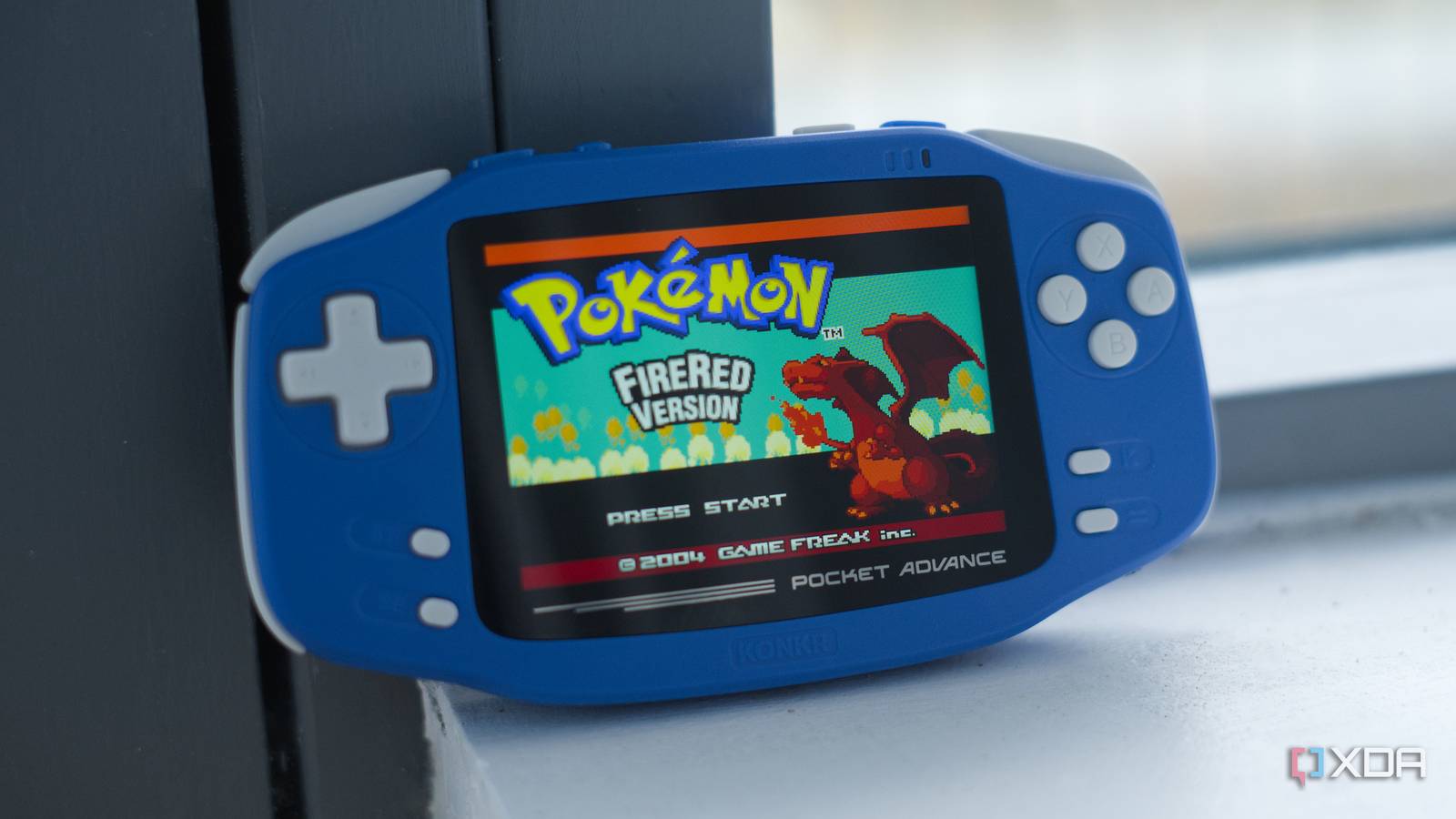
Published Aug 26, 2026, 8:00 PM EDT I’m Adam Conway, an Irish technology fanatic with a BSc in Computer Science and I'm XDA’s Lead Technical Editor. My Bachelor’s thesis was conducted on the viability of benchmarking the non-functional elements of Android apps and smartphones such as performance, and I’ve been working in the tech industry in some way or another since 2017. In my spare time, you’ll probably find me playing Counter-Strike or VALORANT, and you can reach out to me at adam@xda-developers.com, on Twitter as @AdamConwayIE, on Instagram as AdamConwayIE, or u/AdamConwayIE on Reddit. Sign in to your XDA account Ayaneo's new budget line, Konkr, has been spending the summer drip-feeding reveals of the Pocket Advance before it went on sale in early August. It debuted at an early-bird price of $89 for the 3GB model and $109 for 4GB alongside a unique pitch: PS2 emulation in a Game Boy Advance-shaped shell. However, there's a pretty big problem with that: it can't really do PS2 emulation at all. What it does instead, though, is play Game Boy Advance games better than anything else at this price, on a screen that is an exact four-times match for the original hardware, just like the Ayaneo Pocket Micro had. The Konkr Pocket Advance is a horizontal handheld that copies the 2001 Game Boy Advance so closely that, at a glance, they'd be difficult to tell apart. It runs Android 12 on the MediaTek Helio G90T with an Arm Mali-G76 MP4 GPU, which is an SoC from 2019. As for the other hardware, you get a D-pad, four face buttons, two shoulder buttons each side, a 3.5-inch LCD at 960 by 640 in a 3:2 ratio, and a 4,000mAh battery, which lasts an incredibly long time given the modest specifications. Going into this, I had a feeling that the promise of PS2 emulation would fall flat, and so my attention was always going to focus elsewhere. While that turned out to be true, this device is phenomenal for GBA games. Despite the obvious likeness, Ayaneo's marketing team have focused on the PS2 which baffles me, because this is one of the best GBA-focused (and older) retro handhelds out there. About this article: Ayaneo sent us the Konkr Pocket Advance for the purposes of this article. The company had no input into its contents. Konkr Pocket Advance The Konkr Pocket Advance is a great retro gaming handheld that runs Android, capable of practically every console up to the PS2. Its display is a perfect four-times multiplication of the original Game Boy Advance, so your GBA games look fantastic on this lookalike device. PS2 emulation isn't the reason to buy this No analog sticks and an underpowered chip With the Konkr Pocket Advance, Ayaneo has focused on the device's PS2 emulation capabilities, despite being encased in a GBA-style design. It's true in the loosest sense imaginable: the Helio G90T is an old chip, MediaTek's GPU drivers have historically been worse for emulation than Qualcomm's... oh, and there are no analog sticks. For the likes of the NES, SNES, Mega Drive, Game Gear, and Game Boy, you won't have any problems, and PS1 runs at full speed, but PS2? Admittedly, some work alright, but most aren't actually playable given the lack of appropriate inputs to even play them. Some lighter PS2 titles work in ARMSX2, which to be fair, is remarkable for the money. The games people actually want from a PS2 don't cooperate, though. The demanding ones are a no-go even on the highest performance profile, and given that a huge number of titles want at least one analog stick for camera controls or movement, it's just not worth it. A single D-pad and four buttons are the wrong controls for that console no matter the silicon actually inside. I did try to give PS2 emulation a proper test in ARMSX2, but the control issues made themselves apparent immediately, and I realized it just wasn't worth my time. In fact, if Ayaneo hadn't mentioned PS2 at all, I wouldn't have even tested it in the first place. Built for a two-button era Lifted straight from 2001 There are plenty of D-Pad only retro handhelds around the place, and the Konkr Pocket Advance swims in a sea of them at a similar price point. You've got ones from the likes of Anbernic, Miyoo, Trimui, Mangmi, and so much more, and they're all aimed at the exact class of retro gaming that the Pocket Advance covers, too. The D-pad here is soft and quiet, with a padded feel that doesn't need a lot of force, and the ABXY buttons feel quite similar. The entire device is incredibly quiet, which is especially funny given that there is literally an active fan inside to cool the chip. It only ever turned on when I enabled Max performance mode, and at that level, you'll definitely hear it. The shell is chunky in the way the original GBA was chunky, but it's light enough that you can stow it away anywhere and forget about it. It's comfortable to hold for long two-handed sessions, battery life has been quite decent too, and the shoulder buttons are comfortable, with how much the extra pair gets used coming down to the game. The volume wheel on the edge hasn't troubled me, though I can see it being easy to nudge with your palm accidentally. It's a handheld built to feel robust and practical, which is helped by the price. It doesn't feel cheap, it just doesn't feel premium, and that honestly helps with the nostalgia quite a bit. It feels like the original GBA; it's built in a way that it expects to be dropped, or to be tossed into a bag with your keys and forgotten about. Going back to those competitors for a moment, the main competitor for your nostalgia money is the Anbernic RG34XX, at a price of $60. Like the Konkr, it also copies the GBA design, except it runs Linux instead of Android. That results in two things: the first is the Android licensing fee, which comes as a part of the total price, and the second is the additional hardware needed to run Android in the first place. The downside of the Anbernic, though, is that you either use the stock operating system, or hope that someone maintains a custom firmware. On the Pocket Advance, though, you can install whichever emulators and frontends you want, because it's just Android, the same ecosystem that your phone might have. This means you get RetroArch and all of its emulation cores, you get frontends like ES-DE or Daijisho to turn it into a proper library (assuming you don't want to use Ayaneo's front-end), and you get RetroAchievements without taking the custom software route. If you've ever set up emulators on Android, then you know the drill here. AyaSpace even supports integrations with different frontends, so you can make it truly your own with a bit of work. Because there's a touchscreen, getting the library set up on day one is fiddly but doable, and the small screen makes the Android UI itself pretty painful. Ayaneo's launcher helps at least, with a couple of big buttons to start with and then just an app drawer, but you'll still need to have a proper setup session to get everything set up the way you want it. The Android build is... weird I got root access I was able to get root access on this device, but unfortunately, I'm not able to talk about how I achieved it just yet, as I've sent a security disclosure to Ayaneo and am awaiting their response. What I will say, for those who may have one and are worried, is that the vulnerability I found requires physical access to the device. With that said, that level of access lets me check the two things people always ask about a cheap device, and I have good news and bad news. First, telemetry: I checked system-wide (using mitmproxy) what this thing talks to while I used it normally, and nothing seems to leave the device except Google's own services and Ayaneo's apps. That app sends basic usage telemetry for a few specific things, like being opened and closed, and beyond that, it's just normal update checks. I didn't find any mystery endpoints or third-party SDKs sending anything more than basic debugging information. For a brand-new budget line from a company usually associated with much more expensive hardware, that's genuinely reassuring, especially because some companies have, in the past, used advertisements and data as a way to subsidize hardware costs. Second, the build itself: when I signed into Google Play, my signed-in devices list showed me the ARBOR GT78-VN, an industrial Android device from a few years back, the security patch level is November 2022, which is close to four years old. From what I can gather, it reads like the standard ODM story: a cheap MediaTek Android platform like this usually starts as a reference build an ODM maintains for a few customers, and this base wasn't cleaned up before the Konkr branding went on, especially given that there are factory-test applications still sitting in the build that you normally never see. None of this matters much for what the device actually is; there's usually no personal data on a $100 game player that anyone would want, and for a device like this, it's less of a problem than if it were, say, a smartphone. Still, by any 2026 standard the security here is weak, but it's also not a device most hackers would even bother targeting. It's also only sold through Ayaneo's own store, and the developer program now has an actual Developer Edition; a translucent-shell variant with red accents and DEV stickers on the back that you can't buy, because it's handed out only through that program which is, well, odd. Buy it for the GBA, not the PS2 That's what it's really good at If you want a PS2 emulator, this isn't it. Instead, either buy a PC gaming handheld or another, more powerful handheld that comes with two analog sticks. If you want the most faithful, pocketable, inexpensive way to actually play Game Boy Advance games, this is the best thing at this price and it's not particularly close. The screen does the pixel grid correctly, the controls feel tuned for that era, and Android means you can install and test whatever you want. Would I recommend it to someone who's never owned an emulation handheld before? Actually, yes, especially because it's possibly the least intimidating entry point there is. The Ayaneo-specific settings you'd expect to be buried are easily accessible, and emulators can be installed from the Play Store. Even better, the nostalgic handheld-based games that you remember are the ones it plays the best. It still baffles me that the PS2 was mentioned in the context of this device at all, as it's the completely wrong reason to buy one of these. Instead, it's the screen, design, and most titles built for systems older than the PS2. All of it is why Pokémon Fire Red actually looks like Fire Red.
Every cheap retro handheld copies the Game Boy, but this $109 one has a screen from a handheld twice the price
Full Article
Original Source
Read the full article at Xda-developers →KhanList aggregates and links to publicly available news content. We do not host full articles from third-party sources. Always verify important information with original sources.