
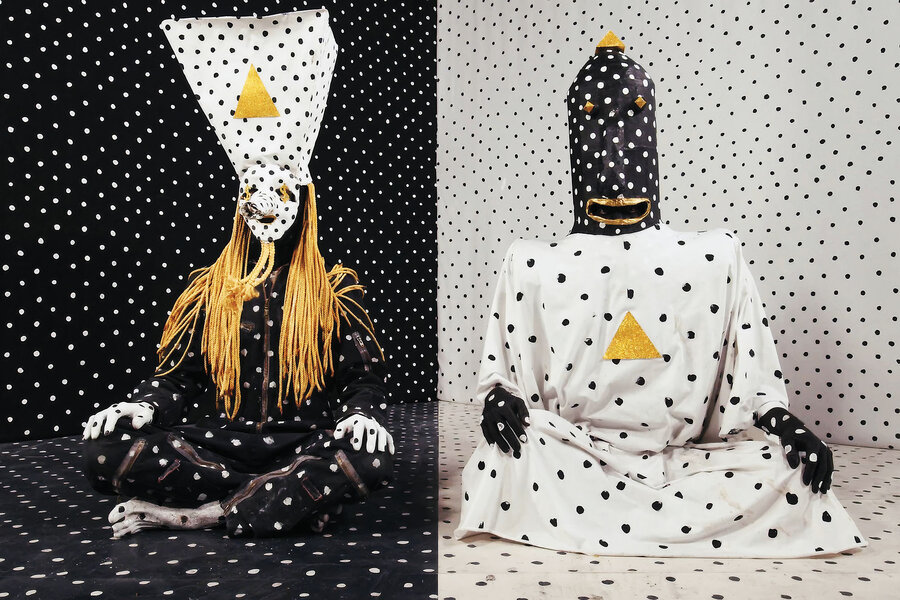
Last December, a rock band from outer space performed live on a Seattle radio station. The extraterrestrial group, a duo, calls itself Angine de Poitrine. The guitarist, Khn, and drummer, Klek, were covered in black-and-white polka dots. Each musician had a proboscis longer than Pinocchio’s nose. Their music is even more otherworldly. Listeners had never heard anything like it. A YouTube video of the duo’s performance on radio station KEXP went viral. To date, it has garnered over 20 million views.In reality, Angine de Poitrine consists of two anonymous musicians from Canada who wear absurdist costumes, speak in a made-up alien language, and claim they came to Earth because they were intrigued by human rock concerts. But the Dadaist gag belies their serious musicianship. The duo’s music is unusual to the human ear because it employs microtones. Those are the notes in between the 12 notes used in traditional Western scales. You’d think that Angine de Poitrine’s instrumental math-rock would be the antithesis of mainstream music. Yet the group has inspired Halloween costumes, been elevated to headline status at rock festivals, and garnered praise from icons such as Dave Grohl, Jack White, and the rock group Rush. Following sold-out shows and venue upgrades for its U.S. dates this November, the band has announced a 2027 world tour. What accounts for Angine de Poitrine’s breakout success? Some see it as a reaction against predictable and generic music in an age when anyone can create songs with artificial intelligence tools.“Angine de Poitrine is a thorn in the side of that machine,” says Stephen Weigel, a music teacher at the Bach to Rock music school in Carmel, Indiana, who has transcribed some of Angine de Poitrine’s performances. “They’re so left field and out there, and not what the industry expects.” Mr. Weigel adds that the listening public could perceive their music as very unlike AI.Even the duo’s instruments are out there. Khn plays a modified double-neck guitar. One of the necks is for six-string guitar; the other is for four-string bass. Each of the necks has additional frets jammed between the usual intervals. With all those extra notes, climbing a scale becomes a dizzying feat. Khn saturates the areas between familiar notes with frantic quarter steps. Arlyn Mcadorey/The Canadian Press/APRock duo Angine de Poitrine performs at The Mod Club in Toronto, July 14, 2026. Microtonality is highly uncommon in the rock, pop, and country songs that generative AI models its music after. Consequently, it’s difficult to use AI to generate new microtonal songs. Even if generative tools could make the kind of music that Angine de Poitrine plays, it would be difficult for anyone to employ musical AI in such imaginative ways. The guitarist and drummer not only utilize tricky rhythms, such as the 12/8 guitar figure in the song “Sarniezz,” but also play out-of-phase rhythms from each other only to reconnect by shifting time signatures until they synchronize. It’s a blend of music and higher math. Khn and Klek up the ante by wearing papier-mâché masks that make it difficult for them to see the instruments they’re playing.People want to watch the exotic pair, not just listen to them. KEXP’s video of Angine de Poitrine has more streams than any of the songs from their two albums, “Vol. I” and “Vol. II,” on Spotify. “There’s something engaging about watching somebody do something that is hard,” says Christopher White, professor of music theory at the University of Massachusetts Amherst.Angine de Poitrine is not the only group bringing microtonal music to macro-sized stages. In 2022, Australian band King Gizzard and the Wizard Lizard dazzled audiences at the Coachella Valley Music and Arts Festival in Indio, California, with microtonal songs. On a smaller scale, David Fiuczynski has been teaching microtonal – or xenharmonic – music for almost 20 years. That doesn’t mean it’s easy to play.“I can count off on one hand the people who not only have mastered it but have gone to make significant music of their own,” says Mr. Fiuczynski, artistic director of the Planet MicroJam Institute at Berklee College of Music in Boston.Musicians often tend to make music based on what they’ve heard before. When artists create something groundbreaking, it’s often in response to a limitation. In the case of Angine de Poitrine, it’s the fact that even supposed aliens only have 10 fingers. Khn is an incredible guitar player, says Mr. Fiuczynski, but the musician can’t play multiple parts at the same time. To compensate, Khn utilizes a pedalboard that looks like something that helped Apollo mission control put a man on the moon. He uses it to record and loop guitar riffs. The guitarist builds up to five separate tracks over the course of one song and weaves them in and out, operating the looper with his (polka-dot covered) toes.“The looper always kind of dictates what is possible and what is not,” Gabriel Gagné Gaudreault, who helped the band record their album “Vol. II,” said in an interview with YouTube channel “Produce Like a Pro.” The duo won’t record a song until it can also find a way to play it live using the five channels of the looper. Deepen your worldviewwith Monitor Highlights.Politics with respectGet political stories with respectful analysis.There‘s a world of new ideas in everyBooks newsletter.There‘s more to life, enrich yours withCulture & Learning weekly.Follow humanity‘s discoveries withScience & Nature stories in your inbox.Gain a spiritual perspectivefrom the stories in your inbox.Want to understand the deeper impact of critical events? Learn the Monitor‘s insight.Already a subscriber? Log in to hide ads. Despite the band’s weirdness, it’s not as if there’s some music police bearing down on it. Yet the members are keeping their masks on. Like groups such as Daft Punk and The Residents before it, Angine de Poitrine enjoys the perks of anonymity in its rebellion against conventionality. Fans of microtonal music are happy to see the once niche technique finally in the spotlight.“There is usually some small portion of wackadoos who are making beautiful, interesting new music,” says Mr. White. “That’s what drives music forward, historically.” ALREADY A SUBSCRIBER? LoginReal news can be honest, hopeful, credible, constructive.The Christian Science Monitor was founded in 1908 to lift the standard of journalism and uplift humanity. We aim to “speak the truth in love.” Our goal is not to tell you what to think, but to give you the essential knowledge and understanding to come to your own intelligent conclusions. Join us in this mission by subscribing.
Even AI couldn’t replicate this year’s breakout band
Full Article
Original Source
Read the full article at Csmonitor →KhanList aggregates and links to publicly available news content. We do not host full articles from third-party sources. Always verify important information with original sources.