
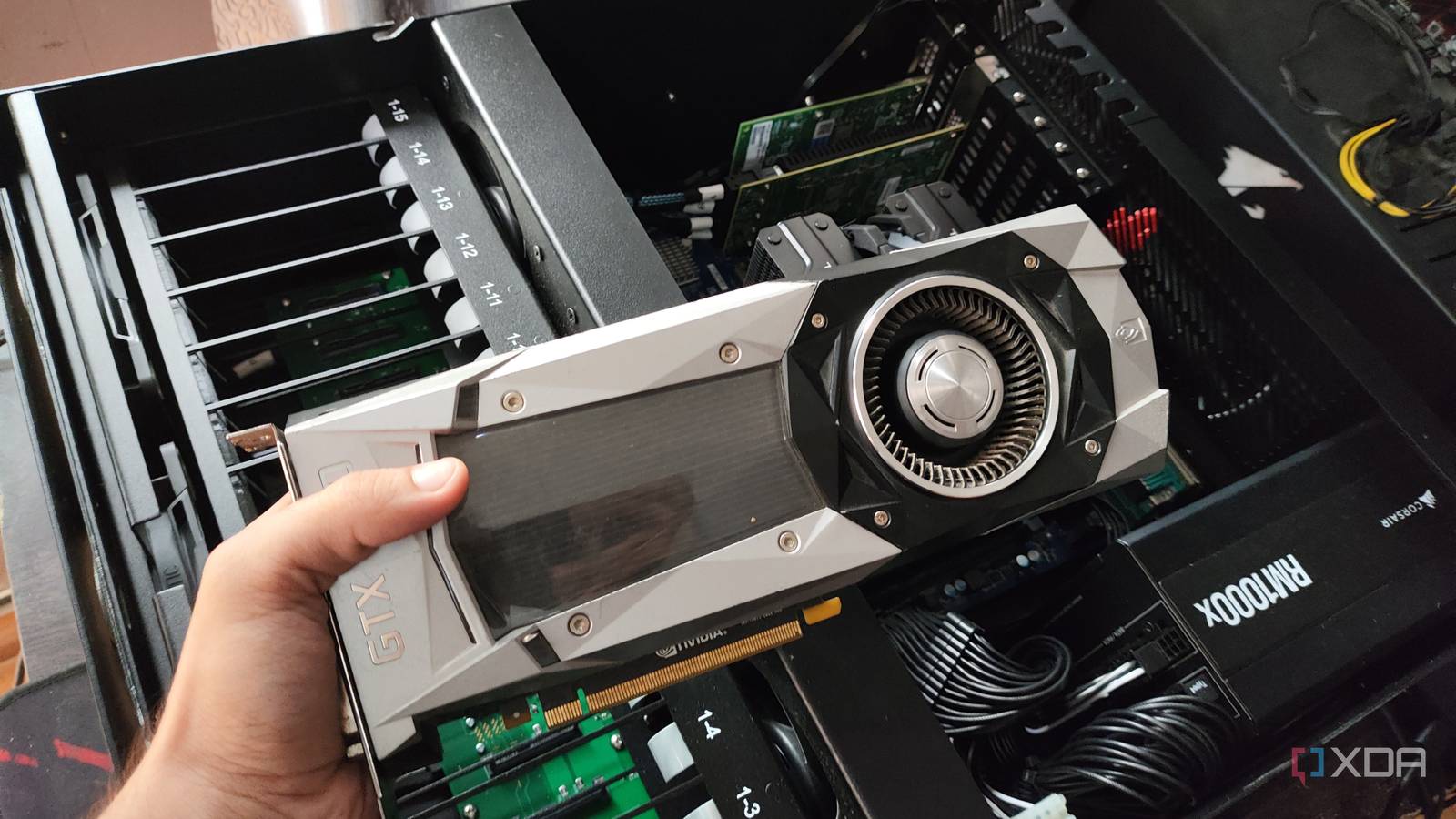
Published Sep 5, 2026, 12:00 PM EDT After a 7-year corporate stint, Tanveer found his love for writing and tech too much to resist. An MBA in Marketing and the owner of a PC building business, he writes on PC hardware, technology, and Windows. When not scouring the web for ideas, he can be found building PCs, watching anime, or playing Smash Karts on his RTX 3080 (sigh). There are very few graphics cards that evoke as much emotion as the iconic GTX 1080 Ti, at least in recent memory. Considering the disappointing gen-on-gen innovation we've seen in the modern GPU market, the GTX 1080 Ti's contrasting history becomes even harder to ignore. It came, it conquered, and it made lifelong loyalists. It's no wonder many gamers still can't part ways with this card. After all, there's no reason to do that if it still delivers the performance they want. And, surprisingly, it does exactly that in many modern games. For gamers who don't care about ray tracing, high-resolution gaming, or triple-digit framerates, the GTX 1080 Ti is still good enough. By most standards, the Pascal flagship is obsolete That's not breaking news Credit: NvidiaCredit: Remedy EntertainmentSource: Nvidia A graphics card becomes objectively obsolete when it fails to stand toe-to-toe with modern equivalents in several key areas. If you look at the GTX 1080 Ti's feature set in 2026, it's hard to argue in its favor. Firstly, there is no hardware ray tracing support here, since real-time ray tracing arrived only on the RTX 20 series cards. Then, there's the lack of DLSS support, so Nvidia's high-quality upscaling and frame generation are absent, too. The Pascal generation also doesn't support mesh shaders, so modern titles like Alan Wake 2 run terribly on the GTX 1080 Ti. Resizable BAR isn't a thing on these cards, since you need at least an RTX 30 series GPU for that. Lastly, Nvidia ended Game Ready driver support for Pascal cards in October 2025, so the GTX 1080 Ti is on its own, performance-wise. With so many pieces of the modern gaming pipeline missing from the Pascal flagship, it's easy to grasp its obsolescence. After all, it's been almost a decade since it launched, so we shouldn't be too harsh on it. That being said, there are real reasons why gamers still refuse to upgrade this monster of a card. But most owners don't see a reason to upgrade yet Don't fix what ain't broke It's a common saying in PC gaming that "your GPU is old only when it stops delivering the performance you want." Fortunately, the GTX 1080 Ti is still pretty capable of 1080p 60+ FPS gaming, at least in most modern titles. Whether it's Cyberpunk 2077, Ghost of Tsushima, Dying Light 2 Stay Human, or Dead Space (2023), breaking the 60 FPS barrier isn't hard for the Pascal flagship, once you adjust the graphics settings. What's amazing is that the GTX 1080 Ti can even deliver playable framerates in some RT titles, such as Metro Exodus, Battlefield V, Control and Watch Dogs: Legion, although it drops to a 30–40 FPS experience in some of them. It's basically an RTX 3060 in terms of rasterized performance, and the Ampere card just happens to be one of the most popular GPUs on the Steam Hardware Survey. So, the GTX 1080 Ti isn't going away anytime soon. Not everyone wants to play ray-traced titles with maxed-out settings every day. People still love their lightweight side-scrollers, strategy titles, old classics, and online multiplayer shooters. The GTX 1080 Ti is still enough for that. It doesn't have DLSS, but FSR upscaling and frame generation are still possible on the Pascal card. Plus, you can use tools like Lossless Scaling and OptiScaler to add these unsupported features to your GTX 1080 Ti. The results vary by the game, but these workarounds have extended the Pascal flagship's life considerably. The 11GB VRAM makes the upgrade even harder Getting enough VRAM today is too much to ask Another aspect of the GTX 1080 Ti that makes it hard to replace is its VRAM capacity. The 11GB framebuffer makes it serviceable even at 1440p in some modern titles. Where many modern GPUs with 8GB of VRAM turn into a stuttering mess at higher resolutions, the GTX 1080 Ti at least has some headroom to keep going. Newer-gen cards don't make it cheap for people who want 12GB of VRAM or more. Gamers looking for a high-end upgrade over the GTX 1080 Ti will have to spend over a grand for an 80-class card. And those are just the MSRPs, which have become meaningless in this economy. Memory costs have made everything significantly more expensive, and GPUs are not immune either. Plus, people need to consider the cost of upgrading everything else around the GPU. A GTX 1080 Ti build is probably quite old by now, so someone upgrading their GPU will also want to switch to a modern platform. This entails buying a new CPU, motherboard, and memory kit, which can quickly ruin all your upgrade plans when you look at DDR5 RAM prices. The GTX 1080 Ti was just too good. It was an anomaly from Nvidia, and the company hasn't been able to offer anything close, at the right price, to make most owners consider a switch. ASUS Prime GeForce RTX 5080 OC $1355 $1500 Save $145 Will Nvidia ever make another GTX 1080 Ti? The Pascal generation followed the already excellent GTX 900 series, but delivered a massive performance uplift, especially with the GTX 1080 Ti. We've seen similar or bigger jumps after that, but the price-to-performance of the GTX 1080 Ti hasn't really been matched since. The company doesn't need to do that, considering there is no high-end competition, and PC gaming has become a footnote on its balance sheets.
Even a decade later, the GTX 1080 Ti isn't an easy card to replace
Full Article
Original Source
Read the full article at Xda-developers →KhanList aggregates and links to publicly available news content. We do not host full articles from third-party sources. Always verify important information with original sources.