
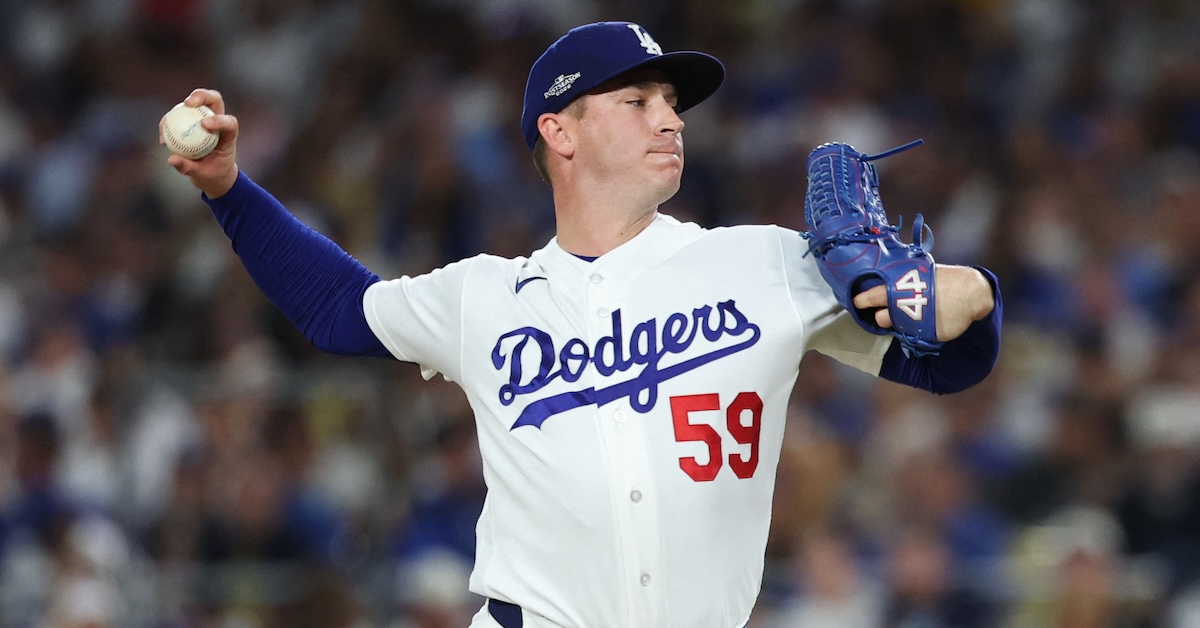
Kiyoshi Mio-Imagn Images November isn’t normally a boom time for major league free agency, and particularly not the first half of the month. But with a lockout all but assured come December 2, teams and players alike will be all business in this usually-sleepy month. And so a mere two weeks after the World Series, we have our first multi-year deal of the winter. As the Atlanta Braves first reported, Evan Phillips has agreed to a three-year, $35 million contract with the team. Phillips hasn’t pitched much in the recent past. Tommy John surgery in June 2025 cost him most of that year and half of 2026. He was shaky at times as he worked his way back into form; he had eight shutdowns and seven meltdowns this year, per our accounting, which is a poor ratio. For comparison, Phillips had 85 shutdowns and 38 meltdowns in his career before 2026. He missed plenty of bats – as he always has – but couldn’t always convert that into clean outings, and he gave up five homers in just 26 innings. Luckily, though, half-season statistical lines for relievers are about as reliable as 30-day weather forecasts: You shouldn’t take them at face value. It’s just not enough information, and plenty of the underlying data was pretty good anyway, even before you get into the fact that Phillips looked better as the year wore on. But you don’t have to parse small-sample trajectories or extrapolate from trend lines to try to figure out how good Phillips will be next year. The biggest signal of what’s to come is the fact that when he returned, Phillips essentially looked the same as the pitcher he’s been since joining the Dodgers, and he’s been phenomenally effective over that span, with a 2.31 ERA (2.88 FIP, 3.18 xFIP, 2.82 SIERA) over the last five years. How did he put up those gaudy numbers? With elite bat-missing stuff. Pitch models drool over Phillips’ four-seamer and sweeper, and he commands both of them well against lefties and righties alike. He mixes in a hard cutter, primarily against lefties, but for the most part, he throws his two best pitches and dares opponents to hit them. That’s exactly what he should be doing with such excellent stuff, and it’s why he consistently puts up a strikeout rate around 30% and a walk rate better than league average. If that sounds like a high-leverage reliever to you, well, yup. That’s the role Phillips held in Los Angeles, and it’s what the Braves no doubt expect from him in Atlanta. He was never the team’s primary closer, but he was always one of the late-inning options, both in the regular season and the playoffs. That’s exactly the fit the Braves are looking for; they already have Robert Suarez as the presumptive top banana and Dylan Lee as a high-leverage lefty, so a one-inning righty as an additional setup man gives them an excellent back of the bullpen. This is how the Braves like to build their pitching staff. Ever since Brian Snitker rode the Night Shift bullpen to a World Series title in 2021, they’ve consistently tried to keep the bullpen stocked with multiple good late-inning options, and they’re willing to go to free agency or the trade market if their internal solutions aren’t cutting it. This winter, a bullpen refresh feels particularly important for them. Raisel Iglesias, a steady presence in Atlanta since he joined the team in a 2022 trade, is a free agent. Lee was ineffective down the stretch, his first rough patch in years, and he got absolutely shelled in the playoffs, which makes relying on him with no backup plan a scary option. Suarez missed half of 2026 with elbow inflammation and his velocity was inconsistent when he returned. All told, the Atlanta bullpen put up middle-of-the-road run prevention numbers, and that was with a star turn from Didier Fuentes as a multi-inning monster. He’ll certainly get a chance to start next year, which puts further stress on an already-thin group. The Braves are paying Phillips handsomely for his services. His deal guarantees him $11 million in each of the next two years and $13 million in 2029 (he’s donating 1% of it to the Braves Foundation, naturally). In the last five offseasons combined, only eight relievers have received larger guarantees. Now, four of those eight came last winter, because the best teams are increasingly prioritizing great bullpen arms, but the point remains that this contract treats Phillips like a star reliever. I’m somewhat surprised by that. Not because I don’t think he’s good; I absolutely do. I thought I’d ranked Phillips aggressively by having him 36th on my Top 50 list, and I put him down for two years and $20 million, roughly triple the crowdsourced estimate of his guarantee (one year, $6.8 million). But Atlanta went well beyond my estimate, even to the point of guaranteeing a third year. That’s a Braves pattern, believe it or not. In the last three winters, they’ve given out three-year deals to Reynaldo López, Joe Jiménez, and Suarez, and they gave longer-than-expected two-year deals to Pierce Johnson and Aaron Bummer as well. Atlanta just seems to lean longer on relief pitcher contracts relative to the market, which is useful to take into account when putting Phillips’ deal into the proper context as it relates to the rest of this winter’s class. Why don’t teams generally give guarantees longer than two years to relievers? The Braves’ own history is instructive. López transitioned to the rotation and was lights out in 2024, so much so that the Braves guaranteed the fourth year on his deal, previously a team option, in a restructuring. Then he missed nearly the entire 2025 season with injury, and posted a 4.54 ERA with similar peripheral numbers as a swingman in 2026. Jiménez was downright outstanding in his first season in Atlanta, but he didn’t pitch a single inning in the final two years of his deal. Suarez might pan out, but he missed half the season in the first year of his three-year deal. Guaranteeing money to relievers far in the future is risky. That naturally invites a follow-up question: Is this a sign that the free agency market will run hotter than expected, or is it just Atlanta marching to the beat of its own drum? I’m leaning towards this being a Braves thing, as well as an early-free-agency-signing thing. Phillips is a Braves kind of reliever. For one thing, he debuted with the Braves after they drafted him. For another, he grew up in the south (North Carolina) and even before signing with the team, he lived in Georgia in the offseason. The Braves definitely prioritize homegrown talent, and Phillips fits that description in multiple ways. Signing early in free agency is an interesting signal, too. Generally speaking, the free agents who sign first sign bigger-than-projected contracts. That’s just logical: If you get a bunch of lowball offers, you’re probably not going to be in a hurry to sign, whereas if the first contract someone offers you is twice what you thought you’d make, you’ll probably put pen to paper. It’s similar from a team perspective. If a team is very interested in signing one guy in particular, they should offer that guy a contract early, and make sure the offer is compelling. Thus, teams that really want particular players – and players particularly wanted by teams – usually reach agreements on the earlier side, and for more money than expected on average. That’s what I see here. The Braves were near-locks to add a veteran late-inning reliever this winter. They went to their comfort zone when looking through a thin free agent slate, bringing in a former Brave who grew up nearby and still lives there in the winter. Is this slightly more money than I expected? Sure. But it’s not a ton in the grand scheme of things; their payroll hovers in the $200 million to $250 million range. And for a team in Atlanta’s competitive situation, having one reliever too few is far more damaging than overpaying a free agent by $10 million or so. In a few weeks’ time, we’ll have plenty more deals that we can use to get a handle on the temperature of free agency in a very weird offseason. But for now, this just feels like business as usual to me. The Braves gave out a Braves-y contract to a Braves-y guy at a position of need. Phillips, who has only thrown 31 2/3 innings in the last two years, guaranteed himself $35 million after previously earning $20 million in a nine-year career. That’s a win-win deal – which explains why they agreed to it so quickly.
Evan Phillips and Atlanta Get Free Agency Moving With Multi-Year Pact
Full Article
Original Source
Read the full article at Blogs →KhanList aggregates and links to publicly available news content. We do not host full articles from third-party sources. Always verify important information with original sources.