
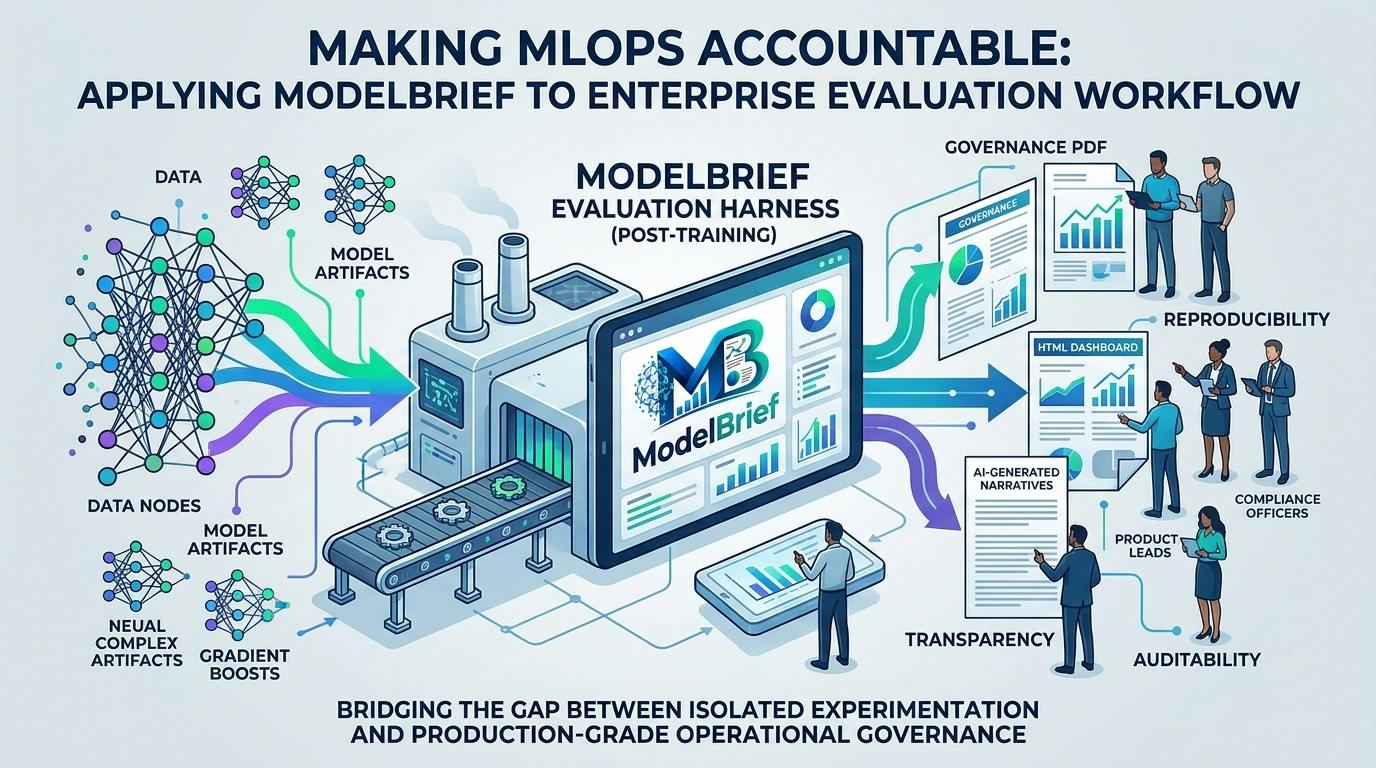
Machine learning initiatives often begin with rapid, engaging momentum. Sitting inside an interactive Jupyter notebook, an engineer can clean raw datasets, execute feature transformations, iterate on model architectures, tune hyperparameter grids, and watch validation metrics systematically improve. Within hours or days, an impressive prototype emerges, sparking immediate enthusiasm across product teams and organisational leadership eager to unlock AI-driven business value. Machine learning models can achieve impressive results during testing, but that does not always mean they are ready to be used in real-world applications. A model that performs well in a notebook may still have problems when deployed. These problems often become more noticeable when teams start working together. Data scientists may use different tools to track experiments, test results may be stored on individual computers, code may be scattered across different repositories, and preparing reports for reviews can take a lot of time. Things become even more difficult when a model starts producing unexpected results after deployment. Finding out what went wrong can be challenging, especially when there is no clear record of how the model was tested or what its performance looked like before deployment. This was one of the reasons I started building ModelBrief, an open-source Python library designed to make model evaluation easier, more consistent, and more transparent. It helps developers assess trained models, understand their performance, and produce clear reports without having to do everything manually. Understanding the Gaps in Machine Learning Operations For machine learning to be trusted and used reliably in organisations, four things are important: reproducibility, integrity, transparency and auditability. Teams need to be able to repeat their results, trust that their models and data have not been altered unexpectedly, understand how their models perform, and keep records that allow others to review and verify their work. Workflow Risk DiagramWhen machine learning evaluation is not handled consistently, it can create several problems for organisations: Too much manual work: Engineers often have to write separate scripts to calculate metrics, check errors and compare results across training, validation, and test datasets. Risk of breaking existing models: Some tools require changes to existing pipelines or retraining models, which can introduce unwanted changes to model behaviour or cause other parts of the system to fail. Difficulty understanding results: Raw numbers, charts and technical outputs can be difficult for non-technical teams, managers, and auditors to understand. Poor record-keeping: Without clear and consistent evaluation reports, it becomes harder to investigate why a model's performance changed, compare results over time or provide evidence during audits and compliance reviews. Challenges of the Traditional Machine Learning Workflow To understand why traditional machine learning workflows struggle in large organisations, it helps to look at the different stages of model development and where problems tend to arise when there are no proper tools for evaluating models. Lifecycle Stage Common Problems Enterprise Business Impact Model Evaluation Data scientists have to write new evaluation scripts for different experiments. Teams waste time repeating work, and different teams may use different ways to measure model performance Compliance & Auditing Performance results are collected manually and added to reports or presentations. This increases the chance of mistakes, slows down approvals and makes it harder to meet regulatory requirements. Production Hand-Off Moving models into production can involve complex dependencies on the tools used to train them. Models may be retrained when they shouldn't be, their saved weights may change, or information from the test data may accidentally influence the results. Knowledge Sharing Important findings about model performance are often buried in notebooks and are difficult for others to access.. Teams become dependent on individual developers to explain the results, making it harder to share knowledge and work together. Rethinking Model Evaluation To address these challenges, I developed ModelBrief around a simple idea: once a machine learning model has been trained, its saved state should remain unchanged during evaluation. ModelBrief focuses on evaluating models after training. It does not train them again, change their weights, or require users to rebuild their existing machine learning workflows. The library works with different types of machine learning models, including Scikit-Learn, XGBoost, LightGBM, CatBoost, PyTorch, and TensorFlow. This means users can evaluate models built with different tools without having to change their existing setup. The main aim is to make it easier to understand how a trained model performs, identify areas that need attention, and produce useful evaluation reports without introducing extra complexity. Modelbrief Flowchart ArchitectureCore Features of ModelBrief 1. No Retraining or Model Changes: It evaluates an already-trained model without training it again or changing its internal settings. This means the model remains in its original state throughout the evaluation process. 2. Works with Different Tools and Dependencies: It is designed to work with different machine learning frameworks and optional packages. If a particular extension or dependency is unavailable, it provides a clear warning instead of unnecessarily stopping the entire workflow. 3. Different Ways to View and Share Results: Users can generate evaluation reports in different formats depending on their needs. These include simple summaries in the terminal, interactive HTML reports for exploring results, and PDF reports that can be shared with teams or used for documentation and review Implementing ModelBrief in Production Workflows Installation & Environment Setup The library installs modularly via standard Python package distribution channels. Specialized framework adapters can be included based on your active stack: # Core framework installation pip install modelbrief # Modular extensions for enterprise stacks pip install "modelbrief[xgboost]" # Gradient Boosting support pip install "modelbrief[pytorch]" # PyTorch integration wrappers pip install "modelbrief[vision]" # Computer Vision analytical suite pip install "modelbrief[ai]" # Optional AI narrative synthesis engine #Step 1: Multi-Split Execution Harness #Integrating ModelBrief into existing training or pipeline scripts requires only a few lines of clean code. By passing the trained model alongside dataset partitions, you generate comprehensive multi-split evaluations instantly: from modelbrief import ModelBrief from sklearn.ensemble import RandomForestClassifier from sklearn.model_selection import train_test_split # 1. Train your estimator using standard workflow patterns model = RandomForestClassifier(n_estimators=100, random_state=42) model.fit(X_train, y_train) # 2. Instantiate the ModelBrief evaluation harness across partitions audit = ModelBrief( model=model, X_train=X_train, y_train=y_train, X_val=X_val, y_val=y_val, X_test=X_test, y_test=y_test, ai=False # False by default and can be ) # 3. Export deterministic evaluation artifacts print(audit.show()) # Terminal summary for rapid debugging audit.html("reports/model_audit.html") # Interactive HTML web dashboard audit.pdf("reports/model_audit.pdf") # Governance PDF for compliance archiving How ModelBrief Works Keeps the Original Model Unchanged: ModelBrief uses the trained model to make predictions without changing its internal settings. This ensures that the model remains the same before and after evaluation. -Compares Results Across Different Datasets: ModelBrief can evaluate a model using training, validation and test datasets. Comparing the results helps users identify problems such as overfitting, where a model performs well during training but struggles with new data. Step 2: Supporting Custom and Specialised Models Not all machine learning models are built in the same way. Some developers use custom neural networks, specialised data loaders, or their own prediction methods. To support these situations, ModelBrief allows developers to create their own adapters using the BaseAdapter class. This provides a way to connect custom models to ModelBrief without changing how the original model is built or how its internal architecture works. import torch from modelbrief import ModelBrief, BaseAdapter class PyTorchInferenceAdapter(BaseAdapter): """Custom adapter wrapping a PyTorch model for standardized evaluation.""" def predict(self, X): self.model.eval() with torch.no_grad(): tensor_input = torch.tensor(X, dtype=torch.float32) logits = self.model(tensor_input) predictions = torch.argmax(logits, dim=1) return predictions.numpy() # Wrap custom model without altering its architecture or parameter states raw_pytorch_model = LoadCustomVisionModel() adapter = PyTorchInferenceAdapter(raw_pytorch_model) # Run standardized audit across test set report = ModelBrief( model=adapter, X_test=test_tensor_data, y_test=test_labels, task="computer_vision" ) Understanding How the Adapter Works Consistent Prediction Format: Different machine learning libraries handle predictions in different ways. ModelBrief provides a common format for these predictions, making it easier to work with models built using different tools. Separates Model Operations from Reporting: ModelBrief keeps the technical work happening inside a model separate from the tasks used to analyse and report its results. This means reporting tools receive information in a consistent format, regardless of how the original model was built. Optional Report Explanations Model evaluation can produce a lot of numerical results, graphs and tables. While these are useful to technical teams, they are not always easy for managers or other non-technical readers to understand. ModelBrief addresses this by offering an optional AI feature through modelbrief[ai]. When users enable it by setting ai=True, the library uses the evaluation results to generate written explanations of model performance, highlight possible problems, and suggest areas that may need attention. This helps users understand what the results mean without having to interpret every table or graph themselves. Important: The AI feature is optional. Users can still carry out model evaluation and generate reports without enabling it. Privacy-First AI Principles Explicit Opt-in Infrastructure: External LLM calls are disabled by default (ai=False). Zero network requests or telemetry transmissions occur without explicit developer activation. Human-in-the-Loop Governance: AI-generated narratives serve as diagnostic baselines to support engineering reviews;final deployment decisions remain with qualified human specialists. Sample AI Diagnostic Output (Random Forest Evaluation) # Diagnostic Summary - Overall Performance:The estimator achieved a 1.00 ROC-AUC score on the test partition, primarily driven by Feature 2 (43.2% weight) and Feature 3 (42.8% weight). - **Overfitting Risk Alert: Perfect evaluation metrics combined with unconstrained default tree depth indicate potential overfitting to training distribution characteristics or latent data leakage. # Recommended Remediation Steps 1. Cross-Validation Check:Run stratified k-fold cross-validation across raw data partitions to verify split integrity and eliminate leakage risks. 2. Hyperparameter Regularization: Restrict `max_depth` parameters and increase `min_samples_leaf` constraints to ensure robust generalization on out-of-distribution production inputs. Modelbrief supports different types of machine learning models and frameworks, most of which are: Scikit-learn: Classification, regression, clustering and other traditional machine learning models. XGBoost: Gradient boosting models for classification and regression. LightGBM: Gradient boosting models designed for efficient training and prediction. CatBoost: Gradient boosting models that work particularly well with categorical data. PyTorch: Deep learning models and custom neural network architectures. TensorFlow: Deep learning models, including custom neural networks. Keras: Neural network models built using the Keras API. Testing with CNN !pip install modelbrief import tensorflow as tf from tensorflow.keras import layers, models from modelbrief import ModelBrief print("TensorFlow version:", tf.__version__) (X_train, y_train), (X_test, y_test) = tf.keras.datasets.cifar10.load_data()# online dataset accessible for everyone print("Dataset downloaded successfully.") print("Training images:", X_train.shape) print("Test images:", X_test.shape) X_train = X_train[:300]# pick any number of images of your choice for training y_train = y_train[:300] X_test = X_test[:60] #pick any number of image for testing y_test = y_test[:60] # Convert labels from shape (n, 1) to (n,) y_train = y_train.flatten() y_test = y_test.flatten() # Scale pixel values X_train = X_train.astype("float32") / 255.0 X_test = X_test.astype("float32") / 255.0 print("Training images:", X_train.shape) print("Test images:", X_test.shape) model.fit( X_train, y_train, epochs=25, batch_size=20, verbose=1 ) print("CNN trained successfully.") report = ModelBrief( model=model, X_test=X_test, y_test=y_test, ai=True ) print(report.show()) report.html("tensorflow_cnn_report2.html") report.pdf("tensorflow_cnn_report2.pdf") print("HTML and PDF reports created successfully.") Screenshot of what a generated modelbrief report looks likeIn the report above, ModelBrief documented a non-retrained Keras Sequential classifier (79,530 parameters) evaluated on 60 CIFAR-10 test images across 10 classes. It recorded 23.33% accuracy (23.78% balanced accuracy), 0.7937 ROC-AUC, 46 misclassifications, a 10x10 confusion matrix showing frequent errors across classes such as 0 and 6, with AI explanations and remediation steps.Insights into Better Machine Learning Practices Having a consistent way to evaluate machine learning models using makes a big difference in how data science and engineering teams work together. By providing a consistent way to evaluate models, generate reports and share results without retraining, ModelBrief helps reduce repetitive work, simplify auditing, avoid unnecessary changes to trained models and make evaluation findings easier for teams to access and understand." Making Information Easier to Share: Automatically generating PDF and HTML reports gives teams a clear record of how their models perform. Product managers, risk teams, and software engineers can all review the results and understand where a model performs well and where it needs improvement. Making Deployment Faster and Easier: Automating reports allows teams to include model checks in their existing CI/CD processes. This helps identify problems such as changes in data, imbalanced datasets or declining model performance before a model goes live. Improving the Way Teams Work: Relying less on manual checks in notebooks makes model evaluation more consistent. Teams can follow the same process, keep records of their results and make it easier to review models as projects grow. Better Decision-Making: Having clear and easy-to-understand reports helps teams make better decisions about their models. Instead of relying only on accuracy scores, they can look at the full results, understand where mistakes are happening and decide what needs to be improved before putting a model into use. Saving Time and Reducing Repeated Work: By bringing different evaluation results together in one place, ModelBrief reduces the need for developers to write the same scripts or prepare reports manually for every project. This gives them more time to focus on building, testing and improving their machine learning solutions. Conclusion Building a successful machine learning model involves more than achieving a high accuracy score. Organisations also need to understand how their models perform, keep track of changes, and make sure they can be properly tested before and after deployment. This is the problem that ModelBrief aims to address. By separating model evaluation from the training process, it provides an open-source tool that helps developers, researchers, and organisations evaluate their trained models and produce clear reports. The goal is to make machine learning evaluation easier, more consistent and accessible to people working with different tools and frameworks.
Evaluating CNN Performance on CIFAR-10 Using ModelBrief
Full Article
Original Source
Read the full article at Hackernoon →KhanList aggregates and links to publicly available news content. We do not host full articles from third-party sources. Always verify important information with original sources.