
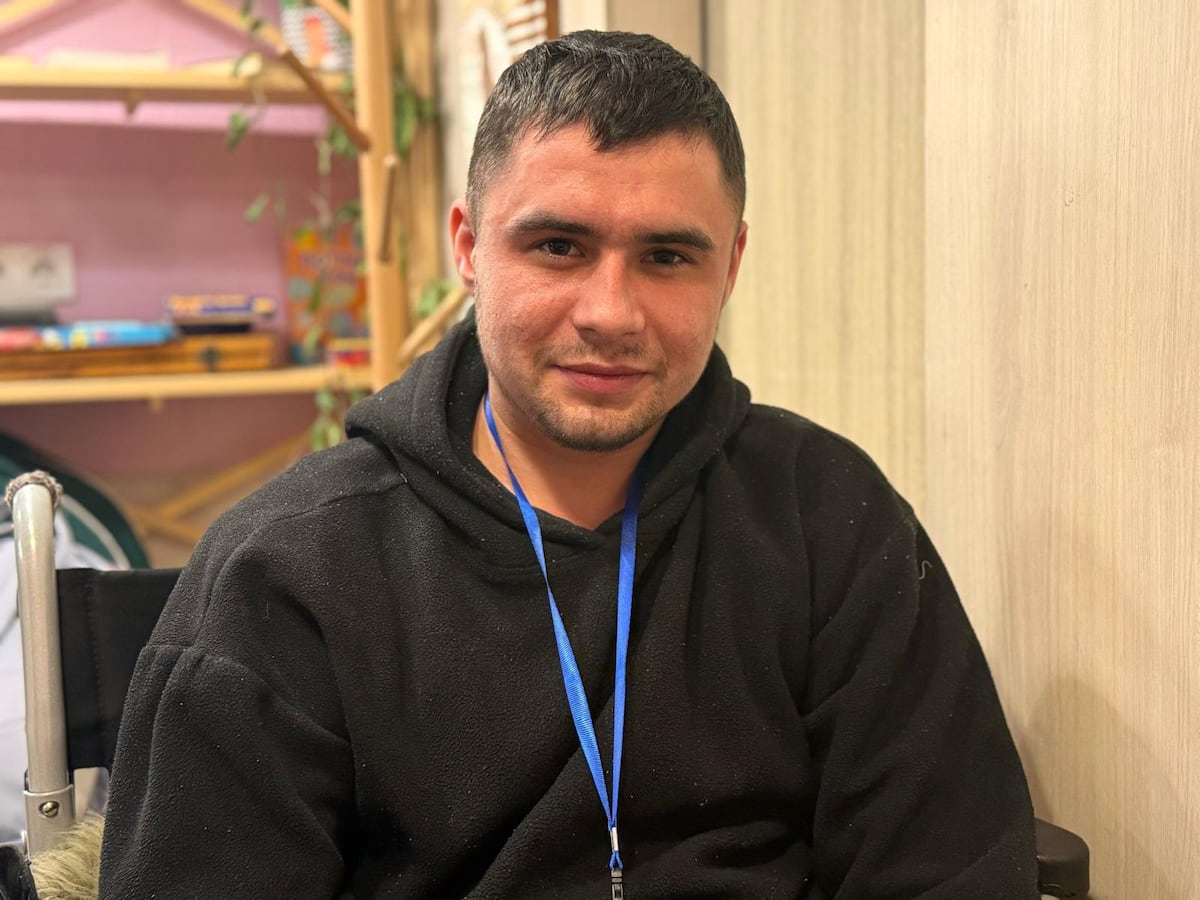
That day, Eugen was digging trenches, just as he had done every day since — after trekking through rivers and across hillsides — he reached the front-line position to which he had been assigned: just three miles from Russia. Shielded by a strip of trees, he dug out dirt with a shovel while remaining on alert in case he sensed the presence of a Russian FPV drone.“What’s that?” the 25-year-old Ukrainian soldier asked over the radio when he heard a suspicious buzzing sound in the distance. He crouched down, rested his right knee on the ground, and tried to stay still while waiting for a reply. Moments earlier, he had cut down a tree, and the yellow acacia leaves had further covered the ground, which was already blanketed with leaves at this time of year. It was October 23.“Go to the shelter,” came the order from the base. He made a move to stand up, put weight on his left foot — and then came the explosion. When he looked down, he realized part of his foot was missing. He had been standing on a landmine for several minutes and hadn’t noticed it because of the dense foliage. In the days that followed, he would endure an ordeal, seriously wounded and unable to move from his position, until an aerial drone managed to extract him in a type of evacuation that was unheard of until recently but is beginning to become more common on the Ukrainian front lines.After the detonation, two comrades approached Eugen and rushed him to the shelter. Inside, another soldier applied a tourniquet, cut off his shoe, and bandaged him; over the radio, nearly 20 miles away, a military medic specializing in combat medicine was giving them instructions. The logistical operation got underway: at the base, they loaded a Vampire drone with painkillers, antibiotics, and a few bottles of water, and sent it to the trench.“On the first day, the medications managed to control the pain, but on the second day I felt terrible, both physically and mentally,” recalls Eugen — who goes by the name Izum in military circles — weeks later, at a café across from one of the military hospitals in Kyiv, where he continues to undergo treatment. He’s had 12 operations so far.He arrived in a wheelchair. A blue tube hangs from his neck, through which he receives an epidural painkiller, and his foot is covered with a thick blue wool sock that protects it from the freezing cold outside. This is the second time he has been wounded since 2023, when, at age 22, he enlisted in the Ukrainian armed forces.“I realized there weren’t many options for getting out of there,” continues Eugen, who has asked that his last name not be disclosed. Walking out was impossible: he would have had to cross about 20 miles of rugged terrain in the open at full speed to avoid being caught by the drones that patrol the so-called “gray zone” or “death zone.” “I couldn’t be evacuated by ground drones either; there was no way they could reach where I was,” he notes.His spirits began to fade. He slept as much as he could — so much so that he didn’t even notice when, on the fourth day, the company commander announced the rescue over the radio. “Wake up — a StarGate [drone] is coming to get you,” his comrade told him. Izum’s first reaction was to think the guy was joking, trying to cheer him up. “But the thing is, I didn’t even have a clue what a StarGate was,” he admits.Now he knows it’s a giant drone capable of carrying 150 kilos (330 pounds), equipped with a suspended rectangular cabin. That’s what he was loaded into.“It took us a year to arrive at the final version of this drone,” explains the spokesperson for SkyFall, the company behind the project, who asked not to be named. He adds that some time ago, the commander of the 475th Independent Assault Regiment — known as Cod.92 — raised the need to create an alternative to rescue soldiers trapped on the front lines. SkyFall has been one of the pioneers in the development of various types of drones in Ukraine, such as the P1-SUN interceptors and the Vampire.Evacuating the wounded from the front lines in Ukraine is becoming increasingly difficult. Medical evacuation teams are constantly targeted by FPV drones; and ground-based drones — an alternative recently put into use — are often attacked or unable to access certain areas.“As evacuations take longer, infections [in the wounded] become more difficult to treat,” explains one of the doctors from the 24th Brigade in Kramatorsk. Many soldiers lose limbs because they cannot be treated in time; many others die.In mid-October, days before the StarGate model was unveiled, footage of another soldier, Kostyantyn Vlasenko, being evacuated by a different type of aerial drone became a sensation in Ukraine. Seeing Vlasenko flying over the front lines — after having been trapped there for 491 days and with both legs amputated, according to the Ukrainian government — seemed like science fiction.Shortly afterward, the first evacuation of a wounded soldier using the StarGate took place; later, Izum’s evacuation followed. And there have been eight more since then. “The most nerve-wracking part is the moment when you realize the person is already inside [the suspended cabin] and you have to begin takeoff,” notes Andrii from his base in the Kharkiv region; he piloted the drone on the first Stargate mission.On that occasion, they had to attempt takeoff three times, but once airborne, everything went smoothly. The evacuation is complex: they must coordinate with other Ukrainian battalions in the area, and at any moment Russian drones could bring down the vehicle, either via FPV or by interfering with its electronic system.“It was the biggest responsibility of my life,” Andrii admits. “I couldn’t sleep for the three days leading up to it — I was so nervous,” he says as he recounts that first mission, during which Artem Lytvy — a 24-year-old soldier who had been wounded and stranded on the front lines for eight days — was evacuated.“My rifle hit a magnetic antitank mine, and the explosion threw me into the air. It tore off one of my feet, and my comrade lost half his leg,” Artem recalls from a hospital in Lviv, where his mother and girlfriend are with him. Days later, while still on the front lines, his friend died in his arms, and his own leg had to be amputated as the infection spread. The Russians kept attacking them, and his comrades could barely help him by giving him a little food and drink. On the seventh day, they told him they would come to get him. “I didn’t know it would be a drone,” says Artem. When the drone arrived at dawn, he didn’t hesitate: he crawled toward it, opened the hatch, and climbed inside. His comrades closed the hatch, and the drone took off.Back at the café in Kyiv, Izum recounts that when he saw the drone had arrived to pick him up, he feared it would get tangled in the tree branches. “It’s your only option — you have to do it,” he told himself before letting his comrades guide him to the drone. “One of them told me as he closed the hatch that everything would be all right. I believed him and relaxed.” The soldier smiles. He has a long recovery process ahead of him, but he’s happy to be alive.Sign up for our weekly newsletter to get more English-language news coverage from EL PAÍS USA Edition
Evacuated from the front lines inside a drone: ‘It was my only option’
Full Article
Original Source
Read the full article at English →KhanList aggregates and links to publicly available news content. We do not host full articles from third-party sources. Always verify important information with original sources.