
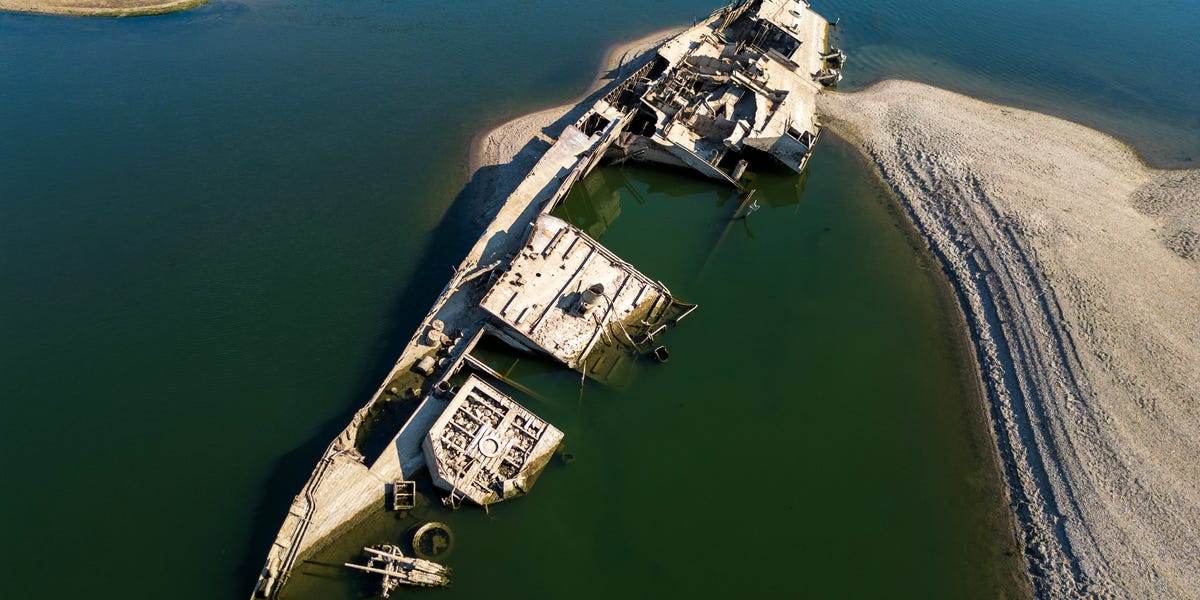
3 min readHere’s what you’ll learn when you read this story:Europe is in the throes of one the hottest summers in recorded history, and the water levels of the continent’s rivers are reaching record lows.While it’s a major problem (for a wide variety of reasons), the lack of water is also allowing archaeologists to find hidden treasures in now-exposed riverbeds, including artifacts from World War II, the Roman era, and even the Pleistocene. The hot weather across Europe is driven in large part by heat domes that are blocking cooler air from the Atlantic Ocean and drawing in hot air from North Africa.For millennia, the major waterways of Europe—the Rhine, the Danube, and the Elbe, among others—served as the arteries of commerce and war. In 2026, during a summer that scorched the European landscape and produced the hottest June-July period in history, those arteries have become weakened, thready, and thin, and low water levels are revealing artifacts from Europe’s recent and distant past.During World War II, Nazi Germany used the Danube as an instrument of war for transporting military supplies across the continent. More than 80 years after the cruel regime’s downfall, its secrets are slowly being revealed along a stretch of the river separating Serbia and Romania. According to Euronews, remnants of Adolf Hitler’s fleet stationed in the Black Sea—which the Nazis scuttled toward the tail end of the war—are reemerging as water levels dip. Historians estimate that around 200 or so ships were deliberately sunk in this way.But this isn’t the first time the past has reappeared along the shores of some of Europe’s most important rivers. In 2022, while experts warned that Europe was experiencing the worst drought in 500 years, Nazi warships could also be seen poking out of the Danube, along with timber building foundations from the Bronze Age in the Oglio River in Lombardy, and the remains of an ancient hamlet along the Po River in Italy.This time around, the rivers snaking throughout the continent have coughed up even older treasures. Archaeologists from the Intercisa Museum in Hungary identified remnants of a limestone altar dedicated to the Roman god Jupiter while examining the newly exposed riverbed near Szalki Island along the Hungarian portion of the Danube. The archaeologists said that the area, which would typically require diving or dredging, was simply walkable due to low water levels. Water levels along the Danube near Budapest, the capital of Hungary, have been as low as nine inches this year, according to the New York Times.But Roman artifacts aren’t even the most ancient finds along these parched riverbanks. On the Danube near the town of Ryahovo in Bulgaria, experts earlier this month identified what they believe to be bone fragments of a woolly mammoth (though most of the skeleton remains buried). Although the very last woolly mammoths died on Wrangel Island (an isolated island in the Arctic Ocean) only 4,000 years ago, scientists say that these eight-ton behemoths died out in Europe more than 10,000 years earlier. So far, experts have identified a jawbone, tusks, a shoulder blade, and ribs, and are now removing the rest with extreme care, as the bones’ long exposure to water makes them more vulnerable to the atmosphere.However, the most ominous reappearance from Europe’s watery depths is a particular stone near Pirna in Saxony. Low water levels along the Elbe have once again revealed what’s known as the Pirna-Oberposta hunger stone. Carved with numerous dates in the rock face, the stone has served as a warning during times of extreme drought, and its eerie reemergence speaks to a climate crisis in progress. Archaeologists have counted some 20 dates carved into the stone, with the oldest going back to 1707.While Europe has been somewhat insulated from the global climate crisis thus far, this summer is a rude awakening. Only time will tell if the specter of history rising from its dying rivers will spur much-needed climate action.Darren lives in Portland, has a cat, and writes/edits about sci-fi and how our world works. You can find his previous stuff at Gizmodo and Paste if you look hard enough.
Europe’s Drought Is Drying up Its Rivers—and Remnants of Lost Worlds Are Emerging
Full Article
Original Source
Read the full article at Popularmechanics →KhanList aggregates and links to publicly available news content. We do not host full articles from third-party sources. Always verify important information with original sources.