
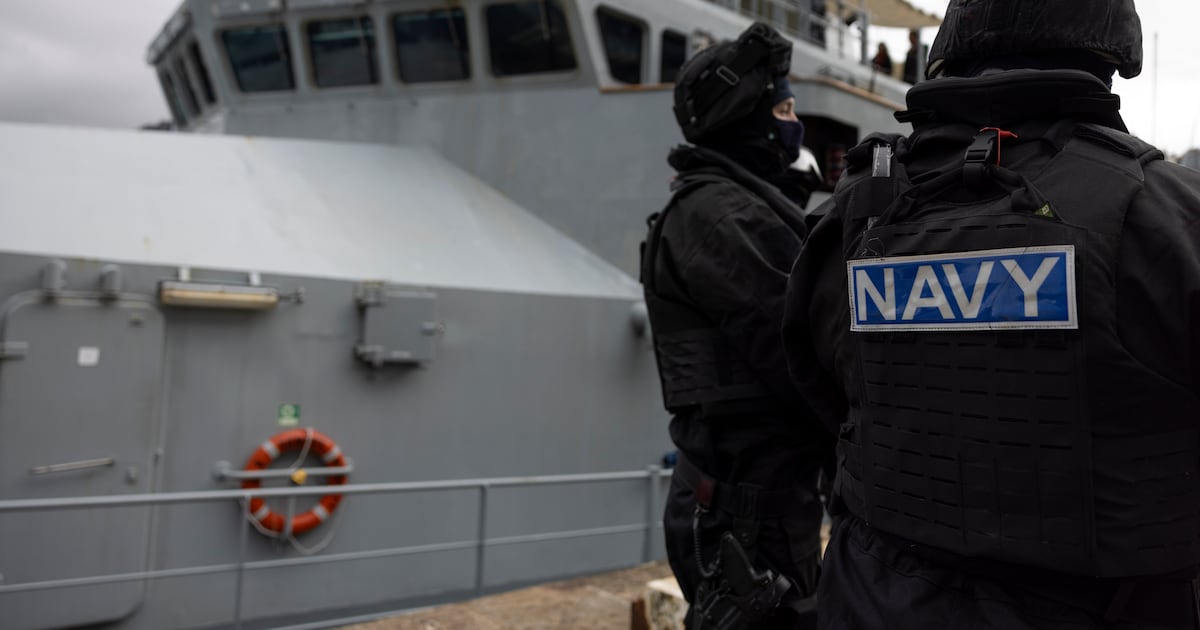
French and British warships providing air defence to Ireland during the EU presidency must remain 22km out to sea on foot of legal advice received by the Government.While the assistance of the French and British navies was formally requested by Ireland to provide security during the six-month presidency, officers were told their ships cannot enter Irish territorial waters while engaged in these operations.The unusual arrangement, which was described by three military and Government sources, is in response to advice from the Attorney General that it would likely be unconstitutional for foreign military forces to deploy within Irish territory while on active operations, even if these operations had been officially requested.In particular, such operations would be in breach of Article 15 of the Constitution which states only the Oireachtas has the right to raise a military force on Irish territory, the Government was advised.READ MOREAnother legal headache emerged when officials asked if a foreign power’s ship sitting outside Ireland’s territorial waters could take lethal action against airborne threats over Irish soil, for example a drone or hijacked airliner.Under Defence Forces rules of engagement, which are known internally as COD 6, only Irish military officers can authorise the use of force in such circumstances.In response, another workaround was developed. An Irish naval officer would be posted on the bridge of the French ships to serve as liaison officer and to give final authorisation, if needed, for the use of deadly force in the form of long-range anti-aircraft missiles.This arrangement has already been put into practice. On July 1st, when Ireland took over the presidency, the French frigate Aquitaine was stationed in Dublin Bay, just outside the 22km limit, where it provided air defence during the visit of dozens of European heads of Government.An Irish naval officer sat on the bridge monitoring the deployment of Irish military aircraft and ships which were also deployed to secure the area. [ Ireland’s EU presidency is a far cry from 1990s - when visitors got a trad CD and bottle of whiskeyOpens in new window ]The next day, the ship was deployed off the south coast during a meeting of the EU commissioners in Cork city.European ships will continue to provide air defence during major events for the rest of Ireland’s term in the EU presidency, including next week during a meeting of EU defence and foreign affairs ministers in Co Wicklow when a Royal Navy air defence frigate will be deployed in the Irish Sea.The presence of the Aquitaine off the Irish coast was something of an open secret. At the time, it was clearly visible to civilian air passengers flying into Dublin. On July 9th the French ambassador to Ireland posted pictures to social media of her and Irish Defence Forces Chief of Staff Lieut Gen Rossa Mulcahy visiting the ship while it was docked in Dublin on a courtesy call.Earlier this month the Irish Naval Service publicised a joint training operation involving the Aquitaine and LÉ Samuel Beckett.However, the Government has refused to confirm the presence of the French ship in a security role. A Department of Defence spokesman referred questions to the Garda. A Garda spokeswoman said it had no knowledge of Operation Fianna, the military security operation mounted for the presidency. The arrangements have led to several logistical and communications challenges for Irish military personnel. Ireland does not use Nato-level radio communications, meaning French forces must to use Irish radios borrowed from the Naval Service.There has also been difficultly in co-ordinating the location of Irish military assets during operations. Irish forces use a system called Sitaware to co-ordinate air and sea assets while the French use more advanced Nato technology called Link 16 and Link 22.Nevertheless, the first test of the arrangement last month passed off without major complications. “There had been a lot of training and things went very smoothly,” said a military source.The only exception, sources said, was an incident on July 1st when three Irish Air Corps PC-9 aircraft left their area of operations and flew over the Irish Sea to get a clearer communications signal.Their presence near the French ship briefly caused some alarm on the bridge before the Irish aircraft were ordered to return to their regular patrol pattern.
European warships providing missile cover during EU presidency must stay 22km off Irish coast
Full Article
Original Source
Read the full article at Irishtimes →KhanList aggregates and links to publicly available news content. We do not host full articles from third-party sources. Always verify important information with original sources.