
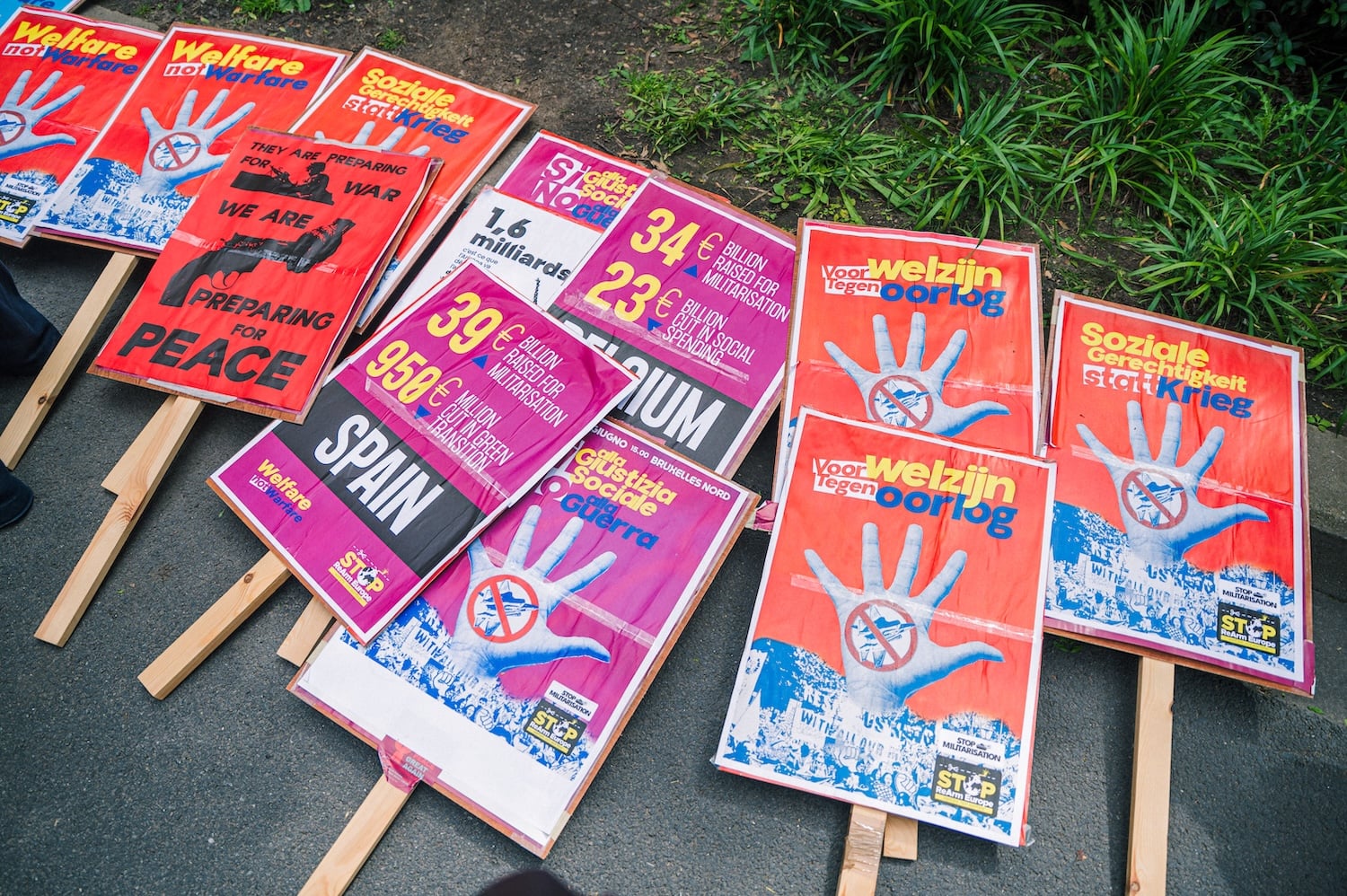
As Russia’s war in Ukraine grinds on, to travel around Europe is often to be confronted with apocalyptic warnings. Europe and Russia are “closer now to all-out war” than at any moment since the Cuban missile crisis, Russian exile Alexander Meniukov told me at a subway station cafe in central Warsaw, Poland. “The Soviet regime was pragmatic. Putin is emotional,” he said. In a hotel room in Tallinn, Estonia, I watched a news report about Romanian troops running urban combat drills on the streets of Bucharest. European governments take seriously the prospect of war with Russia. Across the continent, defense budgets have swelled as countries rush to rearm. In 2026 alone, the European Union’s 27 member states will spend a combined 454 billion euros on their defense capacities—an 8.6 percent increase over last year’s expenditure, which marked a post-Cold War peak. As Russia’s war in Ukraine grinds on, to travel around Europe is often to be confronted with apocalyptic warnings. Europe and Russia are “closer now to all-out war” than at any moment since the Cuban missile crisis, Russian exile Alexander Meniukov told me at a subway station cafe in central Warsaw, Poland. “The Soviet regime was pragmatic. Putin is emotional,” he said. In a hotel room in Tallinn, Estonia, I watched a news report about Romanian troops running urban combat drills on the streets of Bucharest. European governments take seriously the prospect of war with Russia. Across the continent, defense budgets have swelled as countries rush to rearm. In 2026 alone, the European Union’s 27 member states will spend a combined 454 billion euros on their defense capacities—an 8.6 percent increase over last year’s expenditure, which marked a post-Cold War peak. But as this spending intensifies, centrist lawmakers and their allies are overlooking the potential political pitfalls. This is particularly true in countries that have seemingly sacrificed other government programs on the altar of security. Germany is a case in point. In April, Chancellor Friedrich Merz unveiled cuts to the country’s social infrastructure totaling 38.3 billion euros over the next three years. Merz has spoken often about what he sees as the necessity of streamlining Germany’s social safety net. “The welfare state that we have today can no longer be financed with what we produce in the economy,” he told a gathering of his Christian Democratic Union (CDU) colleagues last year. Meanwhile, Merz has overseen a massive increase in German military expenditure, spooked by the cumulative shock of Russia’s revanchist campaign in Ukraine and U.S. President Donald Trump’s return to the White House. By 2030, Germany’s total defense outlays will hit 183.7 billion euros, one-fifth of the federal budget. Merz’s goal, widely shared across the German political spectrum, is to turn the country’s military into the most formidable fighting force in Europe by the late 2030s. The United Kingdom is making similar trade-offs. In June, shortly before he was ousted as prime minister, Keir Starmer published a new “Defence Investment Plan.” If implemented, the plan will increase British government spending on core defense requirements from 2.3 percent of GDP to 2.7 percent by 2029 and then to 3.5 percent by 2035, in line with NATO mandates. This will be supported by 15 billion pounds of additional defense spending in the next four years, 7 billion pounds of which will be funded by cuts to the budgets of other departments. Starmer acknowledged in June that the net effect of these cuts would be scrapping certain infrastructure projects and net-zero initiatives across the U.K. Notably, new Labour Prime Minister Andy Burnham, who otherwise tends to sit to Starmer’s left, has largely accepted the plan’s recommendations. As tensions with Russia rise, these sums are only likely to grow. Senior European Union policymakers cast the continent’s security as a choice between social democracy and outstripping Russia’s massive defense spending. “Member states collectively spent an average 1.9 percent of GDP on defense,” Kaja Kallas, the EU’s high representative for foreign affairs, noted in a speech in Brussels last year. “Russia is spending 9 percent. We spend billions on our schools, healthcare, and welfare, but if we don’t invest more in defense, all of this is at risk.” In the U.K., a cross-party coalition ranging from Conservative leader Kemi Badenoch to former Labour member of Parliament and NATO Secretary-General George Robertson has urged the government to implement harsher fiscal measures to fund the country’s ever-inflating defense brief. “We must cut welfare to fund our defense,” Badenoch said in August. “We must.” It is difficult to avoid the conclusion that such figures have lost sight of political realities. The most obvious is that across Europe, but particularly in Germany and the U.K., the far right is on the rise. According to the latest polls, Alternative for Germany (AfD) sits 10 points ahead of Merz’s CDU at the federal level. Meanwhile, Nigel Farage’s post-Brexit Reform UK party is in second, six points behind the Labour party—despite being hit by a string of financial scandals in recent months. The popularity of European far-right parties has been growing since the 2008 financial crisis; the trend is likely to accelerate with a fresh round of fiscal retrenchment. The evidence that cutting investment in public services bolsters support for far-right and anti-establishment movements seems more than just anecdotal. Thiemo Fetzer’s widely cited 2020 paper found a clear and “causal link between individual-or-regional-level exposure to austerity and support for Leave” in the 2016 Brexit vote, tracing the political impact of the deficit reduction policies between 2010 and 2015. At the time, both Conservative and Labour leaders argued that cuts were necessary, but they entailed massive reductions to local budgets—and an accompanying explosion in poverty rates in the regions where support for Leave was strongest. In Germany, the Agenda 2010 reforms implemented by the Social Democratic Party (SPD) between 2003 and 2005 slashed unemployment payments and significantly raised the number of Germans in low-paid work. Part of Chancellor Gerhard Schröder’s drive to reinvigorate the economy, the reforms ultimately eroded support for the SPD and opened a political vacuum. A decade later, it has been filled by the socialist Left party and the AfD on the radical right. The AfD is the second-largest party in the Bundestag and the most popular party in the five states that make up former East Germany. Support for the SPD is at historic lows. Both AfD co-leader Alice Weidel and Farage have been critical of Western support for Ukraine in the past and urged a more conciliatory approach toward Russia. Weidel flatly opposes further German military assistance to Ukraine and has described Kyiv’s prospective NATO membership as “completely unacceptable.” What Weidel and Farage would do if they held power is anyone’s guess. General elections in both Germany and the U.K. are due in or before 2029. The political folly of the warfare-versus-welfare paradigm is underscored by the fact that European voters at large, exhausted by years of inflation, stagnant wages, and rising energy costs, are not keen on paying for rearmament via further attrition of their living standards. “A large majority of [Europeans] tend to disagree with any option of welfare cutbacks proposed to increase military spending,” a detailed analysis of Europe-wide polling in the Journal of European Policy concluded this year. The ongoing civil unrest in France, which started as a student-led protest against the country’s strained education system and expanded into a wider revolt over inequality and the cost of living, shows how far working-class Europeans are prepared to go to protect what remains of postwar welfare provision. In Spain, where elections loom on Nov. 29, students and trade unionists are leading a street campaign for more affordable housing; Italy, too, has seen mass protests over rising costs. Germany and the U.K. could be next. With uniquely poor timing given the urgency of the risk posed by Russia, Europe looks increasingly distracted and divided. A further irony is that, at least in the short term, remilitarization means European states purchasing more U.S. weapons, deepening their military dependence on an unreliable partner. Under pressure from Trump, who has repeatedly dangled the threat of a U.S. withdrawal from NATO, Europe has significantly increased its volume of arms purchases from the United States. Prior to Russia’s full-scale invasion of Ukraine in 2022, Europe was already reliant on U.S. Patriot missiles for its security. European arms imports from the United States have since roughly doubled. Trump’s hostility toward NATO is built on the crude belief that Europeans have been spending lavishly at the United States’ expense since the end of the Cold War. Trump has dispatched top U.S. officials, including Vice President J.D. Vance and Secretary of State Marco Rubio, to Europe in the last 18 months to hammer home the message that, from Washington’s perspective, the era of this so-called European peace dividend is over. Yet for ordinary Europeans, the end of the Cold War didn’t necessarily generate the perks that Trump imagines. After 1991, most European countries did shrink their defense budgets. But the subsequent fiscal savings mostly weren’t spent on generous unemployment benefits or working-class wages. They were spent either on basic governmental support, such as healthcare and state pensions, or on tax cuts for corporate executives and the ultra-rich. “From the mid-1980s to 2023, corporate income tax rates fell by around half within [OECD countries],” Shahin Vallée and Joseph de Weck of the German Council for Foreign Relations wrote recently. “Social protection for the working age population has fallen across Europe since the end of the cold war.” None of this means that Europe should not be able to defend itself against Russia, if and when a confrontation arrives; rearmament may be necessary. But it would be foolish for Europe to rearm in a way that punishes ordinary people. It is increasingly clear that the political risks of rearmament are being missed as Russian belligerence grows, the specter of U.S. isolationism intensifies, and European nerves fray. Welfare austerity is not the only option. Governments could borrow more to bolster their defenses—or they could impose a defense tax on their richest citizens, circumventing the need to scorch front-line services. The sense of panic in Europe is real and rising, but panic does not make for good policy.
European Rearmament Risks Political Peril
Full Article
Original Source
Read the full article at Foreignpolicy →KhanList aggregates and links to publicly available news content. We do not host full articles from third-party sources. Always verify important information with original sources.