
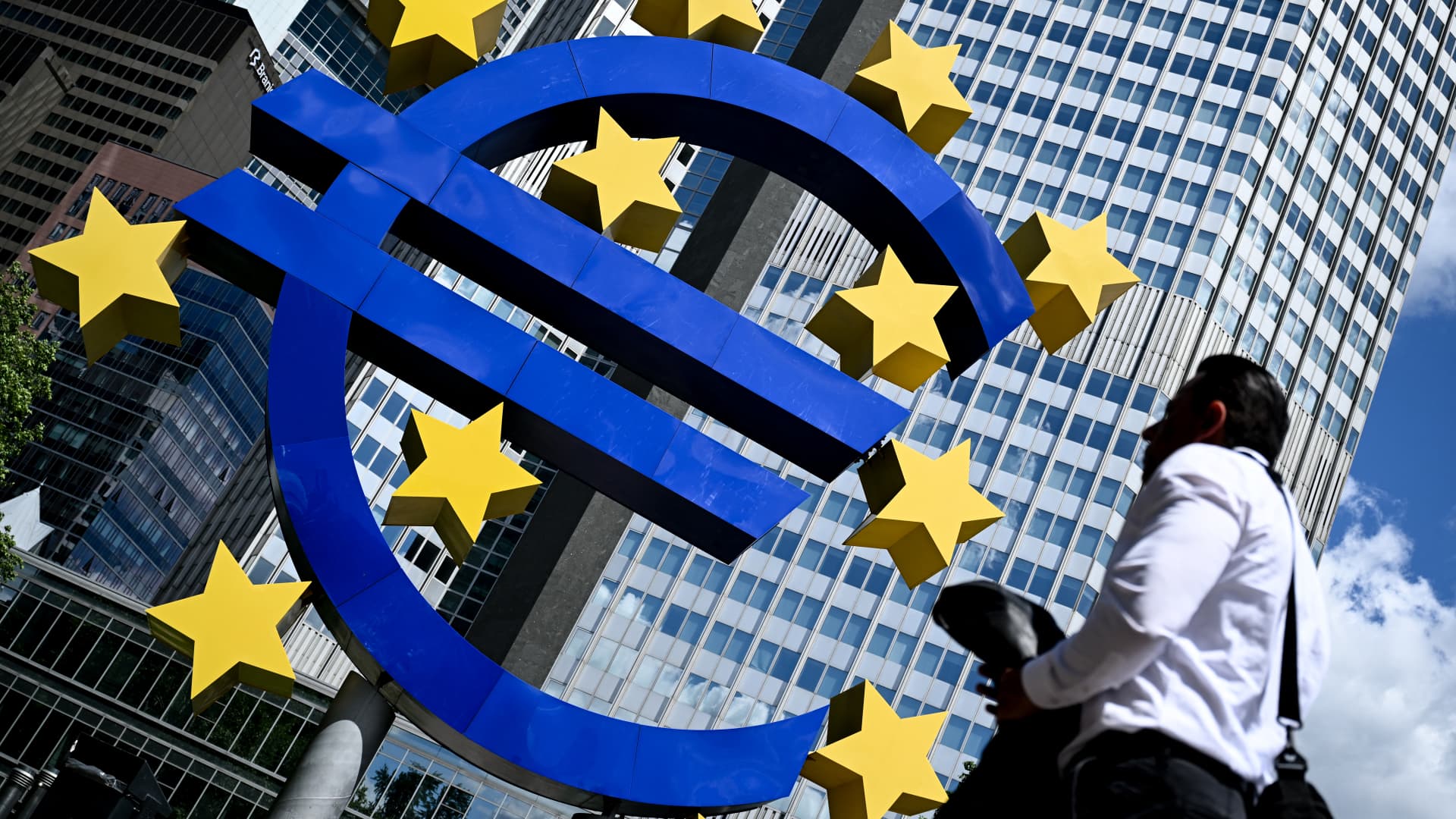
A man walks past the Euro currency sign ('Euro Sculpture' by German artist Ottmar Hoerl) in front of the former European Central Bank (ECB) building in Frankfurt am Main, western Germany, on June 9, 2026. Kirill Kudryavtsev | Afp | Getty ImagesThe European Central Bank voted to hold interest rates steady on Thursday, meeting market expectations, despite euro zone inflation rising to a three-year high. It keeps the central bank's key rate, the deposit facility, at 2.5% following a 25 basis point hike in September. In a statement, the institution's Governing Council said rising energy prices posed upside risks to the inflation outlook and downside risks to growth, but that underlying inflation and wages were so far broadly stable. "At this point in time we are not seeing second round effects in addition to what is already included in the projections" released in September, ECB President Christine Lagarde told CNBC's Annette Weisbach during a press conference. Lagarde identified the main developments since the ECB's last meeting as higher energy costs across oil, petrol, fuel, gas and refining margins, and a sharp rise in long-term financing costs, with the average 10-year sovereign yield up by around 35 basis points."If you combine these two factors — actually, the Governing Council debated whether a hike was appropriate — but on the basis of the uncertainty that accumulates and that rises as well, on the basis of underlying inflation that has broadly remained unchanged, the Governing Council unanimously decided that we were well positioned enough at this stage to hold and that a measured approach at this point in time remained appropriate," Lagarde said. Money markets were pricing in around a 67% probability of a rate hike in December following the announcement, according to LSEG data.Stock Chart IconStock chart iconThe dollar extended gains against the euro in the wake of the ECB decision Headline inflation in the euro area hit 3.8% last month, the highest level since September 2023. Energy price inflation reached 18.8% amid continued turbulence in the Middle East. The resurgence in energy price pressures following the outbreak of the U.S.-Israeli war with Iran in February saw the ECB hike rates in June for the first time since 2023.The euro area economy continued to expand in the third quarter of the year, with a recovery in services since the start of the Middle East conflict, the Governing Council said in an explanation of its decision Thursday.Manufacturing, digital services and exports are being boosted by AI-related investments, while government spending on infrastructure and defense is supporting business activity. However, energy price pressures are likely to hit consumer confidence as higher financing costs weigh on growth.In her press conference, Lagarde said the ECB would continue monitoring rising French borrowing costs and increased fragmentation that has spooked some market watchers. Lagarde noted borrowing costs at the long end of the curve were rising significantly around the world, which she attributed to expectations for inflation and interest rates as well as "debt issuance by some of the hyperscalers," which she said were issuing more long-term bonds and driving up competition. One more hike?"Predicting the path of ECB monetary policy is becoming more challenging," Deutsche Bank's chief European economist, Mark Wall, said in a note on Thursday."One question is whether the two hikes already delivered and the tightening of financial conditions since September are enough to lean against the further increase in energy inflation risk? Probably not."Wall said the other main question was whether the looming departure of Lagarde as ECB president — a decision she announced earlier on Thursday — would impact decision-making next year. "We think the institution is bigger than the person, but there's uncertainty. We expect one more hike to 2.75% in December while Lagarde is still President, and that's probably the end of the hiking cycle."Dean Turner, chief euro zone and U.K. economist at UBS Global Wealth Management, said the Thursday decision "should be viewed as a hawkish pause rather than the end of the tightening cycle." France's fiscal challenge is not expected to change the direction of monetary policy "in the absence of broader financial stress," he said in emailed comments."The ECB's focus remains firmly on ensuring that today's energy-driven inflation does not develop into a more persistent problem."
European Central Bank keeps key interest rate on hold at 2.5%
Full Article
Original Source
Read the full article at Cnbc →KhanList aggregates and links to publicly available news content. We do not host full articles from third-party sources. Always verify important information with original sources.