
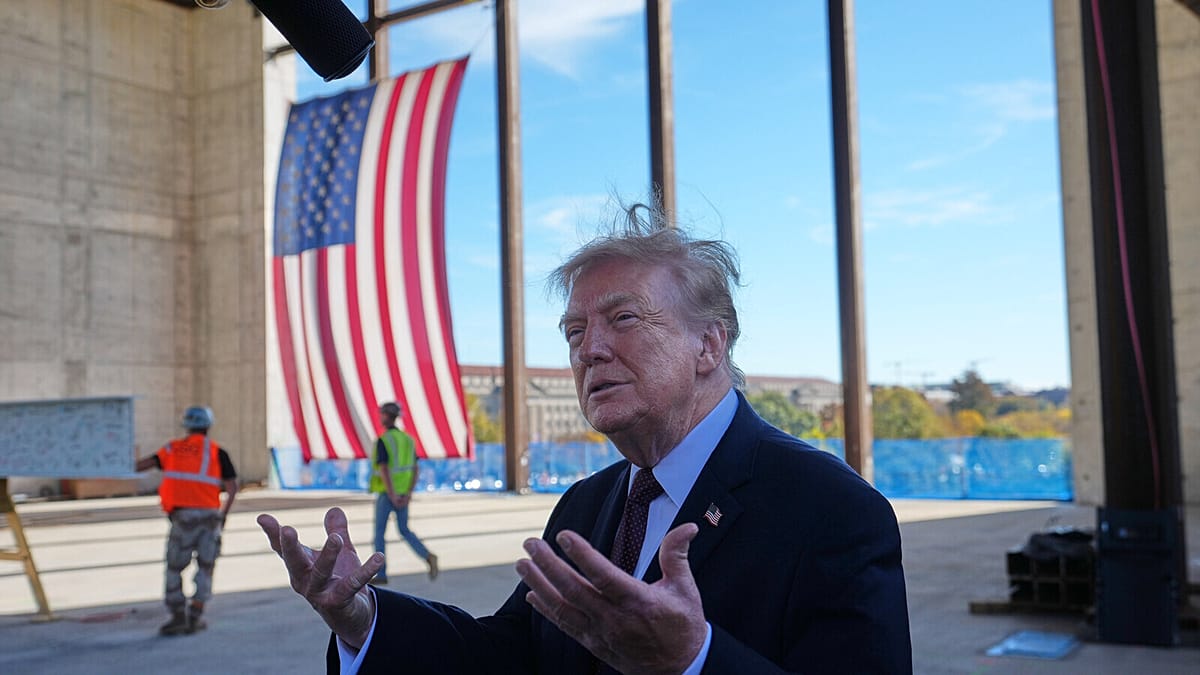
Europe braces for midterms ripple effect: As the dust settles on the Democrats’ sweeping victory in Tuesday’s midterm US elections, Europe is asking whether a weakened Trump means a more dangerous Trump. ADVERTISEMENT ADVERTISEMENT As my colleagues Vincenzo, Sasha, Peggy and Marta write in this must-read analysis, the fear among EU officials is that with his domestic agenda facing stiff resistance in Congress, the US President could now turn increasingly to foreign policy, where he has greater room for manoeuvre, in a bid to reclaim the initiative and secure his legacy. ‘Mad dog’: As one EU diplomat put it, “he (Trump) will be more a ‘mad dog’ than a ‘lame duck’” in the face of a hostile Congress. “The mood is quite realistic: no one expects the current challenges will disappear,” the diplomat added. What it means for Ukraine: But, EU diplomats also recognise that a Democratic Congress could pile pressure on Trump to maintain military support for Ukraine, including supplies of critical air defence systems and ballistic missile interceptors, while taking a tougher line on Moscow. “We hope this change will result in a smoother delivery of military aid to Ukraine,” a diplomat told Euronews. My colleague Shona Murray reports from Helsinki that Finnish officials are also hopeful after the results, saying that the Democrats are generally seen as more open towards Europe, and that the scale of the victory could make it harder for Donald Trump to govern through executive orders, potentially improving the situation for European allies. One official working on foreign policy even suggested the results could trigger a reshuffle within the US administration. They said they hoped this might lead to the departure of US Defence Secretary Pete Hegseth, potentially opening the door to the transfer of Patriot air defence interceptors, Shona reports. Meanwhile, a NATO-led working-level meeting is taking place in Brussels today with representatives from the United States, Germany, France and the UK, as well as NATO officials, including the chief of staff to Secretary General Mark Rutte. Ukraine’s ambassador is also in attendance. The talks are a prelude to next week’s meeting between representatives from Ukraine, Russia and the United States in Abu Dhabi. European officials familiar with the details believe prospects are limited but hope to see some agreement on prisoner exchanges and protecting energy infrastructure. EU candidates receive mixed grades: Meanwhile on Wednesday, the countries vying to become EU members received their annual scorecards from Brussels, with Serbia, Georgia and Turkey under increased scrutiny as the European Commission increasingly prioritises how closely candidate countries follow its foreign and security policy, as Luca Bertuzzi reports. The EU’s foreign policy chief Kaja Kallas also said that EU foreign ministers will hold a “deep dive” in January on new measures against Georgia, aimed at stopping Tbilisi from further democratic backsliding. It came a day after the Georgian Prime Minister failed to set out how he would rekindle strained ties with Brussels in a blistering interview with Euronews’ EU Editor Maria Tadeo. He said, she said: Meanwhile, Berlin and Brussels continue to clash over what “associate membership” means and who should be entitled to get it, Jorge Liboreiro reports after departing Berlin. For German Chancellor Friedrich Merz – who, in all fairness, coined the term first – the status should apply to Ukraine, and help the country feel some of the benefits of EU accession before it can become a fully-fledged EU member. For European Commission President Ursula von der Leyen, “associate membership” should apply to Canada as a sort of premium partnership that falls short of accession. After initial hesitation, Canadian Prime Minister Mark Carney jumped on the bandwagon and set June 2027 as the deadline to finalise the uncharted framework. He’ll fly to Brussels to push it over the finish line. “The Merz vs von der Leyen duel over ‘associate membership’ has enthralled the EU bubble,” Jorge tells me. “Some praise von der Leyen for thinking bold and big, others complain that she has, once again, overstepped and made a promise that it’s not for her to keep. Of course, the fact that both leaders are German and hail from the same party makes the clash even more explosive. At one point, something will have to give. You can’t have a leader of a G7 economy come to Brussels and leave empty-handed.” Dzień dobry! Jorge has by now landed in Warsaw amid a constitutional crisis that has pitted longtime rivals Minister Donald Tusk and President Karol Nawrocki against each other. European Parliament President Roberta Metsola will be in the Polish capital today and will meet separately with Tusk and Nawrocki. The Polish crisis is also set to cast its shadow on a summit of the Visegrad Four presidents in Trenčín, Slovakia, which will be attended for the very first time by European Commission President Ursula von der Leyen, my colleague Sandor Zsiros reports. The gathering will provide an occasion for von der Leyen to exchange views with Nawrocki, after her executive seemed to side with the Tusk government earlier this week, saying the Sejm has the right to choose judges. The presidents will discuss energy, EU enlargement and European security in relation to the war in Ukraine. According to local media reports, Czech President Petr Pavel will argue for European participation in any peace talks aimed at ending the war. MEPs deal another blow to Green Deal with softer car emissions targets The European Green Deal’s legacy keeps fading. EU lawmakers on Wednesday backed a relaxation of the EU’s 2035 car emissions target from 100% to 87.5%, as pressure mounts on Brussels to give the struggling automotive industry more flexibility in its transition to electric vehicles. The deal – spearheaded by the centre-right European People’s Party (EPP) – marks a striking political U-turn from 2023, when the EU agreed to effectively end sales of new petrol and diesel cars by 2035. The EPP’s compromise with the centre-left S&D and the Liberals suggests that concerns about industrial competitiveness are increasingly cutting across traditional political divisions in the Parliament. My colleague Marta Pacheco has the full story. More from our newsrooms Eurozone inflation hits 4%: Which countries saw prices jump the most? Eurozone inflation rose to 4% in October, a three-year high, as energy costs surged. Italy saw the biggest jump, while Germany bucked the trend. Piero Cingari breaks it down. Serbia arrests police over excessive violence against student protesters. Several police officers have been arrested for allegedly using excessive force against students during anti-government protests in Belgrade last year, the Interior Ministry said. Evelyn Ann-Marie Dom has more. WHO backs trials for two new vaccines against Ebola outbreak. The World Health Organization (WHO) has backed clinical trials for two new Ebola vaccine candidates as health workers battle an outbreak in several African countries that has killed more than 5,300 people. Marta Iraola Iribarren has the details. We’re also keeping an eye on European Parliament President Roberta Metsola begins an official visit to Poland European Commission President Ursula von der Leyen joins the Visegrad 4 Presidential Summit in Trenčín, Slovakia European Commission Vice-President Teresa Ribera attends the 30th Ibero-American summit in Madrid European Commission Vice-President Roxana Mînzatu is expected to unveil new Education and Skills package Ukraine’s President Volodymyr Zelenskyy continues his visit to Madrid, and is expected to hold meetings with leaders including UN Secretary-General António Guterres and European Council President António Costa on the margins of the Ibero-American summit. That’s it for today. Shona Murray, Jorge Liboreiro, Sándor Zsiros and Vincenzo Genovese contributed to this newsletter.
Europe weighs implications of Trump’s midterm setback
Full Article
Original Source
Read the full article at Euronews →KhanList aggregates and links to publicly available news content. We do not host full articles from third-party sources. Always verify important information with original sources.